




In the ever-evolving world of technology, it’s essential to stay up-to-date with the latest trends. Hosting your own website is a great way to ensure you’re always ahead of the curve! As we look forward to 2026, there are more opportunities than ever for people to take control of their online presence and host their very own websites. This article serves as a comprehensive resource on How To Host A Website A Beginners Guide. Remember, the key to success is understanding how to host a website A Beginners Guide to ensure a smooth transition into the digital world.
This beginner’s guide, titled How To Host A Website A Beginners Guide, will cover all aspects of hosting a website from start to finish. We’ll go through everything from selecting the right domain name and finding the best web hosting provider, to setting up FTP access and installing WordPress or other content management systems. Along the way, we’ll discuss key considerations such as security protocols, cost effectiveness and scalability so that you can confidently launch your site in no time at all.
This beginner’s guide, titled How To Host A Website A Beginners Guide, will cover all aspects of hosting a website from start to finish. We’ll go through everything from selecting the right domain name and finding the best web hosting provider, to setting up FTP access and installing WordPress or other content management systems. Along the way, we’ll discuss key considerations such as security protocols, cost effectiveness and scalability so that you can confidently launch your site in no time at all. In the context of How To Host A Website A Beginners Guide, understanding these considerations is crucial for success.
By following this comprehensive guide, How To Host A Website A Beginners Guide, you’ll be able to experience an exciting journey into modern web development and create something truly unique – your own website! So let’s get started on our adventure into hosting a website in 2026. As we explore How To Host A Website A Beginners Guide, you’ll find valuable insights that will guide you through each step of the process.
By following this comprehensive guide, How To Host A Website A Beginners Guide, you’ll be able to experience an exciting journey into modern web development and create something truly unique – your own website! So let’s get started on our adventure into hosting a website in 2026!
Domain Name Registration
Now that you’ve decided to create a website, the first step is domain name registration. But before you register your domain name, there are some important considerations for choosing one. Your domain name is the address of your site, so it’s essential to choose one that reflects your brand and goals accurately.
The process of registering a domain name begins with a search. You can use popular sites like GoDaddy or Namecheap to find an available name in seconds. After selecting a few potential domains, double-check if they’re registered using any online tools such as Whois Lookup or Check Domain Availability tool by SiteChecker.io. Once you have confirmed which names are available, you should purchase them quickly – as these domains may be taken soon! The cost of purchasing a domain will depend on its extension; .coms usually cost around $10-$15 per year but other extensions (e.g., .net) may range from free up to hundreds of dollars annually.
Now that you’ve chosen and purchased the perfect domain for your project, the next step is server hosting options – this determines where your site lives on the internet…
Now that you’ve secured your domain, it’s time to find the best server hosting options for your website. This process is integral to understanding How To Host A Website A Beginners Guide effectively. The web hosting solutions available are numerous and can be overwhelming – from traditional dedicated server hosting to cloud hosting providers. To make an informed decision on which type of host would work best for you, consider these factors: budget, audience size, expected traffic levels, and any specialized software requirements.
Most entry-level websites will do well with basic shared hosting plans as they provide enough resources at a reasonable price. For more demanding sites such as those needing large amounts of storage space or bandwidth, a VPS (Virtual Private Server) plan is recommended. This is especially important when considering How To Host A Website A Beginners Guide, as it provides greater flexibility in terms of customization and scalability compared to shared hosts.
Server Hosting Options
Now that you’ve secured your domain, it’s time to find the best server hosting options for your website. The web hosting solutions available are numerous and can be overwhelming – from traditional dedicated server hosting to cloud hosting providers. To make an informed decision on which type of host would work best for you, consider these factors: budget, audience size, expected traffic levels, and any specialized software requirements.
Most entry-level websites will do well with basic shared hosting plans as they provide enough resources at a reasonable price. For more demanding sites such as those needing large amounts of storage space or bandwidth, a VPS (Virtual Private Server) plan is recommended. It provides greater flexibility in terms of customization and scalability compared to shared hosts but still remains cost-effective when choosing one of the many domain hosting services available. Additionally, if you’re expecting heavy traffic or have specific resource needs due to custom applications or plugins, investing in a dedicated server may be necessary. Cloud servers also offer great performance capabilities while providing increased reliability and uptime since they rely on multiple servers instead of just one physical machine like other types of hosting solutions.
No matter what kind of web presence you’re creating, there are plenty of reliable server options out there that fit within most budgets – all it takes is some research into the right provider for your project! With this groundwork done, you’ll now be ready to take advantage of powerful platforms and content management systems (CMS) to build your site…
Platforms And Content Management Systems (Cms)
When it comes to hosting your website, there are a variety of platforms and content management systems (CMS) that can help you get the job done. Platforms such as WordPress, Joomla!, Magento, Drupal, and Squarespace make it easy for users to build their own websites with little technical knowledge required. Website builders like Wix and Weebly provide drag-and-drop interfaces so even complete beginners can put together a stunning site in no time at all. Furthermore, these services come preloaded with various website templates so you don’t have to start from scratch when creating your project.
Another great option is using one of the many ‘all-in-one’ website hosting providers available today. These companies offer not only reliable web servers but also an array of helpful tools tailored specifically for building and managing websites – including integrated CMS software, analytics tracking capabilities, customer support resources, marketing automation solutions, and more. Whether you’re looking for full control over every aspect of your online presence or just need something simple yet powerful enough to get started quickly – there are plenty of options out there in 2021!
In short, investing the time to find the right platform and hosting provider will save you lots of effort down the road while helping ensure your website runs smoothly. With this foundation laid out properly, let’s now move on to consider what design and development tools are best suited for crafting modern sites…
Website Design And Development Tools
When it comes to website design and development, modern tools make the process easier than ever. There are a number of sophisticated solutions available that let you quickly build visually appealing and fully functioning sites with minimal effort. Whether you’re looking for drag-and-drop website building or more complex layout customizations, there is something out there to suit your needs – making it simpler than ever to create an eye-catching project without having to learn any code!
Building a website isn’t just about designing and developing it – it’s also important to consider the security of the site. When following How To Host A Website A Beginners Guide, ensuring your website is adequately secure should be at the top of your list. Thankfully, there are plenty of ways that businesses can protect themselves from potential cyber threats in 2026!
Template selection plays an important role here as well. Many platforms offer prebuilt templates that allow users to get up and running in no time at all – perfect for those who don’t have much experience in web design but still want something stylish and effective. Of course, more experienced designers may be able to take advantage of advanced features like CSS editing and JavaScript integration if they choose – allowing them even greater control over how their site looks and behaves.
No matter what kind of website you’re creating, there’s sure to be a set of tools available that can help bring your vision into reality. With so many options on the market today, choosing the right ones for your particular project should be relatively simple – giving you the power to craft stunning sites with ease in 2021!
Security Considerations
For a detailed exploration, refer to How To Host A Website A Beginners Guide. This will provide you with all the necessary tools and knowledge you need to succeed. SEO strategies are also critical when it comes to following the guidelines established in How To Host A Website A Beginners Guide.
Search engine optimization (SEO) is key for any website looking to maximize its visibility and reach in 2026. With the help of How To Host A Website A Beginners Guide, businesses can improve their rank on search engines like Google – helping them outrank competitors and draw more attention from potential customers. And while SEO efforts may seem daunting at first, the reality of it is much simpler than you might think!
Building a website isn’t just about designing and developing it – it’s also important to consider the security of the site. After all, if you’re asking visitors to trust your business or platform with their personal information, then ensuring your website is adequately secure should be at the top of your list. Thankfully, there are plenty of ways that businesses can protect themselves from potential cyber threats in 2026!
For starters, data encryption is a must-have for any website looking to provide its users with a safe environment. Whether this takes the form of HTTPS connections or SSL certificates, having some level of encryption will help ensure that sensitive information remains confidential when sent over the web. Additionally, firewalls can help guard against malicious attacks while keeping an eye on suspicious activity – giving your website another layer of protection against hackers and other online criminals.
Finally, staying up-to-date on cybersecurity best practices is always advised as well. This includes regularly updating software and plugins used by the site (such as CMS systems), creating strong passwords that change frequently, and backing up data so that nothing gets lost in case of emergency. By taking these steps now, websites owners can confidently manage their own digital safety – allowing them to focus on providing quality services without worrying about becoming victims of cybercrime down the line!
Search Engine Optimization (Seo) Strategies
For a detailed exploration, refer to How To Host A Website A Beginners Guide.
Search engine optimization (SEO) is key for any website looking to maximize its visibility and reach in 2026. With SEO, businesses can improve their rank on search engines like Google – helping them outrank competitors and draw more attention from potential customers. And while SEO efforts may seem daunting at first, the reality of it is much simpler than you might think!
Once a website is up and running with an optimized SEO strategy in place, ongoing maintenance and support are essential to keep it successful. This includes everything from routine backups of the site’s content to monitoring tools that track performance metrics over time – all helping ensure any issues can be quickly identified and resolved before they have a chance to affect its success. Understanding the steps in How To Host A Website A Beginners Guide will help in maintaining your site effectively.
For starters, keyword research should be part of every SEO strategy. Businesses need to identify which terms web users are searching for when they’re trying to find products or services related to theirs. This allows them to create content that will not only match those queries but also better target an audience that already has an interest in what they offer. Additionally, optimizing a website’s metadata (or titles, descriptions, etc.) with appropriate keywords can also help further increase visibility as well.
Content creation is another important component of modern-day SEO plans too. Through crafting blog posts and other pieces that provide value to readers while incorporating relevant keywords within them – websites can establish themselves as authorities in certain industries or niches; resulting in higher rankings on SERPs over time. Also don’t forget about link building either; getting quality backlinks from reputable sources can give your business additional credibility and ultimately lead even more visitors towards your site!
With these strategies taken into account, businesses can quickly climb up the ranks and make sure their websites have maximum online exposure – giving them all the tools necessary to succeed in today’s digital world!
Ongoing Maintenance And Support
Once a website is up and running with an optimized SEO strategy in place, ongoing maintenance and support are essential to keep it successful. This includes everything from routine backups of the site’s content to monitoring tools that track performance metrics over time – all helping ensure any issues can be quickly identified and resolved before they have a chance to affect its success.
Content optimization should also remain part of the equation too; as continual updates help refresh existing pages while keeping them relevant for current searches. Additionally, bug fixing is necessary every now and again too; ensuring no technical errors arise that could lead visitors away from your business. And finally, don’t forget about customer service either! Having dedicated staff readily available to provide assistance when needed helps create better user experiences overall – resulting in more loyal customers who will happily recommend your services to others.
In sum, hosting a website in 2026 requires much more than simply setting up shop online. Constant vigilance is key when it comes to making sure your site remains reliable and useful for visitors; though once you’ve got these strategies down-pat, there’ll be nothing stopping you from achieving digital success!
How To Host A Website: Step-by-Step
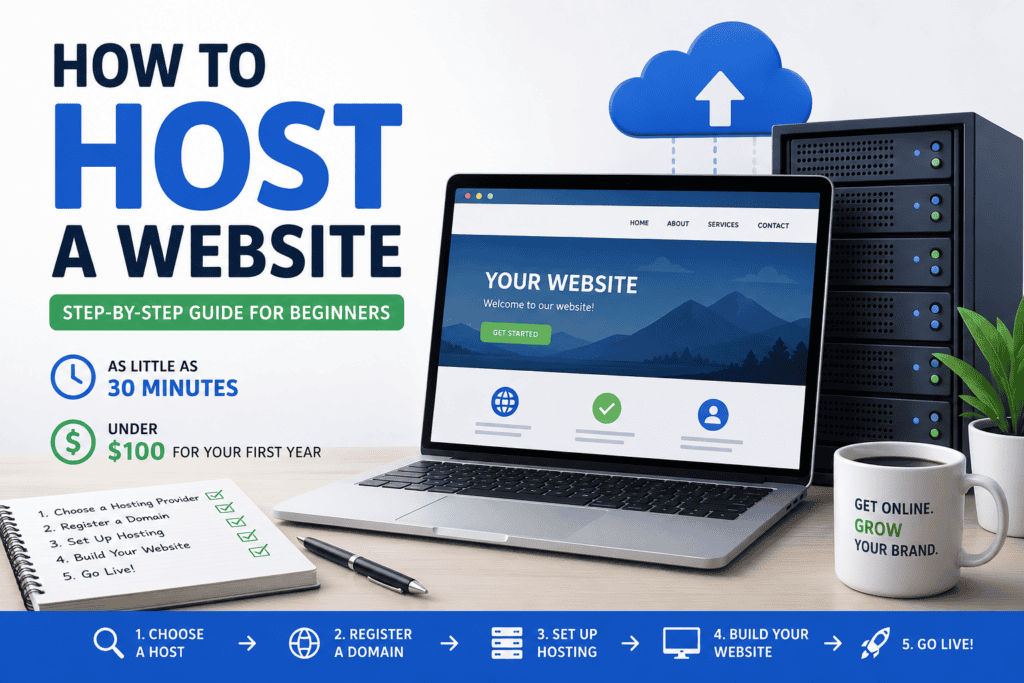
Launching a website can feel like a monumental task, but it’s simpler than you think. In an era where an online presence is non-negotiable for businesses, creators, and professionals, knowing how to host a website is a fundamental skill. This guide demystifies the process, breaking it down into simple, actionable steps.
This guide is for beginners, small business owners, bloggers, and anyone who wants to get their website online without getting lost in technical jargon. By following these steps, you will successfully get a website hosted and live on the internet. The entire process can take as little as 30 minutes and cost under $100 for your first year.
What You’ll Learn
- The different types of web hosting and how to choose the right one.
- How to register a domain name for your website.
- A step-by-step process for connecting your domain and hosting.
- How to upload your website files to make your site live.
- Common mistakes to avoid and expert tips for a smooth launch.
BEFORE YOU START
Before diving in, let’s cover the essential requirements, skills, and tools. Understanding these prerequisites will ensure a smooth and efficient setup process.
| Requirement | Why It Matters |
|---|---|
| A Domain Name Idea | This is your website’s address (e.g., yourbusiness.com). It needs to be unique and memorable. |
| A Hosting Plan | This is the engine that powers your website, storing its files and making them accessible online. |
| Your Website Files | These are the HTML, CSS, JavaScript, and image files that make up your website. (If using a CMS like WordPress, the host often handles this). |
| A Credit Card | Most hosting and domain services require a credit card for purchase. |
STEP-BY-STEP GUIDE
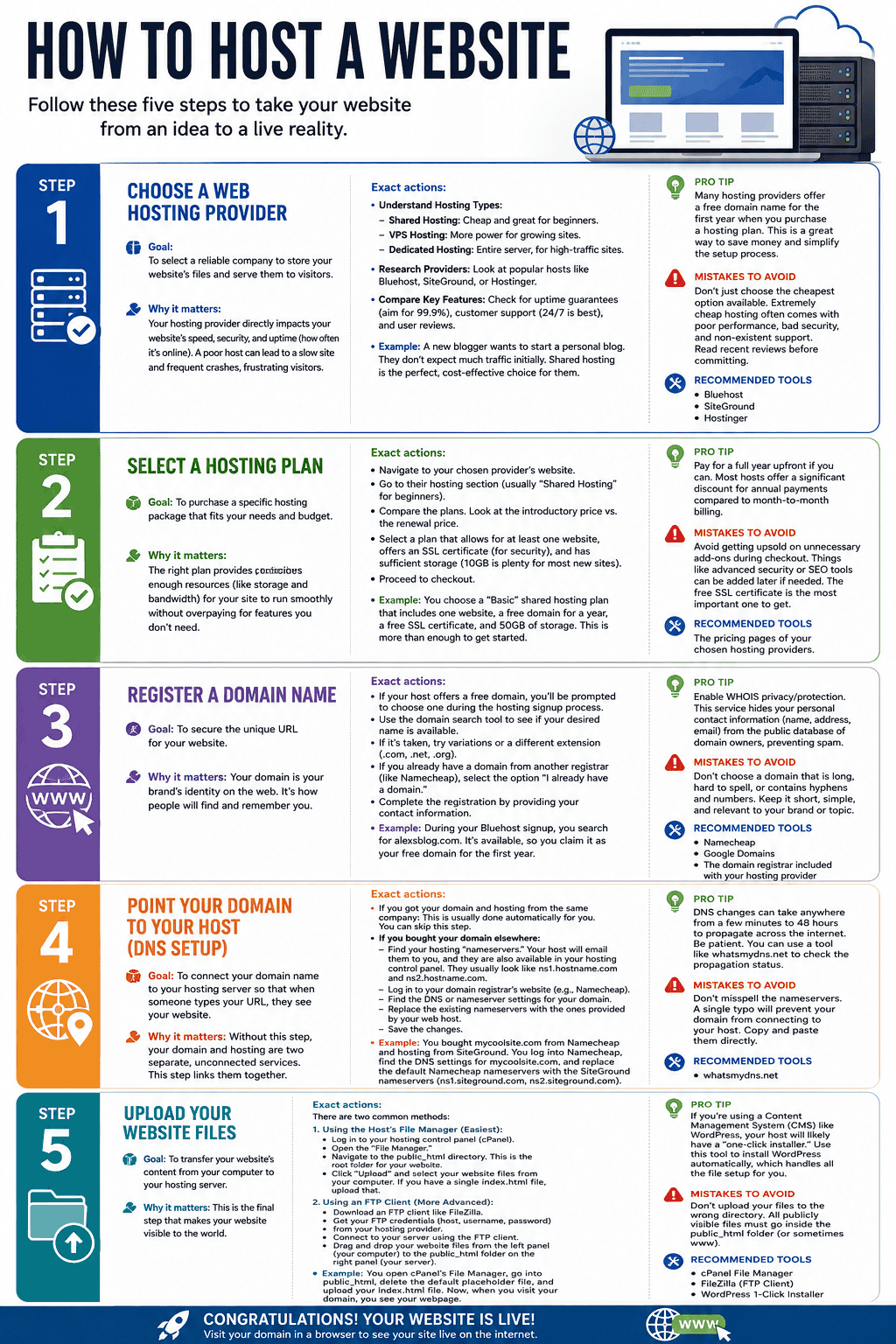
Follow these five steps to take your website from an idea to a live reality.
Step 1: Choose a Web Hosting Provider
Goal: To select a reliable company to store your website’s files and serve them to visitors.
Why it matters: Your hosting provider directly impacts your website’s speed, security, and uptime (how often it’s online). A poor host can lead to a slow site and frequent crashes, frustrating visitors.
Exact actions:
- Understand Hosting Types:
- Shared Hosting: You share server resources with other websites. It’s cheap and great for beginners.
- VPS (Virtual Private Server) Hosting: A step up from shared, offering dedicated resources within a shared environment. Good for growing sites.
- Dedicated Hosting: You get an entire server to yourself. It’s powerful, expensive, and for high-traffic sites.
- Research Providers: Look at popular, reputable hosts like Bluehost, SiteGround, or Hostinger.
- Compare Key Features: Check for uptime guarantees (aim for 99.9%), customer support availability (24/7 is best), and user reviews.
Example: A new blogger wants to start a personal blog. They don’t expect much traffic initially. Shared hosting is the perfect, cost-effective choice for them.
Pro Tip
Many hosting providers offer a free domain name for the first year when you purchase a hosting plan. This is a great way to save money and simplify the setup process.
Mistakes to Avoid
Don’t just choose the cheapest option available. Extremely cheap hosting often comes with poor performance, bad security, and non-existent support. Read recent reviews before committing.
Recommended Tools
- Bluehost
- SiteGround
- Hostinger
Step 2: Select a Hosting Plan
Goal: To purchase a specific hosting package that fits your needs and budget.
Why it matters: The right plan provides enough resources (like storage and bandwidth) for your site to run smoothly without overpaying for features you don’t need.
Exact actions:
- Navigate to your chosen provider’s website.
- Go to their hosting section (usually “Shared Hosting” for beginners).
- Compare the plans. Look at the introductory price vs. the renewal price.
- Select a plan that allows for at least one website, offers an SSL certificate (for security), and has sufficient storage (10GB is plenty for most new sites).
- Proceed to checkout.
Example: You choose a “Basic” shared hosting plan that includes one website, a free domain for a year, a free SSL certificate, and 50GB of storage. This is more than enough to get started.
Pro Tip
Pay for a full year upfront if you can. Most hosts offer a significant discount for annual payments compared to month-to-month billing.
Mistakes to Avoid
Avoid getting upsold on unnecessary add-ons during checkout. Things like advanced security or SEO tools can be added later if needed. The free SSL certificate is the most important one to get.
Recommended Tools
- The pricing pages of your chosen hosting providers.
Step 3: Register a Domain Name
Goal: To secure the unique URL for your website.
Why it matters: Your domain is your brand’s identity on the web. It’s how people will find and remember you.
Exact actions:
- If your host offers a free domain, you’ll be prompted to choose one during the hosting signup process.
- Use the domain search tool to see if your desired name is available.
- If it’s taken, try variations or a different extension (.com, .net, .org).
- If you already have a domain from another registrar (like Namecheap), select the option “I already have a domain.”
- Complete the registration by providing your contact information.
Example: During your Bluehost signup, you search for alexsblog.com. It’s available, so you claim it as your free domain for the first year.
Pro Tip
Enable WHOIS privacy/protection. This service hides your personal contact information (name, address, email) from the public database of domain owners, preventing spam.
Mistakes to Avoid
Don’t choose a domain that is long, hard to spell, or contains hyphens and numbers. Keep it short, simple, and relevant to your brand or topic.
Recommended Tools
- Namecheap
- Google Domains
- The domain registrar included with your hosting provider.
Step 4: Point Your Domain to Your Host (DNS Setup)
Goal: To connect your domain name to your hosting server so that when someone types your URL, they see your website.
Why it matters: Without this step, your domain and hosting are two separate, unconnected services. This step links them together.
Exact actions:
- If you got your domain and hosting from the same company: This is usually done automatically for you. You can skip this step.
- If you bought your domain elsewhere:
- Find your hosting “nameservers.” Your host will email them to you, and they are also available in your hosting control panel. They usually look like
ns1.hostname.comandns2.hostname.com. - Log in to your domain registrar’s website (e.g., Namecheap).
- Find the DNS or nameserver settings for your domain.
- Replace the existing nameservers with the ones provided by your web host.
- Save the changes.
- Find your hosting “nameservers.” Your host will email them to you, and they are also available in your hosting control panel. They usually look like
Example: You bought mycoolsite.com from Namecheap and hosting from SiteGround. You log into Namecheap, find the DNS settings for mycoolsite.com, and replace the default Namecheap nameservers with the SiteGround nameservers (ns1.siteground.com, ns2.siteground.com).
Pro Tip
DNS changes can take anywhere from a few minutes to 48 hours to propagate across the internet. Be patient. You can use a tool like whatsmydns.net to check the propagation status.
Mistakes to Avoid
Don’t misspell the nameservers. A single typo will prevent your domain from connecting to your host. Copy and paste them directly.
Recommended Tools
- whatsmydns.net
Step 5: Upload Your Website Files
Goal: To transfer your website’s content from your computer to your hosting server.
Why it matters: This is the final step that makes your website visible to the world.
Exact actions:
There are two common methods:
- Using the Host’s File Manager (Easiest):
- Log in to your hosting control panel (cPanel).
- Open the “File Manager.”
- Navigate to the
public_htmldirectory. This is the root folder for your website. - Click “Upload” and select your website files from your computer. If you have a single
index.htmlfile, upload that.
- Using an FTP Client (More Advanced):
- Download an FTP client like FileZilla.
- Get your FTP credentials (host, username, password) from your hosting provider.
- Connect to your server using the FTP client.
- Drag and drop your website files from the left panel (your computer) to the
public_htmlfolder on the right panel (your server).
Example: You open cPanel’s File Manager, go into public_html, delete the default placeholder file, and upload your index.html file. Now, when you visit your domain, you see your webpage.
Pro Tip
If you’re using a Content Management System (CMS) like WordPress, your host will likely have a “one-click installer.” Use this tool to install WordPress automatically, which handles all the file setup for you.
Mistakes to Avoid
Don’t upload your files to the wrong directory. All publicly visible files must go inside the public_html folder (or sometimes www).
Recommended Tools
- cPanel File Manager
- FileZilla (FTP Client)
- WordPress 1-Click Installer
VISUAL ROADMAP
Here’s a quick overview of the timeline for hosting your website.
| Phase | Goal | Time Required |
|---|---|---|
| 1. Research & Purchase | Choose and buy a hosting plan and domain name. | 15 Minutes |
| 2. DNS Configuration | Point your domain to your host’s nameservers. | 5 Minutes (plus waiting time) |
| 3. Website Upload | Install WordPress or upload your site files. | 10 Minutes |
| Total | Go Live | ~30 Minutes |
TOOLS & RESOURCES
Here are some essential tools for hosting and managing your website.
| Tool | Purpose | Best For | Cost |
|---|---|---|---|
| Bluehost | Web Hosting & Domain | Beginners who want an all-in-one solution with WordPress. | ~$3/month (intro) |
| Namecheap | Domain Registration | Buying and managing domains separately from hosting. | ~$10/year |
| FileZilla | FTP Client | Transferring large numbers of files to your server. | Free |
| WordPress | Content Management | Building any type of website without coding. | Free (open-source) |
Mistakes Most Beginners Make
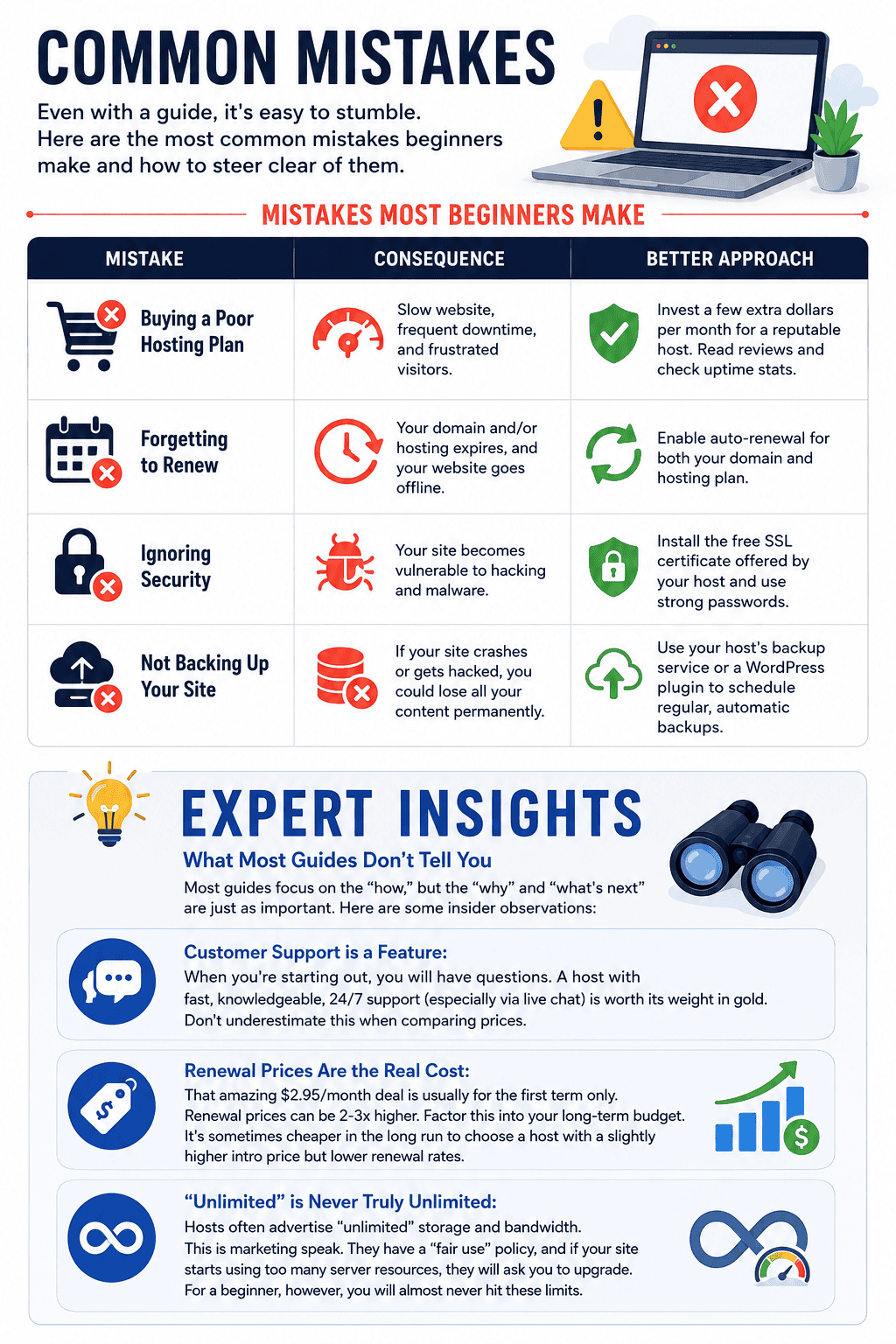
Even with a guide, it’s easy to stumble. Here are the most common mistakes beginners make and how to steer clear of them.
| Mistake | Consequence | Better Approach |
|---|---|---|
| Buying a Poor Hosting Plan | Slow website, frequent downtime, and frustrated visitors. | Invest a few extra dollars per month for a reputable host. Read reviews and check uptime stats. |
| Forgetting to Renew | Your domain and/or hosting expires, and your website goes offline. | Enable auto-renewal for both your domain and hosting plan. |
| Ignoring Security | Your site becomes vulnerable to hacking and malware. | Install the free SSL certificate offered by your host and use strong passwords. |
| Not Backing Up Your Site | If your site crashes or gets hacked, you could lose all your content permanently. | Use your host’s backup service or a WordPress plugin to schedule regular, automatic backups. |
EXPERT INSIGHTS
What Most Guides Don’t Tell You
Most guides focus on the “how,” but the “why” and “what’s next” are just as important. Here are some insider observations:
- Customer Support is a Feature: When you’re starting out, you will have questions. A host with fast, knowledgeable, 24/7 support (especially via live chat) is worth its weight in gold. Don’t underestimate this when comparing prices.
- Renewal Prices Are the Real Cost: That amazing $2.95/month deal is usually for the first term only. Renewal prices can be 2-3x higher. Factor this into your long-term budget. It’s sometimes cheaper in the long run to choose a host with a slightly higher intro price but lower renewal rates.
- “Unlimited” is Never Truly Unlimited: Hosts often advertise “unlimited” storage and bandwidth. This is marketing speak. They have a “fair use” policy, and if your site starts using too many server resources, they will ask you to upgrade. For a beginner, however, you will almost never hit these limits.
CASE STUDY
Real Example: Launching a Portfolio Website
- Starting Point: Sarah, a freelance graphic designer, needed a simple website to showcase her work. She had her portfolio images and project descriptions ready but no technical experience.
- Process:
- She chose a basic shared hosting plan that came with a free domain and a one-click WordPress installer.
- She registered
sarahdesigns.comduring signup. - She used the one-click tool to install WordPress, which took about 5 minutes.
- She logged into her new WordPress site, installed a free portfolio theme, and spent a few hours uploading her images and creating project pages.
- Results: Within one afternoon, Sarah went from having no web presence to a professional, live portfolio site. The total cost for the first year was under $50.
- Lessons Learned: Sarah realized she didn’t need to know how to code. Using the tools provided by her host (like the WordPress installer) was the key to a fast and easy launch.
TROUBLESHOOTING
Common Problems & Solutions
| Problem | Cause | Solution |
|---|---|---|
| My website shows a “Not Secure” warning. | The SSL certificate is not installed or activated correctly. | Log in to your hosting panel and find the SSL/TLS settings. Most hosts have a simple button to activate the free Let’s Encrypt SSL for your domain. |
| I uploaded my files, but I still see the hosting company’s default page. | You may have uploaded to the wrong folder, or there’s a default index.html file taking precedence. | Ensure your files are in the public_html directory. Delete any default or placeholder files from that folder. |
| My domain shows an error like “This site can’t be reached.” | DNS changes haven’t finished propagating, or the nameservers were entered incorrectly. | Wait up to 48 hours. If it still doesn’t work, double-check that you copied the nameservers correctly in your domain registrar’s settings. |
SUCCESS FRAMEWORK
How To Get Results Faster
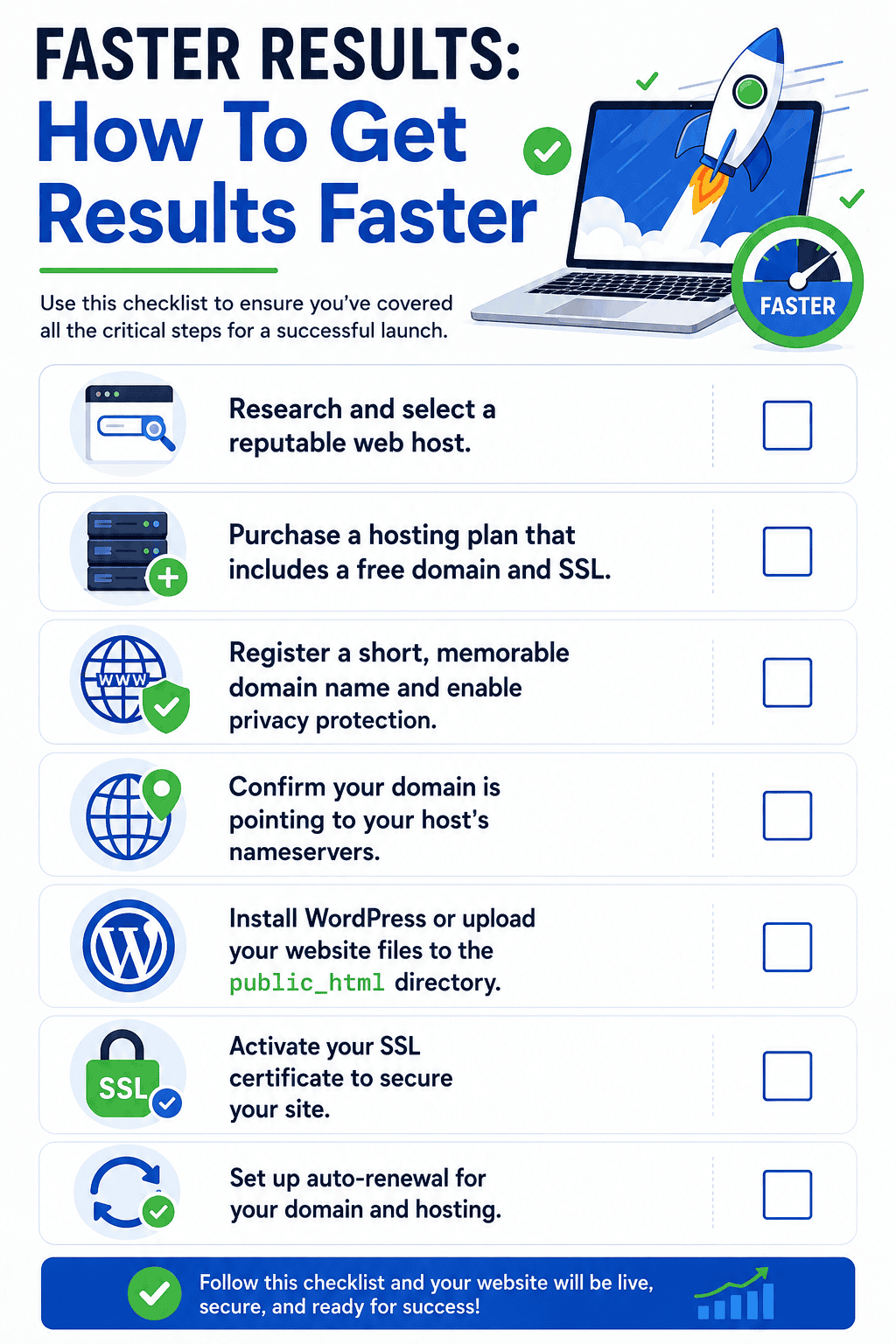
Use this checklist to ensure you’ve covered all the critical steps for a successful launch.
□ Research and select a reputable web host.
□ Purchase a hosting plan that includes a free domain and SSL.
□ Register a short, memorable domain name and enable privacy protection.
□ Confirm your domain is pointing to your host’s nameservers.
□ Install WordPress or upload your website files to the public_html directory.
□ Activate your SSL certificate to secure your site.
□ Set up auto-renewal for your domain and hosting.
NEXT STEPS
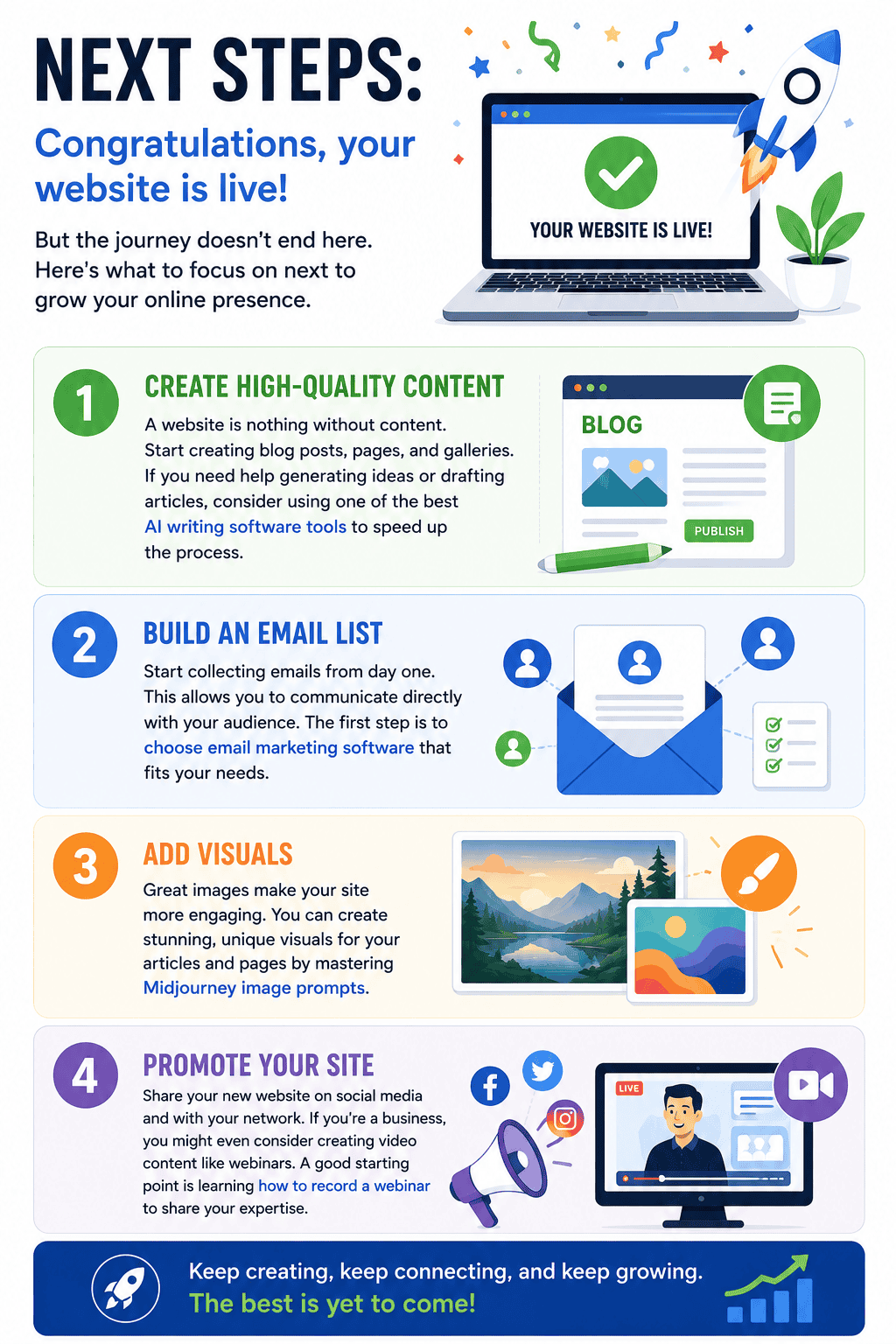
Congratulations, your website is live! But the journey doesn’t end here. Here’s what to focus on next to grow your online presence.
- Create High-Quality Content: A website is nothing without content. Start creating blog posts, pages, and galleries. If you need help generating ideas or drafting articles, consider using one of the best AI writing software tools to speed up the process.
- Build an Email List: Start collecting emails from day one. This allows you to communicate directly with your audience. The first step is to choose email marketing software that fits your needs.
- Add Visuals: Great images make your site more engaging. You can create stunning, unique visuals for your articles and pages by mastering Midjourney image prompts.
- Promote Your Site: Share your new website on social media and with your network. If you’re a business, you might even consider creating video content like webinars. A good starting point is learning how to record a webinarto share your expertise.
FAQ
1. What is web hosting?
Web hosting is a service that allows you to store your website’s files on a server, making them accessible on the internet. When someone visits your domain name, the server sends the files to their browser.
2. Can I host a website for free?
While free hosting services exist, they are not recommended for serious projects. They often have slow performance, intrusive ads, limited features, and poor security. A paid plan is a small investment for a much more professional and reliable website.
3. How much does it cost to host a website?
For a beginner, shared hosting typically costs between $3 to $10 per month for an introductory plan. This often includes a free domain name for the first year, making the total startup cost under $100.
4. What’s the difference between a domain name and web hosting?
A domain name is your website’s address (e.g., google.com), while web hosting is the space where your website’s files live. You need both to have a functioning website.
5. What is a cPanel?
cPanel is a popular web-based control panel that makes it easy to manage your hosting account, files, databases, and email accounts without needing technical skills.
6. What is an SSL certificate?
An SSL certificate encrypts the data between your website and its visitors, protecting sensitive information. It also enables the padlock icon and “https” in the browser bar, which builds trust. Most hosts provide a free SSL certificate.
7. How long does it take for my website to go live?
After you point your domain to your host and upload your files, your site can be live in minutes. However, it can sometimes take up to 48 hours for the DNS changes to be visible to everyone around the world.
8. Do I need to know how to code to host a website?
No. With tools like WordPress and one-click installers provided by hosts, you can build and manage a full-featured website without writing a single line of code.
9. What is the public_html folder?
The public_html directory is the main folder on your server where all the files for your primary domain must be placed to be visible on the internet.
10. Can I switch web hosts later?
Yes, you can migrate your website to a new hosting provider at any time. Many hosts even offer free migration services to make the process easier.
Frequently Asked Questions
What Is The Best Way To Choose A Domain Name?
Choosing the right domain name is key when creating a website. It’s often one of the first steps in getting your site off the ground, and can have a lasting impact on how successful you are online. Selecting an appropriate domain selection, or domain name selection, is critical to ensuring that potential customers can find you easily and remember your business’s URL.
When making a decision about what domain choosing works best for you, there are several factors to consider. Firstly, think carefully about what exactly your brand stands for – this will help guide you towards selecting a domain name that reflects it effectively. Secondly, make sure the chosen domain name isn’t too long as it may be difficult to recall over time – aim for something short and snappy yet memorable! Thirdly, try out different combinations before settling on one; certain words or phrases might sound good in theory but not so much when they’re written down. Finally, check if the desired name has already been taken by another company – this could be disastrous if users accidentally come across their page instead of yours!
By following these tips during your search for the perfect domain name selection process, you’ll be able to ensure that your website stands out from competitors and makes a strong impression with customers. With a sensible approach and proactive research into available options, locating an apt choice should become easier than ever before!
What Is The Most Cost Effective Server Hosting Option?
When it comes to hosting a website, the most daunting decision can be finding the right server hosting option without breaking the bank. Finding an affordable web hosting provider is like searching for a needle in a haystack! Thankfully, there are some budget-friendly options available that will make your wallet smile.
For those on a tight budget but still wanting reliable and secure service, there are plenty of cheap website hosting packages out there that provide awesome benefits at an unbelievably low cost. Budget server hosting allows you to get up and running quickly with minimal fuss – perfect for beginners who want to dip their toes into the online world.
From shared servers to cloud services, budget website hosting provides great value for money while delivering fast performance and numerous features such as unlimited bandwidth and storage space. Plus, many of these providers offer free domain names so you don’t have to worry about shelling out extra cash when setting up your site. Truly, if you’re looking for a cost effective way to launch your very own website, then look no further than budget server hosting – this could be just what you need!
What Is The Difference Between A Platform And A Cms?
When it comes to hosting a website, understanding the difference between platforms and content management systems (CMS) is essential. Platforms are services that provide developers with tools to build websites from scratch, while CMS offer ready-made solutions which require minimal coding knowledge. Here’s how you can tell them apart:
1. Design & Development – Platforms often have extensive design capabilities but lack the ready-made themes of CMS; they also require more advanced coding skills than most CMS.
2. Content Management – A platform requires webmasters to construct their own code for managing content, whereas many CMS come preloaded with plugins or modules to make site administration easier.
3. Cost & Hosting Options – Building on a platform tends to be costlier due to developer fees, while some popular CMS options are free or low cost depending on the hosting plan chosen.
Whether choosing a platform or selecting a CMS for your website hosting needs depends largely on budget as well as technical proficiency and desired features/functionality of the end product. It pays off in time saved and money spent if these considerations are taken into account before diving into development. In short, take note of what you need out of your website when deciding whether to go with a platform or use a CMS – then enjoy building something awesome!
What Are The Most Popular Website Design And Development Tools?
As the website design and development industry continues to grow, it’s no surprise that there are now an abundance of helpful tools available for those looking to create a website. In fact, statistics show that in 2019 alone over 1.5 billion websites were registered worldwide. With so many options out there, understanding which tools will best suit your needs can be tricky. Here is a look at some of the most popular website design and development tools:
WordPress is one of the leading content management systems (CMS). This open-source platform offers users user-friendly drag-and-drop page builders as well as powerful plugins and themes – making creating stunning designs a breeze. WordPress also has its own HTML editor, allowing you to customize your site even further with custom codes. Plus, if you ever run into any issues, there’s a large community of developers ready to help answer questions on their forums.
Next up we have web development suites such as Adobe Dreamweaver and Microsoft Visual Studio Code. These all-inclusive coding programs provide users with everything they need from text editors to debuggers and code validators in order to build sophisticated sites quickly and easily. However, these suites come with more features than what would typically be needed by someone new to web development, making them better suited for experienced coders who want complete control over the entire process from start to finish.
Finally, for those who aren’t quite comfortable using either WordPress or having access to source code, there are plenty of drag-and-drop page builder solutions such as Weebly or Wix – both offering templates designed specifically for beginners while still delivering high quality results without requiring any coding knowledge whatsoever. Additionally these platforms offer useful resources like analytics tools so you can track how visitors interact with your website once it goes live online!
How Can I Ensure My Website Is Secure?
Website security is a key part of ensuring your online presence remains safe and secure. With the ever-changing landscape of technology, website owners need to be aware of the latest threats to their website’s protection. By understanding how to protect against malware, hackers and other malicious attacks, you can ensure that your website stays secure now and in the future.
When it comes to website security, there are several steps you can take to safeguard your site:
* Use secure hosting services with built-in encryption protocols.
* Implement regular malware scanning to detect any potential threats before they become an issue.
* Utilize strong passwords for all accounts associated with your website.
* Invest in firewalls or IDS systems to protect from external intrusions.
In today’s digital world, cybercrime is on the rise – so protecting yourself should be taken seriously! Taking proactive measures such as these will help keep your data safe while preventing costly downtime due to malicious attack. Additionally, staying up-to-date on current trends in cybersecurity can further bolster your website’s security posture by recognizing new vulnerabilities and addressing them quickly when necessary. Don’t let yourself become complacent; actively work towards maintaining a healthy defense system for your website each day.
Final Thoughts
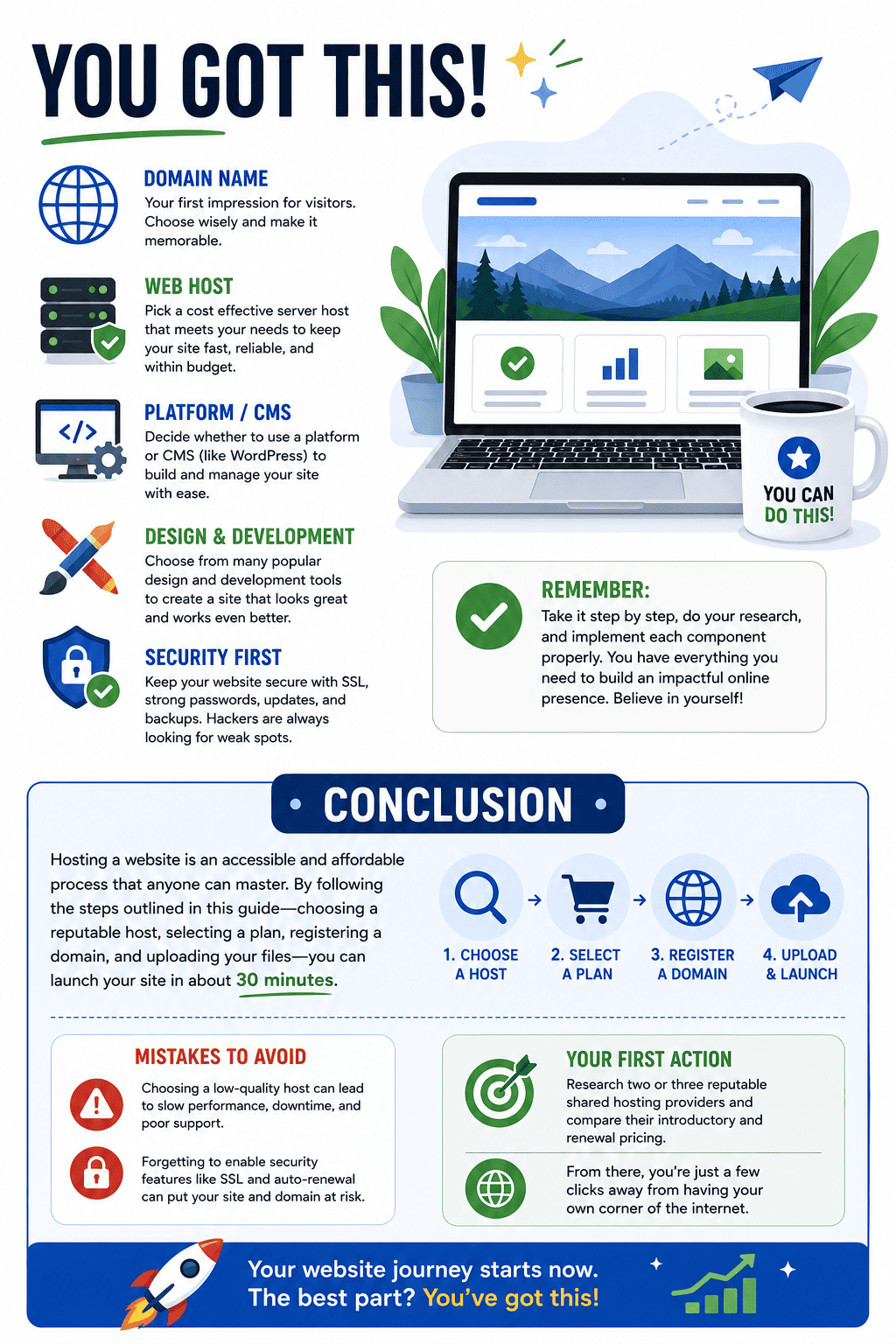
In conclusion, hosting a website has never been easier. With the right decisions and tools in place, anyone can have their own site up and running in no time. The key is taking it step by step and understanding the different components involved.
The domain name will be your first impression for visitors – so choose wisely. Choosing a cost effective server host that meets your needs is essential to control expenses. From there, you can decide whether to use a platform or CMS before selecting from many popular design and development tools available today. Finally, keeping your website secure should remain top of mind as hackers are always looking for vulnerable sites to exploit.
Overall, hosting a website doesn’t need to be overwhelming if I take my time doing research beforehand and make sure all components are properly implemented. With this comprehensive guide at hand, I am confident that anybody can create an impactful online presence with ease!
CONCLUSION
Hosting a website is an accessible and affordable process that anyone can master. By following the steps outlined in this guide—choosing a reputable host, selecting a plan, registering a domain, and uploading your files—you can launch your site in about 30 minutes.
The biggest mistakes to avoid are choosing a low-quality host and forgetting to enable security features like SSL and auto-renewal. Your recommended first action is to research two or three reputable shared hosting providers and compare their introductory and renewal pricing. From there, you’re just a few clicks away from having your own corner of the internet.
In Summary, How To Host A Website
Hosting a website is one of the most important steps in building an online presence in 2026. Whether you’re launching a personal blog, portfolio, business site, or online store, learning how to host a website properly can save time, money, and frustration. In this article, you’ll learn how to host a website, choose the right hosting provider, select the right domain name, and get your website up and running with confidence.
When hosting a website, the first decision is choosing a web hosting company. The right hosting provider plays a critical role in your website’s speed, security, reliability and uptime. Finding the right hosting solution starts with understanding the different types of website hosting available today. Common types of hosting include shared hosting, managed WordPress hosting, VPS or dedicated server hosting, and self-hosting a website on your computer.
Shared hosting remains one of the most affordable website hosting plans for beginners because multiple websites operate on the same server. Managed WordPress hosting is ideal for users who want simplified management and automatic updates. VPS or dedicated server hosting provides more control and resources for larger websites. Self-hosting a website on your computer is another option, but hosting a website on your computer is generally not recommended for beginners because your computer is responsible for serving visitors 24/7 access to high-speed internet, security updates, backups, and ongoing maintenance.
One of the most important considerations when hosting a website is selecting the right hosting plan. A web hosting plan should provide sufficient storage, bandwidth, security features, and customer support. When choosing a web hosting plan, compare website hosting plans carefully and review the top features when choosing a provider. Features when choosing a web host should include SSL certificates, backups, reliability and uptime guarantees, customer support, and an easy-to-use control panel.
The benefits of choosing the right hosting provider extend beyond website performance. A professional hosting company you can rely on provides peace of mind, especially when running your business online. Many web hosting services that offer essential security and backup features can help prevent downtime and protect your website from cyber threats. Hiring a professional hosting company is often a better solution than attempting self-hosting a website on your computer unless you possess significant technical know-how and resources.
Another critical step is choosing the right domain name. Your domain name is your website’s identity online and often creates the first impression for visitors. The best domain name is short, memorable, easy to spell, and relevant to your brand. Before committing to a domain, research the best domain name registrars and compare domain name registrars based on pricing, privacy protection, and support. Popular domain name registrars types of website owners frequently use include Namecheap, Cloudflare, and other reputable providers.
Once you choose and register a domain name, the next step is linking your domain name with your web host. Most hosting companies make linking your domain name with your web host simple through a control panel. If your domain name with your hosting provider was purchased separately, you may need to update nameservers and DNS records manually. Linking your domain name correctly ensures visitors can access your website with a few clicks.
After selecting a web hosting provider and register a domain name, you can begin creating your website. Many users choose a content management system CMS such as WordPress because it simplifies website management. WordPress remains the most popular content management system CMS in the world because it allows users to create professional websites without coding. Choosing the right tool for creating your website depends on your goals, budget, and technical experience. The right tool for creating your website could be WordPress, Shopify, Wix, or another platform designed for your specific needs.
For creating your website, many hosting providers include one-click installations that make setting up your website simple. Creating your website becomes easier when your hosting plan includes automatic WordPress installation, SSL certificates, backups, and security monitoring. Website top features when selecting a platform should include ease of use, flexibility, scalability, and integration with marketing tools.
If you decide to purchase a paid plan, carefully review pricing details. Many hosting plans that offer introductory discounts increase significantly upon renewal. Renewal pricing is often overlooked when choosing the right hosting provider. Understanding the long-term costs can save money in the long run. In fact, finding the right hosting plan often requires comparing both introductory and renewal pricing before committing to a provider.
Security is another major consideration when hosting your website. Activating SSL certificates, enabling automatic backups, using strong passwords, and keeping software updated are essential practices. Hosting a website with strong security measures reduces the risk of hacking and malware attacks. Most web hosting services that offer essential security tools include SSL certificates, malware scanning, and firewall protection as part of the web hosting plan.
Whether you want to publish your website for a hobby, portfolio, or to make money online, selecting the right web hosting plan for your goals is essential. Many entrepreneurs researching how to start a website eventually discover that the right web hosting provider can make the entire process smoother. If your goal is to make money on your website, investing in reliable hosting from the beginning is often worth the additional cost.
In conclusion, hosting a website is more accessible than ever before. By choosing the right hosting provider, selecting the right hosting plan, choosing and registering the right domain name, and using the right tool for creating your website, you can have your website up and running quickly. Whether you select shared hosting, managed WordPress hosting, VPS or dedicated server hosting, or explore self-hosting a website on your computer, understanding the benefits of choosing the right solution will help ensure long-term success.
Your recommended next step is to research several reputable hosting providers, compare web hosting plans, select a web hosting plan for your needs, register a domain name, and begin setting up your website. With the right web hosting company and a little preparation, hosting a website can be completed in less than an hour and provide the foundation for a successful online presence.
Affiliate Disclosure: Some of the links mentioned in this article may be affiliate links. If you decide to purchase a paid plan through some of the links, we may earn a commission at no cost to you. You can read our affiliate disclosure in our privacy policy for additional details.
Disclaimer: This site is not intended to provide financial advice and is for entertainment only. Always perform your own research before committing to any hosting provider, domain registrar, or web hosting plan.
Affiliate Disclosure: Some of the links mentioned in this article may be affiliate links. If you decide to purchase a paid plan through some of the links, we may earn a commission at no cost to you. You can read our affiliate disclosure in our privacy policy for additional details. Always remember to refer back to How To Host A Website A Beginners Guide for clear and concise instructions throughout your hosting journey.
Disclaimer: This site is not intended to provide financial advice and is for entertainment only. Always perform your own research before committing to any hosting provider, domain registrar, or web hosting plan. Keep this in mind while utilizing How To Host A Website A Beginners Guide to ensure a successful experience.