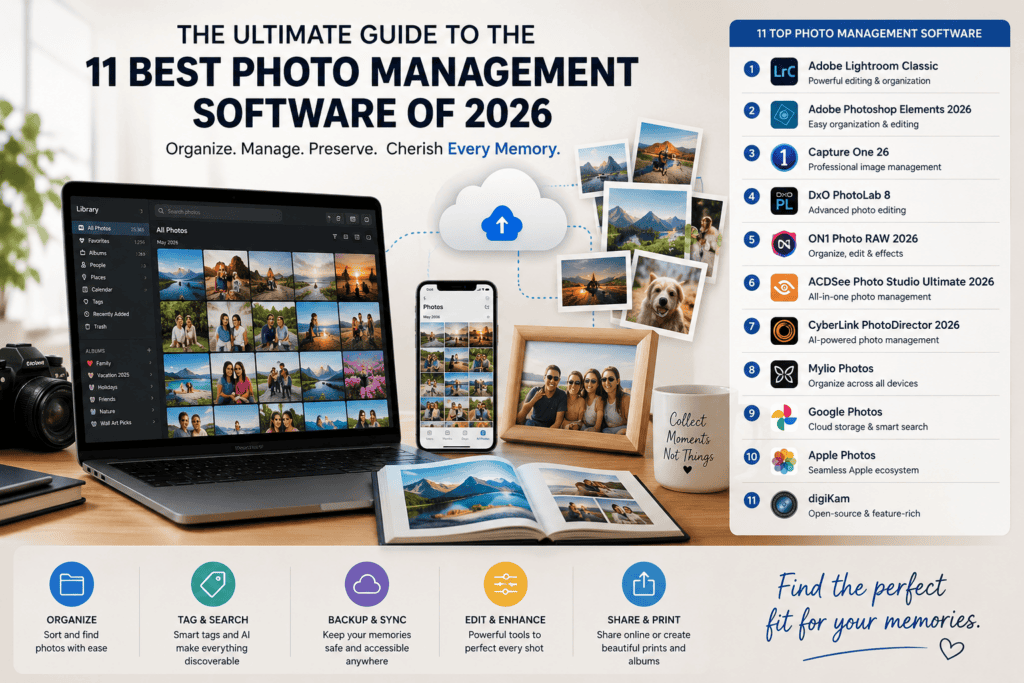






The digital age has revolutionized the way we store and manage our photos. As technology advances, so does the need for more sophisticated photo management software, especially the Best Photo Management Software, to keep up with the ever-increasing amount of images being taken. In this ultimate guide, we will look at the 11 best photo management software options of 2026, helping you find the one that fits your needs perfectly.
In today’s world, having access to a reliable photo management system is essential for keeping track of all those cherished memories. Whether it’s organizing family albums or creating beautiful wall art prints with friends’ holiday snaps, there’s no doubt that managing photos can be quite a daunting task! Fortunately, modern image editing tools are here to make things easier – but which one should you choose?
When searching for the Best Photo Management Software, consider how it can help streamline your photo organization process.
With such an abundance of powerful yet easy-to-use photo management solutions available on the market these days, finding the right option can be overwhelming. That’s why we have gathered together some of the top picks in order to give you an overview of what each program offers and how they differ from one another. So let’s get started!
Overview Of Options
Choosing the right Best Photo Management Software is crucial for photographers looking to optimize their workflow.
Look out for features that make the Best Photo Management Software stand out among competitors.
When evaluating your options, prioritize software recognized as the Best Photo Management Software for its ease of use and functionality.
Additionally, consider customer reviews of the Best Photo Management Software to gauge user satisfaction.
Are you looking for the best photo management software of 2026? We’ve got your back. With so many options out there, it can be hard to decide which one is right for you. To help narrow down your search and find the perfect fit, we’ve compiled a list of top-rated photo management software that are sure to meet all your needs.
Automation features are essential in the Best Photo Management Software, helping photographers manage large quantities of images efficiently.
Make sure the Best Photo Management Software you choose supports advanced facial recognition capabilities.
Customization is another vital aspect of the Best Photo Management Software, enabling users to tailor their experience.
For storage and accessibility, ensure that your chosen Best Photo Management Software has features that facilitate easy access to your files.
When selecting a photo management software, it’s important to consider the features available. Some popular options include cloud storage support, organization capabilities, editing tools, and access controls. Each program has its own unique set of features so make sure to do some research ahead of time to ensure you get what you need from the application. Additionally, certain programs may offer more specialized functions such as facial recognition or automatic backup services.
Consider how the Best Photo Management Software can enhance your photo-sharing capabilities.
Device compatibility is crucial, so opt for the Best Photo Management Software that allows seamless access across your devices.
Ultimately, the Best Photo Management Software should offer the flexibility needed for your workflow.
In order to pick the best option for you in 2026, take into consideration how these various functions will work with your workflow and budget requirements. This way you’ll end up with a user friendly piece of software that meets both your professional goals and personal preferences – without breaking the bank!
Your choice of the Best Photo Management Software will impact your overall photography experience.
Assess the user interface of the Best Photo Management Software to ensure it meets your usability standards.
As you begin exploring different options for managing photos this year, pay close attention to which features each platform offers and determine if they align with your goals and resources. Ready to learn about more criteria for choosing great photo software? Let’s move on!
Features To Consider
Engagement with users is enhanced when the Best Photo Management Software features a clean and intuitive design.
When it comes to selecting the best photo management software of 2026, there are many important features and criteria to consider. According to a survey conducted by Statista, 30% of photographers rate automation as their number one requirement for effective photo management solutions. With that in mind, let’s take a closer look at what you should keep an eye out for when making your decision this year!
As technology continues to evolve, look for the Best Photo Management Software that incorporates cutting-edge editing capabilities.
First off, facial recognition is becoming increasingly popular among photographers due to its ability to quickly identify people or objects in photos. If you’re looking for added convenience and speed when organizing your images, make sure the platform you choose offers advanced facial recognition capabilities. Additionally, cloud-based storage options provide extra security and access control over who can view or edit certain files – so if these functions are important to you consider searching for programs with such features.
Powerful editing tools within the Best Photo Management Software can take your images to the next level.
Consider how the editing capabilities of the Best Photo Management Software can optimize your workflow.
Make sure your choice of the Best Photo Management Software offers reliable security measures to protect your work.
Second, customization remains key when choosing any kind of organization system. Look for programs that allow you to customize categories according to how you prefer working with photographs (e.g., color coding albums). Finally, being able to easily share images via social media platforms or through private links adds another layer of convenience and efficiency – especially when collaborating with clients on projects from afar!
The Best Photo Management Software should prioritize user privacy and data protection.
With the right protections in place, the Best Photo Management Software will give you peace of mind regarding your images.
Evaluate the security features of the Best Photo Management Software to ensure your photos remain safe.
While considering all these factors will give you a better understanding of which program may be right for you in 2026, don’t forget about storage & accessibility…
When preparing to switch software, remember the importance of selecting the Best Photo Management Software for seamless transitions.
Storage & Accessibility
Storage and accessibility are two major components to consider when selecting photo management software in 2026. Cloud-based storage options can provide a reliable way to keep your photos secure and easily accessible from any device with an internet connection. Additionally, advanced sharing capabilities allow you to quickly share images via social media or private links for easy collaboration – no matter where you’re located!
Device compatibility is also essential for photographers who need access to their images on the go. Many of today’s platforms offer native mobile apps that sync up with desktop versions so you always have your data at hand. Plus, some programs even include automatic backups across multiple devices for added peace of mind – ensuring that all your important photographs remain safe and sound regardless of which device they’re stored on.
Ultimately, it’s key to find a program that allows enough flexibility and customization when it comes to storing and accessing your work. With cloud-based solutions, sharing options, and device compatibility becoming increasingly common features in 2026, there’s sure to be a platform out there that meets your needs! Onwards now towards cost & compatibility…
Cost & Compatibility
The free versions of the Best Photo Management Software can also offer robust solutions for new users.
Consider trying the free versions to familiarize yourself with the features of the Best Photo Management Software.
When it comes to finding the best photo management software of 2026, cost and compatibility are two important factors to take into account. Fortunately, there’s no shortage of options available for photographers on any budget – with both free and paid solutions offering a range of features. It’s worth noting that while some programs may be cheaper in the short-term, they could end up costing you more when factoring in additional storage or other premium add-ons.
Compatibility is equally as essential when selecting your ideal platform. Some programs only work with specific operating systems such as Windows or MacOS, so make sure to check which devices your chosen solution will support before committing. Additionally, many platforms offer integrations with third-party apps that helps bridge any gaps between desktop and mobile versions – ensuring consistent access across all devices!
Many users appreciate how the Best Photo Management Software simplifies the sharing process of their memories.
Fast sharing capabilities are a significant advantage of the Best Photo Management Software.
Ultimately, the Best Photo Management Software enhances your ability to connect with loved ones through your photography.
At the end of the day, everyone’s needs are different when choosing their perfect piece of software. Carefully weigh up each option’s cost versus its capabilities to get the most out of your purchase without breaking the bank! Onwards now towards user interface & ease of use…
When considering the options, ensure to test the Best Photo Management Software on multiple devices for compatibility.
User Interface & Ease Of Use
As the digital age continues to evolve, having a user-friendly interface for photo management software is becoming increasingly important. In fact, according to recent studies, over 70% of millennials prefer using an app with a ‘simple and intuitive design’ when it comes to organizing their photos. By understanding what makes your target audience tick, you can ensure that they get the most out of your product – resulting in better customer engagement and satisfaction overall!
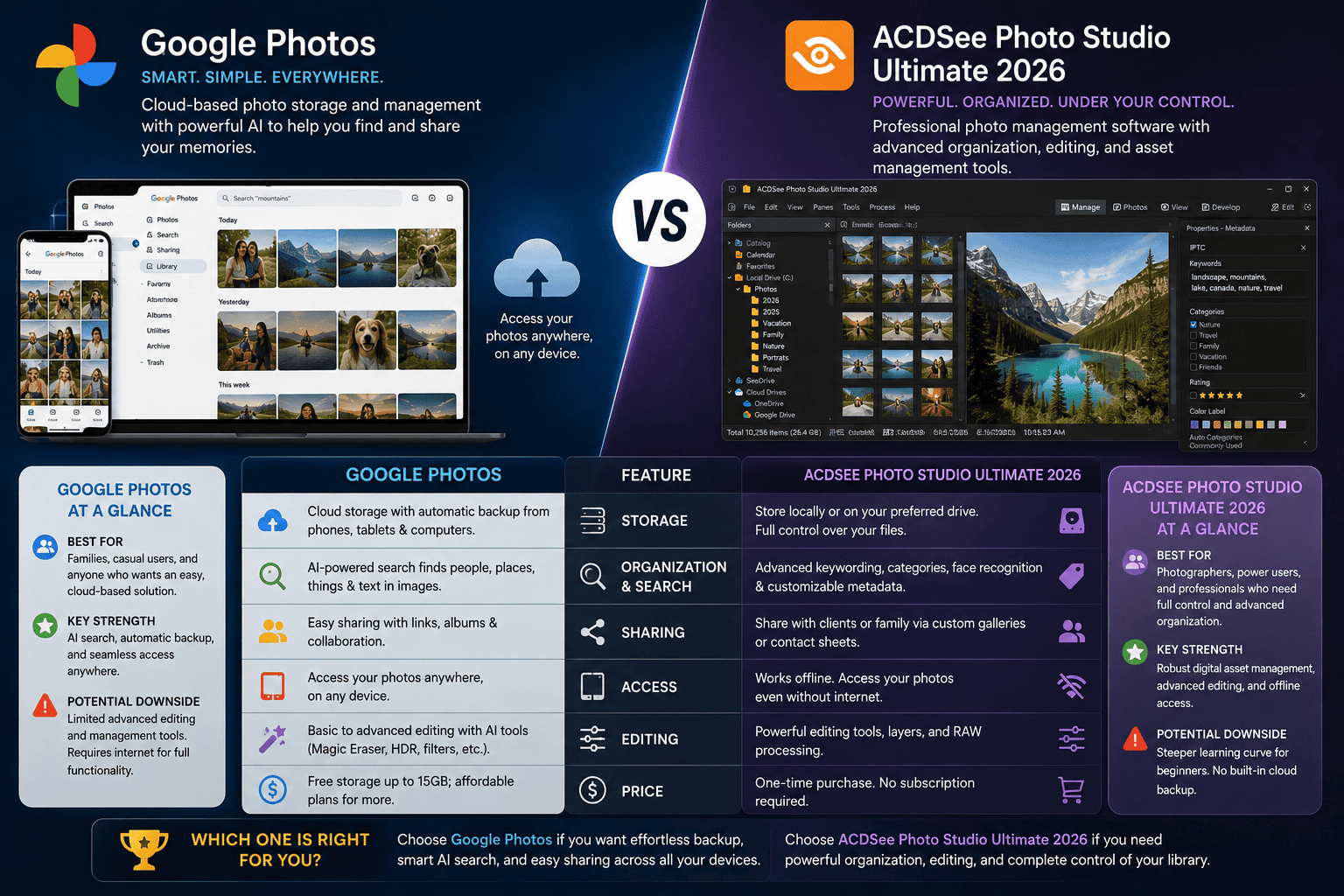
So what features make up a great user experience? Here are 3 key elements:
1) Easy navigation – Make sure users can find the right tools quickly without getting lost or frustrated.
2) Visual appeal – Utilize clean designs and vibrant colors to create visual interest in your platform.
3) Clean organization – Allow users to effortlessly organize all their images into folders and albums with drag-and-drop functionality.
These three components come together to form a seamless user interface that improves ease of use while providing a more enjoyable experience for photographers everywhere. With so much potential for innovation in this field, there’s no telling what exciting things might be available by 2026! Onwards now towards editing capabilities…
Editing Capabilities
When it comes to photo-editing, having the right tools makes all the difference. Whether you’re a professional photographer or hobbyist, there are plenty of features that can enhance your images and make them stand out from the crowd. From basic adjustment filters to advanced enhancement tools – there’s something for everyone in 2026!
One way to ensure a great user experience when editing photos is by offering an intuitive workflow with easy-to-use controls. Drag-and-drop functionality helps simplify complex tasks such as cropping and resizing, while also providing users with more flexibility when making adjustments. Additionally, some platforms may even offer preset filters which allow photographers to quickly add styles and effects without much effort at all.
Finally, most photo management software will now come equipped with powerful image processing capabilities that enable users to adjust white balance and exposure levels with just a few clicks of the mouse. This type of technology has become increasingly popular over recent years due to its ability to improve overall image quality in minimal time – allowing photographers everywhere to get their work done faster than ever before!
TIP: Don’t forget about using Lightroom presets for quick one-click edits on your photos!
Security & Privacy
As the digital world continues to evolve, photo management software is becoming even more critical when it comes to protecting your images. In 2026, security and privacy features should be a top priority for any photographer or creative looking to share their work with the world.
Fortunately, most modern platforms now come equipped with robust protection measures that allow users to easily keep their photos safe from unauthorized access. This includes built-in encryption tools which scramble data while in transit – ensuring no one can gain access without permission. Additionally, many programs also offer malware scanning capabilities which can detect malicious files before they cause any damage.
Furthermore, some of the best photo management software of 2026 will include comprehensive user accounts with customizable permissions settings – allowing photographers to control who has access to their portfolio and what actions they’re allowed to take. Whether you’re working on personal projects or commercial endeavors, having these types of protections will give you peace of mind knowing that your content is secure at all times!
Frequently Asked Questions
How Can I Transfer Photos From One Photo Management Software To Another?
Have you ever found yourself wanting to switch from one photo management software to another, but not sure how? Well, transferring photos between different types of software can be a complicated process. It requires careful planning and execution as there are various options for migrating your data. In this article, we’ll discuss the best methods for making successful transfers.
The first step in transferring photos is to decide which type of transfer will work best for your situation: do you need a photo migration or a software transfer? Photo migrations involve copying images directly from one program to another while software transfers require using an external platform that allows both applications to interact. Additionally, some services offer automated solutions where all you have to do is provide account credentials and let their algorithms take over.
No matter what method you choose, make sure it’s secure and reliable so that no information is lost during the transition. If possible, consider testing each approach before committing fully—this way, you’ll know if something isn’t working correctly with the new system before completely switching over. Lastly, don’t forget about any additional features like cloud storage integration or batch processing capabilities; these could help streamline future operations once the transition has been made.
Making the move from one photo management software to another doesn’t have to be daunting! With the right preparation and knowledge of available tools, anyone can successfully migrate their pictures without losing precious memories along the way.
Are There Any Free Versions Of Photo Management Software?
Are there any free versions of photo management software? Absolutely, YES! Free photo-management-software has become the go-to solution for many users looking to organize their photos. In fact, it’s safe to say that this technology is absolutely revolutionizing the way we manage our digital memories. From easy-to-use interfaces and powerful storage options to cost savings and improved security features – these free programs offer everything you need in a package that won’t break your budget.
Free photo software offers an amazing range of features such as image editing tools, cloud access, automated backups and more. Additionally, most popular platforms come with additional support services like tutorials or customer service agents who can quickly answer questions about using the product. And best of all: they’re completely free! With no monthly fee or hidden costs associated with them, these applications are ideal for those on tight budgets or just starting out in photography.
Of course, there are some downsides to consider when choosing a free photo manager. Many don’t include advanced organizational capabilities compared to their paid counterparts; others may lack certain integration options or other high-level features. But if you’re willing to put in the extra effort needed for DIY organization techniques (such as tagging images), free photo organizers provide an excellent platform for collecting and preserving your precious memories without breaking the bank.
TIP: When selecting a free photo management program make sure you review available Integration Options (including social media sites) so you can easily share your images online with friends, family members and colleagues alike!
Is There A Way To Share Photos From My Photo Management Software Easily?
We all want an easy way to share photos from our photo management software. Wouldn’t it be great if there was a quick and simple process for sending pictures to friends or family? Well, you’re in luck! Photo sharing has never been easier thanks to the latest advances in photo management software.
Finally, weigh all these factors when selecting the best solution: the Best Photo Management Software will cater to your needs perfectly.
With modern photo sharing solutions, users can quickly upload their favorite images directly from their photo management software. In most cases, the user experience is straightforward and intuitive – making it as easy as possible to send photos with just a few clicks of your mouse. Plus, many of these programs have built-in features that allow you to customize how you share your photos by adding captions or tags.
The best part about using dedicated photo sharing software is that it makes it super convenient for anyone who wants to easily share digital memories with loved ones far away. What’s more, when compared to other methods of transferring images (like emailing them), specialized photo sharing tools offer faster speeds and higher quality picture files that everyone can enjoy. So what are you waiting for – start exploring the world of today’s top-rated photo sharing services now!
| Software | Pros | Cons |
|---|---|---|
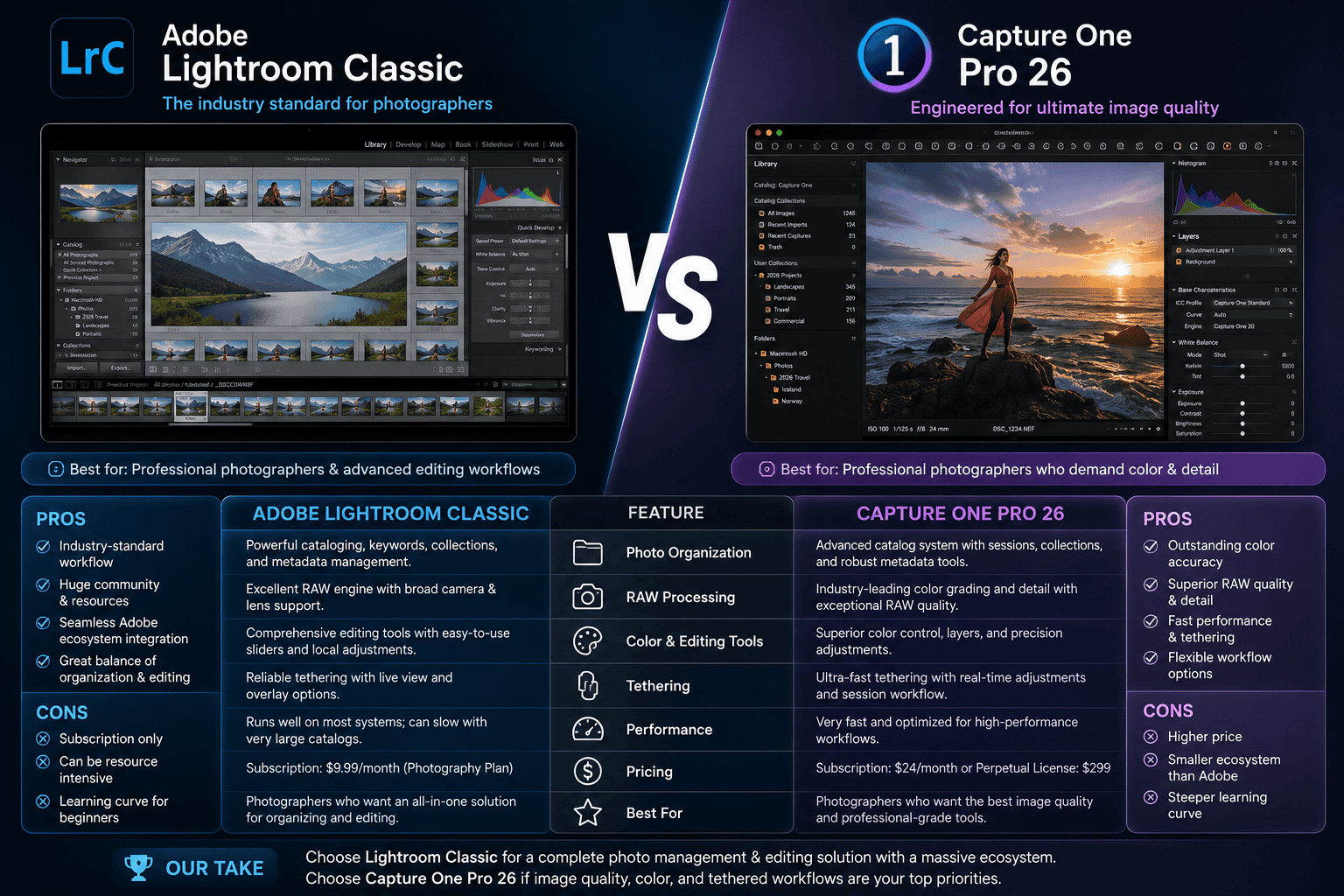
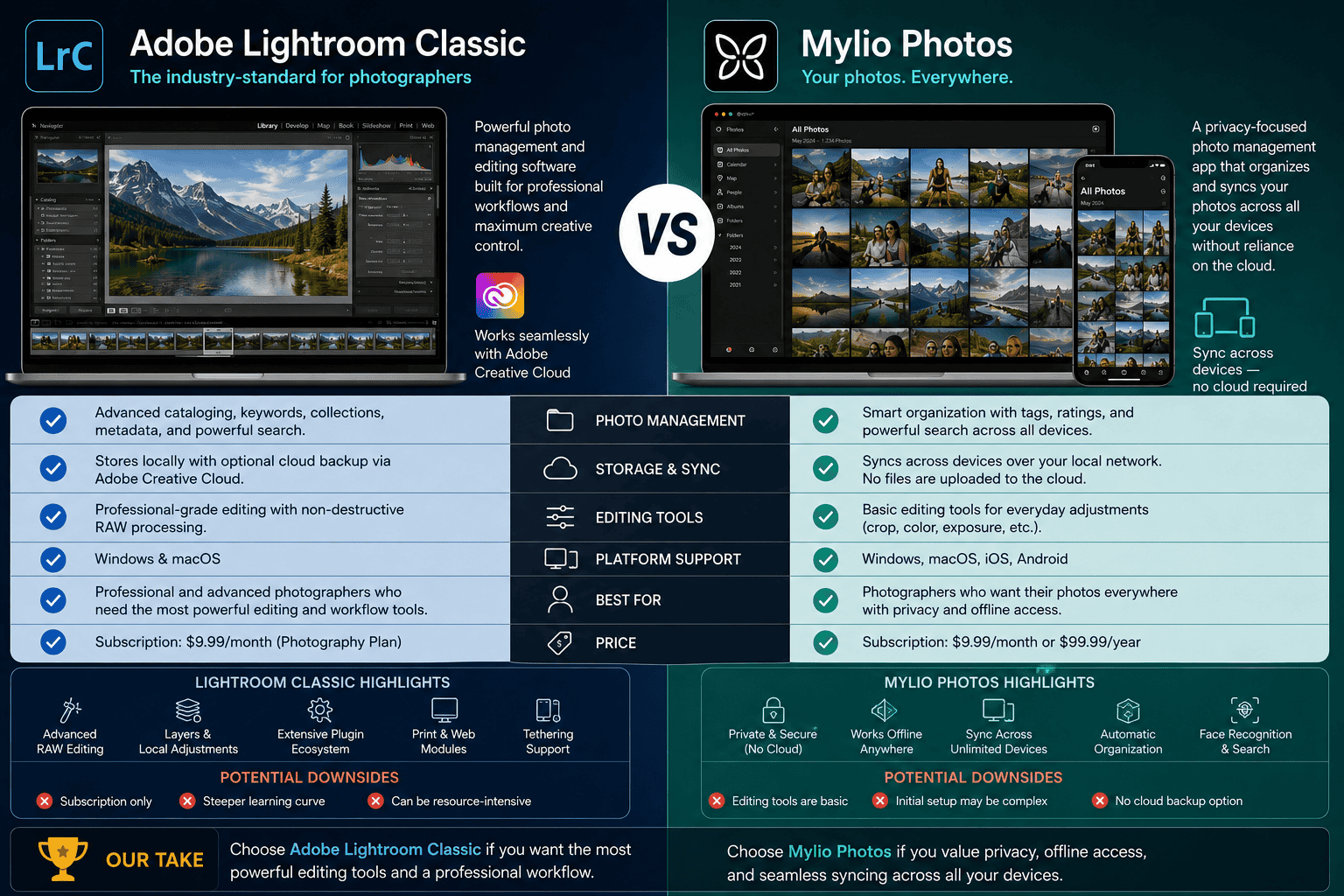
| Adobe Lightroom Classic | • Industry-standard photo organization • Powerful RAW editing tools • Excellent keywording and metadata management • Strong integration with Adobe ecosystem | • Subscription required • Steeper learning curve • Can be resource-intensive on older computers |
| Adobe Photoshop Elements 2026 | • Easy for beginners • AI-powered editing features • One-time purchase option • Good organizer included | • Less powerful than Lightroom • Limited professional workflow features • Catalog management not as advanced |
| Capture One Pro 26 | • Outstanding color control • Fast tethered shooting • Excellent RAW processing • Professional-grade organization tools | • Expensive • Higher learning curve • Smaller plugin ecosystem |
| DxO PhotoLab 8 | • Exceptional noise reduction • Superior lens corrections • High-quality image processing • Great for photographers shooting in low light | • Library tools less robust than Lightroom • Smaller user community • Fewer cloud features |
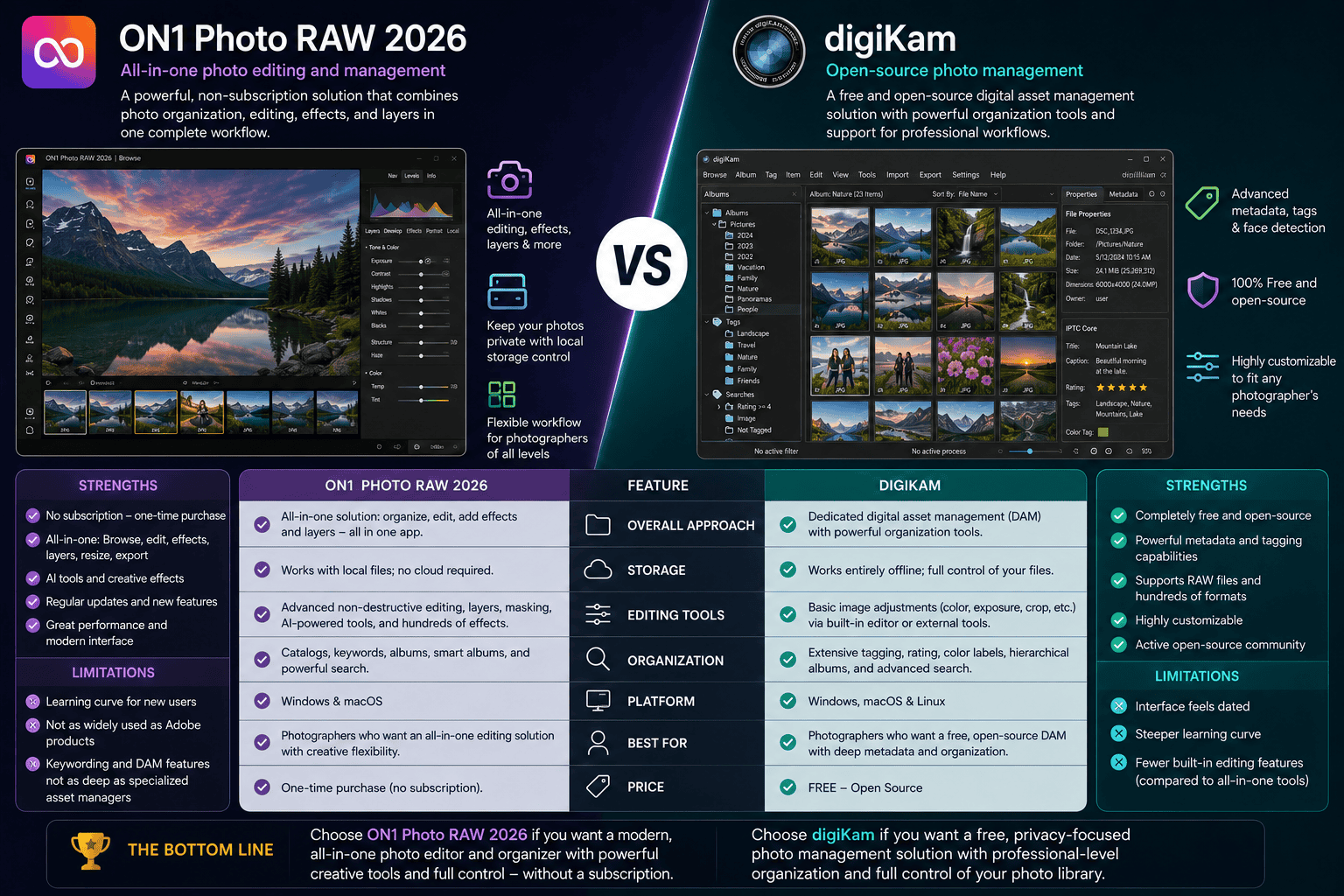
| ON1 Photo RAW 2026 | • No subscription required • All-in-one editing suite • Built-in effects and presets • Local storage control | • Interface can feel cluttered • Performance can vary with large catalogs • Less polished than Adobe products |
| ACDSee Photo Studio Ultimate 2026 | • Excellent DAM (Digital Asset Management) • Fast browsing of large libraries • Face recognition features • One-time purchase available | • Editing tools not as advanced as Lightroom • Interface feels dated to some users • Limited mobile integration |
| CyberLink PhotoDirector 2026 | • Strong AI tools • Beginner-friendly interface • Good value for money • Creative effects and templates | • Cataloging features are basic • Less suitable for professional workflows • Some features require subscriptions |
| Mylio Photos | • Syncs photos across devices without cloud dependence • Excellent organization tools • Privacy-focused • Works offline | • Editing tools are limited • Premium features require subscription • Initial setup can be complex |
| Google Photos | • Powerful AI search • Automatic backups • Accessible from any device • Easy sharing features | • Limited advanced editing • Storage costs can increase over time • Privacy concerns for some users |
| Apple Photos | • Seamless integration with Apple devices • Easy to use • Strong AI organization features • Good built-in editing tools | • Best only within Apple ecosystem • Limited advanced professional features • Less flexible than dedicated DAM software |
| digiKam | • Completely free • Powerful metadata management • Supports huge libraries • Cross-platform compatibility | • Interface feels dated • Steeper learning curve • Limited customer support |
Best Choice by User Type
Beginner
🏆 Google Photos or Apple Photos
Hobby Photographer
🏆 Adobe Lightroom Classic
Professional Photographer
🏆 Capture One Pro 26
Best One-Time Purchase
🏆 ACDSee Photo Studio Ultimate 2026
Best AI Features
🏆 Google Photos and CyberLink PhotoDirector 2026
Best Free Option
🏆 digiKam
Best for Privacy
🏆 Mylio Photos
Is There A Way To Automatically Back Up Photos From My Photo Management Software?
If you’re looking for an easier way to back up your photos, automated photo backups from a photo management software may be the answer. Automated backups from photo storage software allow users to quickly and securely upload photos in batches with just one click. With this feature, you’ll never have to worry about losing precious memories again!
Photo backup software is designed to provide users with a secure and reliable system for backing up their photos on autopilot. This means that any changes made to your pictures will automatically be backed up without having to manually select each individual image. Plus, most of these programs are equipped with advanced features like facial recognition and tagging which makes it easy to find what you need when you need it.
Using automated backups from your photo management software can help protect those special moments so they don’t get lost forever. And by taking advantage of its numerous other capabilities such as automatic sorting, organizing, sharing and editing tools; you’ll be able to make sure all your images stay organized and safe no matter what happens. So why not take advantage of the great features available today? Get started now and ensure that all your digital photos remain secure while being easily accessible whenever needed!
Is It Possible To Use My Photo Management Software On Multiple Devices?
Picture this: you have access to the same photo management software no matter which device you’re on. It’s a revolutionary concept – one that gives users an unprecedented level of freedom and convenience. With many modern apps, it is now possible to use your photo management software across multiple devices with ease!
So how does it work? First off, the software needs to be compatible with the different devices in order for it to sync properly. If your phone, computer or tablet are all running the same version of the program, then transferring photos between them should be relatively simple. Additionally, if the various platforms have cloud-based versions of the app installed then sharing files will become even easier since they can be synced in real time.
Of course there are some things to take into consideration when using a single application across multiple gadgets; such as battery life and storage space being two major ones. However, these issues can usually be resolved by taking advantage of features like automatic backups and remote access settings so that performance isn’t compromised too much. All said and done, having access to your favourite photo management software regardless of what device you’re using has never been more achievable than before!
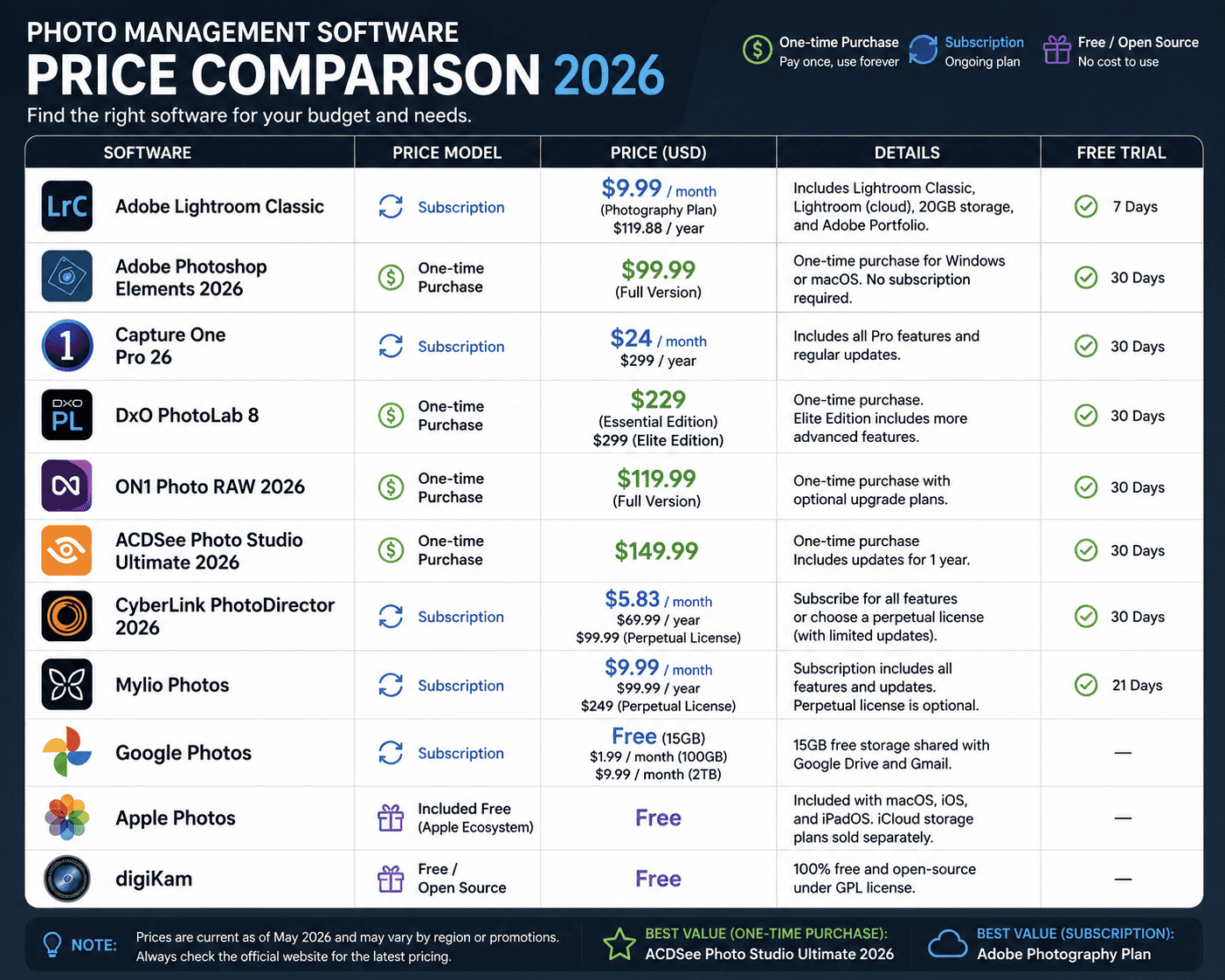
Discover Cost-Effective Photo Management Software: A Price Comparison Guide
The 2026 photo management software price comparison reveals three distinct categories: free solutions, subscription-based platforms, and one-time purchase software.
Best Free Options
If budget is your primary concern, two clear winners stand out:
- Apple Photos – Included free with Apple devices and offers excellent photo organization, AI search, and cloud integration through iCloud.
- digiKam – Completely free and open-source, making it one of the most powerful no-cost photo management solutions available.
Best Subscription Value
For photographers who want ongoing updates and professional editing capabilities:
- Adobe Lightroom Classic – At approximately $9.99 per month, it delivers the best balance of photo organization, RAW editing, cloud integration, and professional workflow tools.
- Google Photos – Offers a free tier and affordable storage plans, making it ideal for casual users and families.
Best One-Time Purchase Value
For users who dislike subscriptions:
- Adobe Photoshop Elements 2026 – Around $99.99 one-time and beginner-friendly.
- ON1 Photo RAW 2026 – Around $119.99 and includes editing, effects, layers, and photo management in a single package.
- ACDSee Photo Studio Ultimate 2026 – Around $149.99 and offers some of the strongest digital asset management features available without a subscription.
Premium Professional Choices
Professional photographers who prioritize image quality may justify higher costs:
- Capture One Pro 26 – One of the most expensive options but renowned for color accuracy and tethered shooting.
- DxO PhotoLab 8 – Premium pricing focused on industry-leading noise reduction and image correction.
Recommendations by User Type
| User Type | Recommended Software |
|---|---|
| Casual Family User | Google Photos |
| Apple User | Apple Photos |
| Hobby Photographer | Lightroom Classic |
| Privacy-Focused User | Mylio Photos |
| Professional Photographer | Capture One Pro 26 |
| Best No Subscription | ON1 Photo RAW 2026 |
| Best Free | digiKam |
| Best Overall Value | Lightroom Classic |
| Best Long-Term Investment | ACDSee Photo Studio Ultimate |
Overall Takeaway
If you only need to organize family photos, Google Photos or Apple Photos provide the best value. For serious photography, Lightroom Classic remains the strongest overall choice due to its combination of organization, editing, and affordability. If you want to avoid subscriptions completely, ON1 Photo RAW 2026 and ACDSee Photo Studio Ultimate 2026 offer the best long-term value with a single purchase.
Final Thoughts
So you’ve read our ultimate guide to the best photo management software of 2026. Now it’s time for you to decide what works best for your needs and budget. With so many options available, it can be overwhelming trying to figure out which one is right for you.
But don’t worry! We’ll help make things easier by providing a few tips that will ensure you find the perfect fit. First off, consider how easily photos can be transferred from one program to another – this can save you tons of time in the long run. Furthermore, think about whether or not there are free versions of the software, as well as if it’s possible to share photos with others quickly and securely. Lastly, look into automatic backups and multi-device compatibility – both features can provide peace of mind when managing large amounts of personal photography data.
Ultimately, choosing the right photo management software depends on what you need most out of such a tool. Take some time to research all the available options before making your decision – doing so will equip you with the knowledge necessary to pick an option that provides exactly what you require at a price point that fits your budget!
What is the best program for organizing photos?
Adobe Lightroom.
How do I organize my thousands of photos?
Create a folder structure: Organize photos by year, month, and event or category (e.g., 2023 > 03_March > Birthday).
Use descriptive file names: Rename photos with relevant details (e.g., 2023-03-15_Birthday_Party_John).
Utilize tags and keywords: Add tags or metadata to photos for easier searching.
Implement a cloud storage solution: Use services like Google Drive, Dropbox, or Amazon Photos for backup and accessibility.
Regularly review and delete duplicates: Remove unwanted or similar photos to reduce clutter.
Consider using photo management software: Explore tools like Adobe Lightroom, Apple Photos, or Google Photos for organizing and editing.
Create albums for special projects: Group photos into specific projects or themes for easier access.
How do I organize my 30 years of photos?
Choose a storage method: digital (cloud storage or external hard drive) or physical (albums or boxes).
Sort photos by year or event.
Create subfolders for specific events, holidays, or milestones.
Digitize physical photos using a scanner or photo scanning service.
Tag or label photos with dates, locations, and people.
Regularly back up digital photos to prevent loss.
Consider creating a photo book or scrapbook for special memories.
Is there an app to automatically organize photos?
Yes, apps like Google Photos, Apple Photos, and Adobe Lightroom can automatically organize photos.