






Here’s a more conversational version:
Columbia, South Carolina is becoming a strong place for businesses to grow. With its central location, expanding workforce, and business-friendly environment, the city gives entrepreneurs a solid foundation to build on. Whether you work in healthcare, construction, commercial real estate, or another growing field, understanding the local market can help you make smarter decisions as you scale.
Why Columbia, SC Is a Strong Business Market
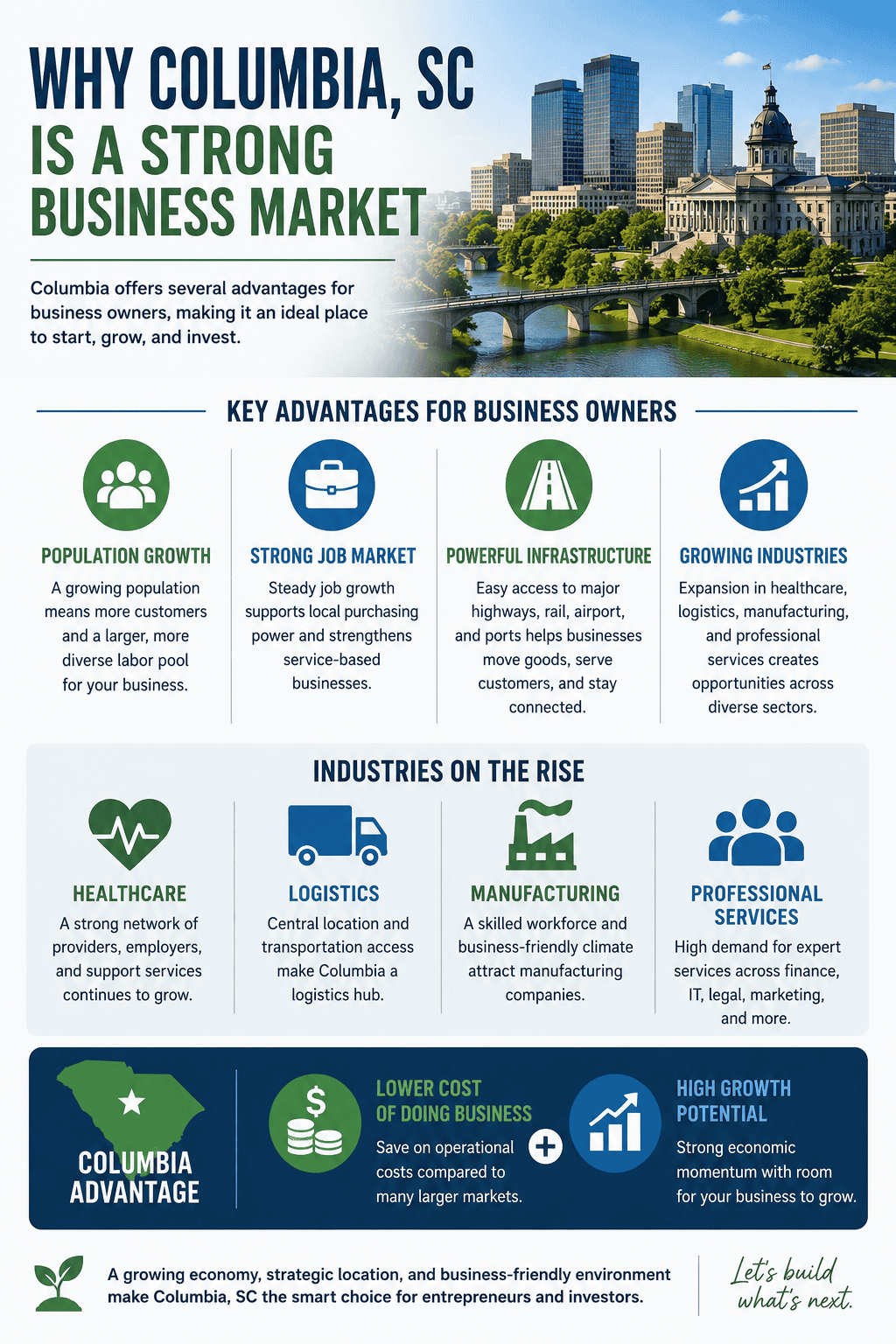
Columbia offers several advantages for business owners. Population growth can increase customer demand and expand the local labor pool. A steady job market helps support service-based businesses, while strong infrastructure makes it easier for companies to move goods, serve customers, and stay connected.
The city is also seeing growth across industries like healthcare, logistics, manufacturing, and professional services. That creates opportunities for both new businesses and established companies looking to expand into specialized niches.
Compared to many larger markets, Columbia also offers a lower cost of doing business while still providing room for growth. For many entrepreneurs, that combination makes it an attractive place to start, expand, or invest.
Local Resources for Business Owners
Business owners in Columbia have access to several helpful resources. The Columbia Chamber can be a great place for networking, advocacy, and local business connections. The South Carolina Department of Commerce supports economic development and may be useful for larger expansion projects. Local SBA offices can also help small business owners with mentorship, loan guidance, and access to financing programs.
Common Questions from Local Entrepreneurs
Is Columbia a good place to start a business?
Yes. Its central location, growing economy, and lower operating costs make it a strong option for entrepreneurs.
What industries are growing fastest?
Healthcare, logistics, construction, professional services, and manufacturing are all creating new opportunities in the area.
What business opportunities are underserved?
There may be room for more niche retail businesses, specialized manufacturing services, and local service providers that meet specific community needs.
How much capital does it take to start?
That depends on your industry, business model, and growth goals. The key is having access to flexible capital that fits your needs.
What challenges do entrepreneurs face?
Many business owners struggle with traditional bank requirements, long approval timelines, and finding funding quickly enough to act on growth opportunities.
Why Columbia, SC Is a Strong Business Market
| Growth Factor | Business Impact |
|---|---|
| Population Growth | Increases consumer demand and labor pool availability. |
| Job Market | Drives stability and supports local service-based industries. |
| Infrastructure | Enhances logistics, transportation, and accessibility for retail. |
| Industry Growth | Creates specialized niches for manufacturing and professional services. |
| Business Climate | Fosters innovation and encourages long-term capital investment. |
Compared to national trends, Columbia offers a lower cost of doing business while maintaining high growth potential, making it an ideal environment for both startups and established firms.
Local Resources for Business Owners
| Resource | Purpose | Best For |
|---|---|---|
| Columbia Chamber | Networking and advocacy | All business sizes |
| SC Department of Commerce | Economic development grants | Large-scale expansions |
| Local SBA Offices | Mentorship and loan guarantees | Small business startups |
Best Business Opportunities in Columbia, SC
| Opportunity | Demand | Competition | Startup Cost |
|---|---|---|---|
| Commercial Real Estate | High | Moderate | High |
| Healthcare Services | Very High | High | Moderate |
| Logistics/Distribution | High | Moderate | High |
| Professional Services | Moderate | High | Low |
If you’re looking to start or expand a business in Columbia, several industries stand out because of their strong growth potential.
Commercial Real Estate continues to be a solid investment, driven by population growth and ongoing commercial development. While it typically requires a larger upfront investment, the long-term opportunities can be significant.
Healthcare Services remain one of the fastest-growing sectors in the region. An aging population and continued demand for medical and wellness services make this an attractive market, although competition can be high.
Logistics and Distribution are thriving thanks to Columbia’s central location and access to major highways. Businesses that support transportation, warehousing, and supply chain operations are well-positioned for growth.
Professional Services—such as accounting, consulting, marketing, IT, and legal services—offer a relatively low-cost entry point for entrepreneurs. While competition exists, there’s always demand for businesses that provide specialized expertise and exceptional customer service.
Funding Challenges for Local Entrepreneurs
One of the biggest obstacles many business owners face isn’t finding a great opportunity—it’s securing the financing to act on it.
Traditional banks often have strict lending requirements, including higher credit score expectations, years of financial documentation, and lengthy underwriting processes. Even qualified borrowers can wait weeks or months for a decision.
That delay can become a real problem when you’re trying to purchase a business, invest in commercial property, or take advantage of a time-sensitive opportunity. By the time a traditional loan is approved, the opportunity may already be gone.
That’s why many entrepreneurs are exploring alternative financing options that offer greater flexibility and faster access to capital, allowing them to move when the right opportunity comes along.
Funding Challenges for Local Entrepreneurs
Many business owners in Columbia find that traditional bank financing comes with rigid requirements. Common hurdles include strict credit score thresholds, extensive documentation requests, and slow approval timelines that can cause you to miss out on time-sensitive business acquisition opportunities.
Private Money vs. Bank Financing
| Factor | Bank Financing | Private Money |
|---|---|---|
| Approval Speed | Slow | Fast |
| Flexibility | Low | High |
| Documentation | Extensive | Streamlined |
| Credit Requirements | Strict | Asset-Based |
| Funding Uses | Limited | Versatile |
When it’s time to fund your next business opportunity, you have more than one option. While traditional bank loans work well for some businesses, they’re not always the best fit—especially if you need funding quickly or your situation doesn’t fit the bank’s lending guidelines.
Traditional bank financing typically offers competitive interest rates, but the process can be slow. Banks often require extensive financial documentation, strong credit, and a lengthy approval process before funds are released. They may also limit how the money can be used.
Private money financing, on the other hand, is designed to be more flexible. Approval is often much faster, documentation requirements are generally simpler, and lenders may focus more on the value of the asset or opportunity than your credit score alone. That makes private funding a popular option for entrepreneurs purchasing businesses, investing in commercial real estate, or moving quickly on time-sensitive deals.
Real-World Financing Scenarios
Every business has different funding needs, but these are some of the most common situations where flexible financing can make a big difference.
Buying an Existing Business
When the right business comes on the market, timing is everything. Waiting weeks—or even months—for a traditional bank loan can mean losing the opportunity. Fast access to capital can help you move quickly and confidently when the right acquisition comes along.
Purchasing Commercial Property
Whether you’re buying your first office, expanding to a larger facility, or investing in commercial real estate, being able to close quickly can give you a competitive edge. Private financing can help you secure a great property before another buyer steps in.
Covering Working Capital
Growth often requires cash before it generates revenue. Whether you’re hiring employees, purchasing inventory, investing in equipment, or managing seasonal fluctuations, working capital can help keep your business moving without disrupting day-to-day operations.
Expert Insight: What Many Entrepreneurs Overlook
When most people start a business, they spend a lot of time thinking about how they’re going to succeed—finding customers, building a great product, hiring the right team, and creating a solid marketing strategy. Those are all important, but there’s another piece of the puzzle that often gets overlooked: having access to capital when you need it most.
The reality is that business opportunities don’t wait for financing. A great commercial property may only be available for a few days. A competitor might decide to sell their business. A major client could place an order that requires you to purchase inventory or hire staff before you get paid.
In each of these situations, the question isn’t just “Can I get funding?” It’s “Can I get funding fast enough to take advantage of this opportunity?”
That’s especially true in a growing market like Columbia, SC. As more businesses and investors move into the area, competition increases. Entrepreneurs who can make decisions and act quickly often have an advantage over those waiting weeks or months for traditional financing.
It’s also important to understand that your funding needs will change as your business grows. The type of financing that works when you’re launching your business may not be the best option when you’re expanding, purchasing commercial real estate, or acquiring another company. Successful business owners think about financing as part of a long-term growth strategy—not just something they look for when cash is tight.
Planning ahead can make all the difference. Building relationships with lenders, understanding your financing options, and knowing how you’ll access capital before you actually need it puts you in a much stronger position when opportunities arise.
The businesses that grow the fastest aren’t always the ones with the biggest budgets—they’re often the ones that are prepared to act when the right opportunity comes along.
Should You Explore Private Money?
Private money can be a smart option when timing and flexibility matter. Traditional bank financing may work well in some situations, but it is not always the best fit when you need to move quickly or when your deal does not fit neatly inside a bank’s lending requirements.
You may want to explore private money if you are trying to purchase commercial property, buy an existing business, fund a renovation, cover working capital, or secure financing for a time-sensitive opportunity. In many cases, private lenders can look at the overall value of the deal, the asset involved, and your exit strategy instead of focusing only on credit scores, tax returns, or years of financial history.
This can be especially helpful for entrepreneurs who are growing fast, investing in real estate, or working through a short-term funding gap. Private money gives you the ability to act when the right opportunity appears instead of waiting weeks or months for a traditional approval.
That said, private money is not one-size-fits-all. It is important to understand the terms, repayment timeline, fees, and how the funding fits into your larger business plan. The best financing choice is the one that supports your goals without putting unnecessary pressure on your cash flow.
As your business grows, visibility matters too. Funding can help you take the next step, but your website, SEO, and online presence help customers find you once you get there. Keeping your website updated, easy to navigate, and optimized for search can make a big difference in how well your business attracts leads and builds trust.
If you are exploring growth opportunities in Columbia, private money may give you the speed and flexibility you need to move forward with confidence.
FAQ
- Is Columbia a good place to start a business? Yes, it is a growing hub with strong economic drivers.
- What industries are growing in Columbia? Healthcare, logistics, and construction.
- How much does it cost to start a business? It depends on the sector, but capital access is key.
- What are the best funding options? Banks, SBA loans, and private money.
- How does private money lending work? It is typically asset-based and faster than traditional loans.
- Is Columbia business-friendly? Yes, with many local resources available.
- Can I get funding with bad credit? Private money focuses more on asset value than credit scores.
- How fast is private money? Often within days, compared to months for banks.
- What is the first step to funding? Assessing your specific capital needs.
- Where can I find local help? Start with the Columbia Chamber of Commerce.
Conclusion
Columbia is an exciting place to grow a business, and the right financing can help turn your next big opportunity into reality. Whether you’re expanding your operations, purchasing commercial property, or investing in new equipment, understanding your funding options can make the process much smoother.
If you’re ready to explore what’s possible, start with our free funding assessment. It’s a quick, no-obligation way to see which financing solutions may be the best fit for your business.
Take the free funding assessment today: Take Funding Quiz Today!