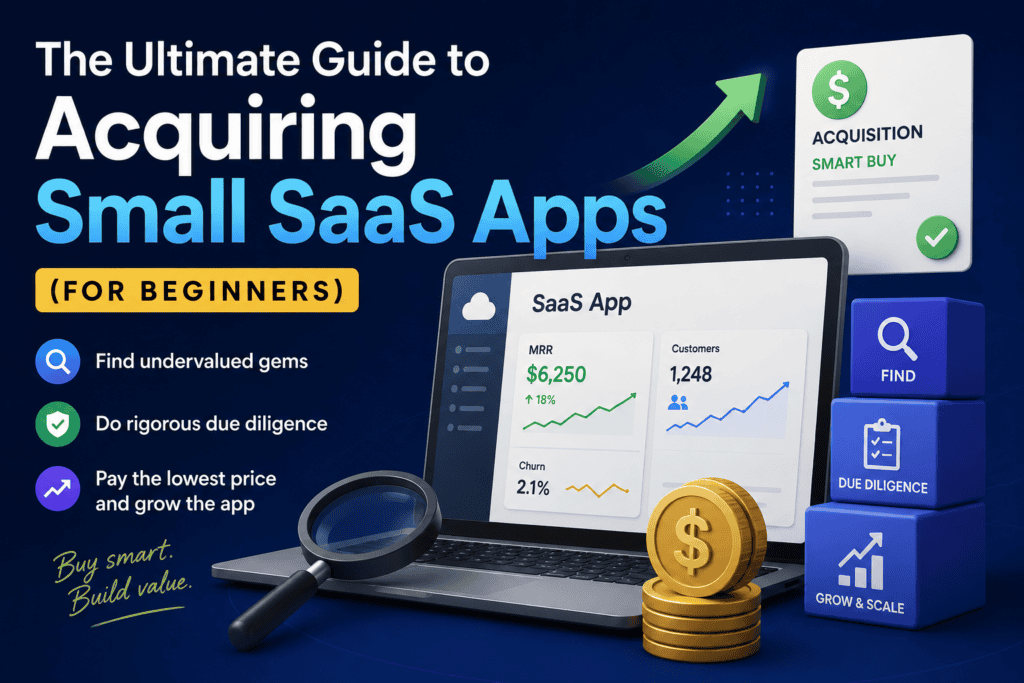





Acquiring a small Software-as-a-Service (SaaS) app can be one of the most direct paths to generating online revenue. Instead of starting from zero, you buy an existing asset with customers, revenue, and a proven market. This guide is for aspiring entrepreneurs, indie hackers, and investors who want to learn how to buy their first small SaaS app. We’ll show you how to find undervalued gems, perform rigorous due diligence, and ultimately pay the lowest price and grow the app into a more valuable asset while acquiring small saas app.
This isn’t a get-rich-quick scheme. The process requires patience, diligence, and a strategic mindset. Expect the journey from searching to closing your first deal to take up to 12 months, with an initial investment starting around $10,000 for smaller micro-SaaS products, though this can vary widely.
Deciding between buying vs building a business is a critical first step, and this guide will equip you with the knowledge to succeed on the acquisition path.
What You’ll Learn
- How to define your ideal acquisition target.
- Where to find profitable SaaS apps for sale.
- A step-by-step framework for due diligence to avoid bad investments.
- Methods for valuing a small SaaS and making a compelling offer.
- The process of closing a deal and ensuring a smooth transition.
- Strategies for growing your newly acquired app.
BEFORE YOU START
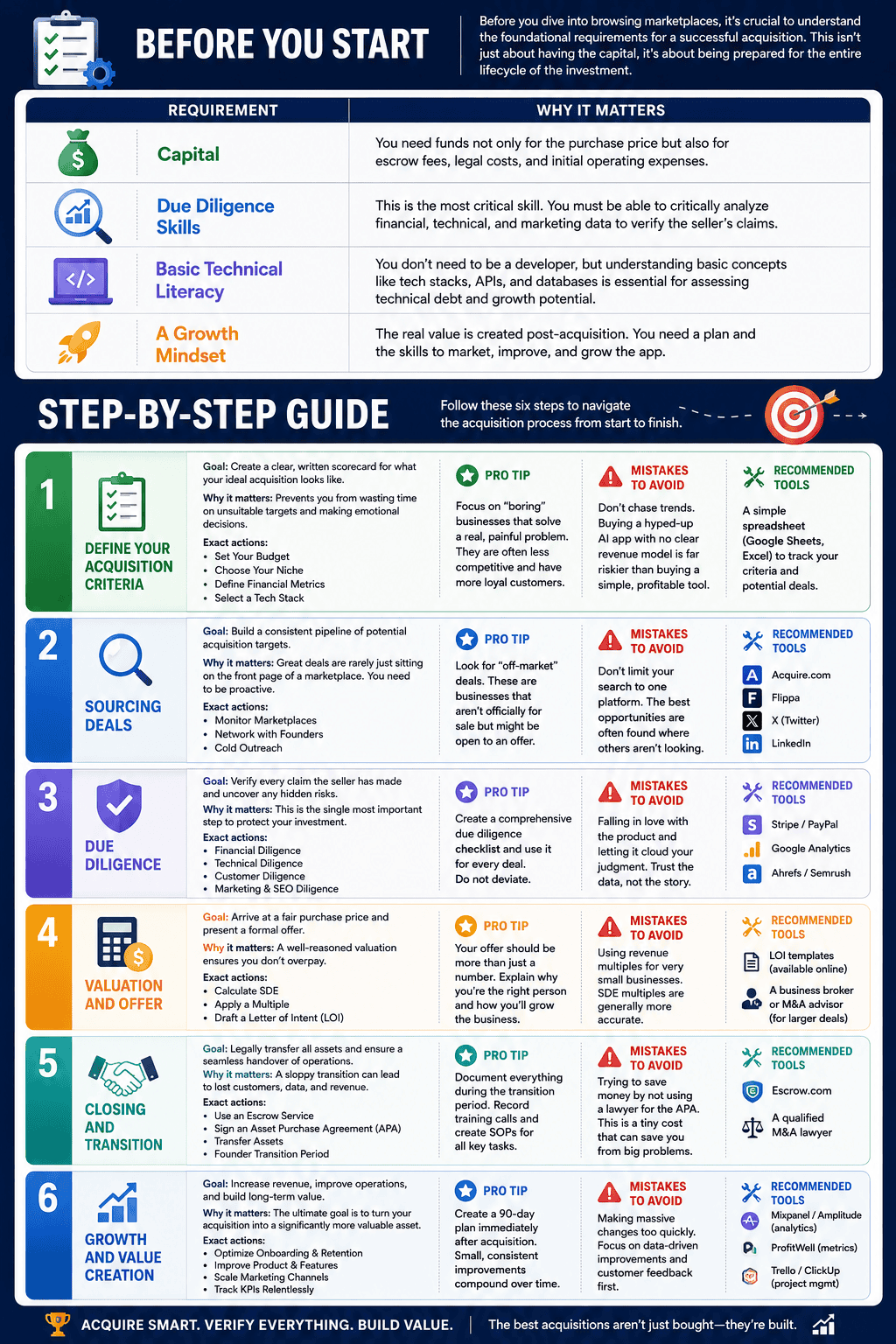
Before you dive into browsing marketplaces, it’s crucial to understand the foundational requirements for a successful acquisition. This isn’t just about having the capital; it’s about being prepared for the entire lifecycle of the investment.
| Requirement | Why It Matters |
|---|---|
| Capital | You need funds not only for the purchase price but also for escrow fees, legal costs, and initial operating expenses. |
| Due Diligence Skills | This is the most critical skill. You must be able to critically analyze financial, technical, and marketing data to verify the seller’s claims. |
| Basic Technical Literacy | You don’t need to be a developer, but understanding basic concepts like tech stacks, APIs, and databases is essential for assessing technical debt and growth potential. |
| A Growth Mindset | The real value is created post-acquisition. You need a plan and the skills to market, improve, and grow the app. |
STEP-BY-STEP GUIDE
Follow these six steps to navigate the acquisition process from start to finish.
Step 1: Define Your Acquisition Criteria
- Goal: To create a clear, written scorecard for what your ideal acquisition looks like.
- Why it matters: A defined set of criteria prevents you from wasting time on unsuitable targets and making emotional decisions.
- Exact actions:
- Set Your Budget: Determine your maximum purchase price, including a buffer for post-acquisition costs.
- Choose Your Niche: Focus on industries you understand. Your domain expertise is a competitive advantage. If you’re unsure, exploring niche site ideas can spark inspiration.
- Define Financial Metrics: Specify your target range for Monthly Recurring Revenue (MRR), Annual Recurring Revenue (ARR), or Seller’s Discretionary Earnings (SDE).
- Select a Tech Stack: Decide which technologies you’re comfortable managing (e.g., React/Node.js, PHP/Laravel, Bubble.io).
- Example: “I am looking for a B2B SaaS app with $1,000 – $3,000 MRR, a 3-5x SDE multiple valuation, built on a modern JavaScript framework, serving the e-commerce marketing niche.”
Pro Tip
Focus on “boring” businesses that solve a real, painful problem. They are often less competitive and have more loyal customers.
Mistakes to Avoid
Understanding the Process of Acquiring Small SaaS Apps
Don’t chase trends. Buying a hyped-up AI app with no clear revenue model is far riskier than buying a simple, profitable scheduling tool.
Recommended Tools
- A simple spreadsheet (Google Sheets, Excel) to track your criteria and potential deals.
Step 2: Sourcing Deals
- Goal: To build a consistent pipeline of potential acquisition targets.
- Why it matters: Great deals are rarely just sitting on the front page of a marketplace. You need to be proactive.
- Exact actions:
- Monitor Marketplaces: Regularly check sites like Acquire.com and Flippa.
- Network: Engage with founders on platforms like X (formerly Twitter), Indie Hackers, and LinkedIn. Many deals happen through private conversations.
- Cold Outreach: If you identify a great app that isn’t publicly listed, a polite and professional email to the founder can sometimes open a door.
- Example: Setting up saved searches on Acquire.com for your specific criteria and spending 30 minutes a day engaging with founders in your target niche on social media.
Pro Tip
Look for “off-market” deals. These are businesses that aren’t officially for sale but might be open to an offer. They often have less competition and better pricing.
Mistakes to Avoid
Don’t limit your search to one platform. The best opportunities are often found where others aren’t looking.
Recommended Tools
- Acquire.com
- Flippa
- X (Twitter)
Step 3: Due Diligence
- Goal: To verify every claim the seller has made and uncover any hidden risks.
- Why it matters: This is the single most important step to protect your investment. Skipping or rushing due diligence is the #1 cause of failed acquisitions.
- Exact actions:
- Financial Diligence: Get read-only access to payment processors (Stripe, PayPal) to verify revenue. Scrutinize expenses and profit margins.
- Technical Diligence: Review the codebase for quality, scalability, and technical debt. If you’re not technical, hire a freelance developer for a code audit.
- Customer Diligence: Analyze customer churn, Lifetime Value (LTV), and support ticket volume. Ask to speak with a few customers if possible.
- Marketing & SEO Diligence: Review Google Analytics to verify traffic sources. Check backlink profiles using tools like Ahrefs. Is the traffic sustainable?
- Example: During financial diligence, you notice a sudden spike in revenue. You investigate and find it was due to a one-time lifetime deal offer, not sustainable recurring revenue. This insight drastically changes your valuation.
Pro Tip
Create a comprehensive due diligence checklist and use it for every deal. Do not deviate. When assessing the market, ask yourself key questions like those posed when seeking startup business loans with no revenue: Is the market large enough? Are people already paying for this solution?
Mistakes to Avoid
Falling in love with the product and letting it cloud your judgment. Trust the data, not the story.
Recommended Tools
- Stripe/PayPal (for revenue verification)
- Google Analytics
- Ahrefs or Semrush
Step 4: Valuation and Offer
- Goal: To arrive at a fair purchase price and present a formal offer.
- Why it matters: A well-reasoned valuation forms the basis of a successful negotiation and ensures you don’t overpay.
- Exact actions:
- Calculate SDE: Start with the net profit and add back the owner’s salary and any personal expenses run through the business.
- Apply a Multiple: For small SaaS (<$1M valuation), multiples typically range from 3x to 5x SDE. The exact multiple depends on growth rate, age, and business quality.
- Draft a Letter of Intent (LOI): This non-binding document outlines the proposed price, terms, and conditions of the sale.
- Example: A SaaS has a net profit of $40,000. The owner pays himself a $30,000 salary. The SDE is $70,000. A 4x multiple would lead to a valuation of $280,000.
Pro Tip
Your offer should be more than just a number. Explain why you’re the right person to buy the business and how you plan to continue its legacy.
Mistakes to Avoid
Using revenue multiples for very small businesses. SDE multiples are generally more accurate as they reflect the actual cash flow available to the new owner.
Recommended Tools
- LOI templates (available online)
- A business broker or M&A advisor for larger deals.
Step 5: Closing and Transition
- Goal: To legally transfer all assets and ensure a seamless handover of operations.
- Why it matters: A sloppy transition can lead to lost customers, data, and revenue.
- Exact actions:
- Use an Escrow Service: Use a trusted third party like Escrow.com to hold the funds until all assets are transferred.
- Sign an Asset Purchase Agreement (APA): This is the legally binding contract that details every aspect of the sale. Hire a lawyer to draft or review it.
- Transfer Assets: Systematically transfer the domain, codebase, social media accounts, customer list, and any other relevant assets. This includes understanding how to host a website and migrating the application if necessary.
- Founder Transition Period: Agree on a period (e.g., 30-90 days) where the founder will provide support and training.
- Example: Creating a shared checklist in Google Docs that both buyer and seller tick off as each asset (domain, GitHub repo, Mailchimp account, etc.) is successfully transferred.
Pro Tip
Document everything during the transition period. Record training calls with the founder and create standard operating procedures (SOPs) for all key tasks.
Mistakes to Avoid
Trying to save money by not using a lawyer for the APA. This is a tiny cost that can save you from catastrophic legal issues later.
Recommended Tools
- Escrow.com
- A qualified M&A lawyer
VISUAL ROADMAP
Here’s a simplified timeline for your acquisition journey.
| Phase | Goal | Time Required |
|---|---|---|
| 1. Preparation & Sourcing | Define criteria, find potential deals | 1-3 Months |
| 2. Vetting & Due Diligence | Analyze top 1-3 candidates | 1-2 Months |
| 3. Negotiation & Closing | Make offer, sign APA, transfer assets | 1-2 Months |
| 4. Post-Acquisition Growth | Implement your 90-day growth plan | 3-6 Months |
TOOLS & RESOURCES
| Tool | Purpose | Best For | Cost |
|---|---|---|---|
| Acquire.com | Marketplace for buying/selling SaaS | High-quality, curated SaaS deals | Free to browse, premium features available |
| Flippa | General marketplace for online businesses | Finding smaller micro-SaaS and starter projects | Free to browse, success fees apply |
| Escrow.com | Secure payment and asset transfer | Protecting both buyer and seller during closing | Percentage-based fee (1-3%) |
| Ahrefs | SEO and marketing analysis | Due diligence on traffic and backlinks | Starts at $99/month |
| Google Analytics | Website traffic analysis | Verifying traffic claims for free | Free |
COMMON MISTAKES
Mistakes Most Beginners Make
Many first-time buyers make predictable and costly errors. Here’s how to avoid them.
| Mistake | Consequence | Better Approach |
|---|---|---|
| Skipping Due Diligence | Buying a business with fatal flaws (e.g., fake revenue, critical bugs, pending lawsuits). | Create a non-negotiable due diligence checklist and follow it religiously for every single deal. |
| No Post-Acquisition Plan | Growth stagnates or declines as you struggle to figure out what to do after the sale. | Before you even make an offer, draft a detailed 90-day plan outlining your immediate growth levers. |
| Overpaying Based on Emotion | You pay a premium for a “cool” product, destroying your potential ROI from day one. | Stick to a data-driven valuation based on SDE multiples and comparable sales. Be willing to walk away. |
| Underestimating Founder Dependency | The business collapses because all customer relationships and technical knowledge were in the founder’s head. | During due diligence, assess how much the business relies on the founder. Ensure a proper knowledge transfer is part of the deal. |
EXPERT INSIGHTS
What Most Guides Don’t Tell You
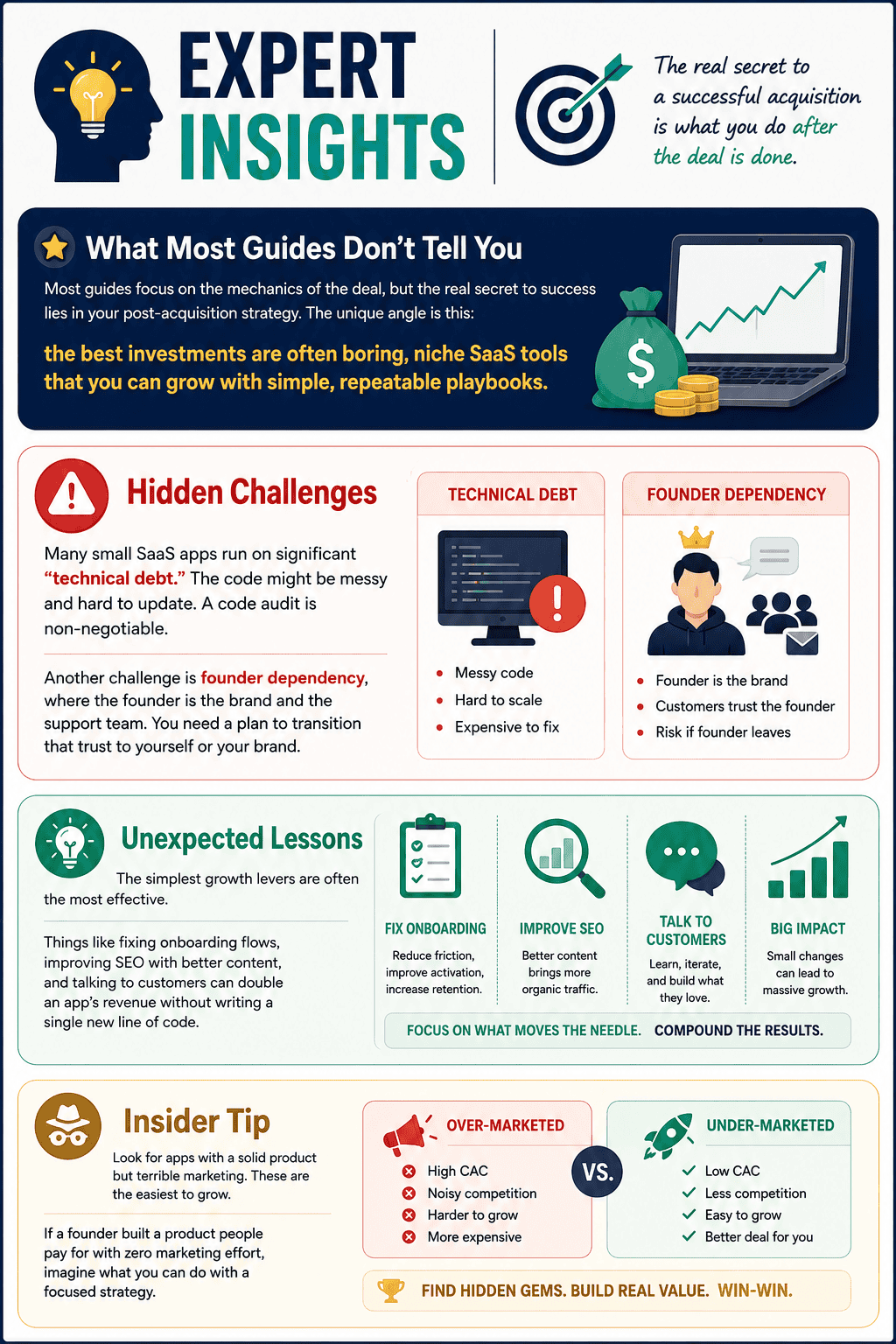
Most guides focus on the mechanics of the deal, but the real secret to success lies in your post-acquisition strategy. The unique angle is this: the best investments are often boring, niche SaaS tools that you can grow with simple, repeatable playbooks.
- Hidden Challenges: Many small SaaS apps run on significant “technical debt.” The code might be messy and hard to update. A code audit is non-negotiable. Another challenge is founder dependency, where the founder is the brand and the support team. You need a plan to transition that trust to yourself or your brand.
- Unexpected Lessons: The simplest growth levers are often the most effective. Things like fixing onboarding flows, improving SEO with better content, and talking to customers can double an app’s revenue without writing a single new line of code.
- Insider Tip: Look for apps with a solid product but terrible marketing. These are the easiest to grow. If a founder built a product people pay for with zero marketing effort, imagine what you can do with a focused strategy.
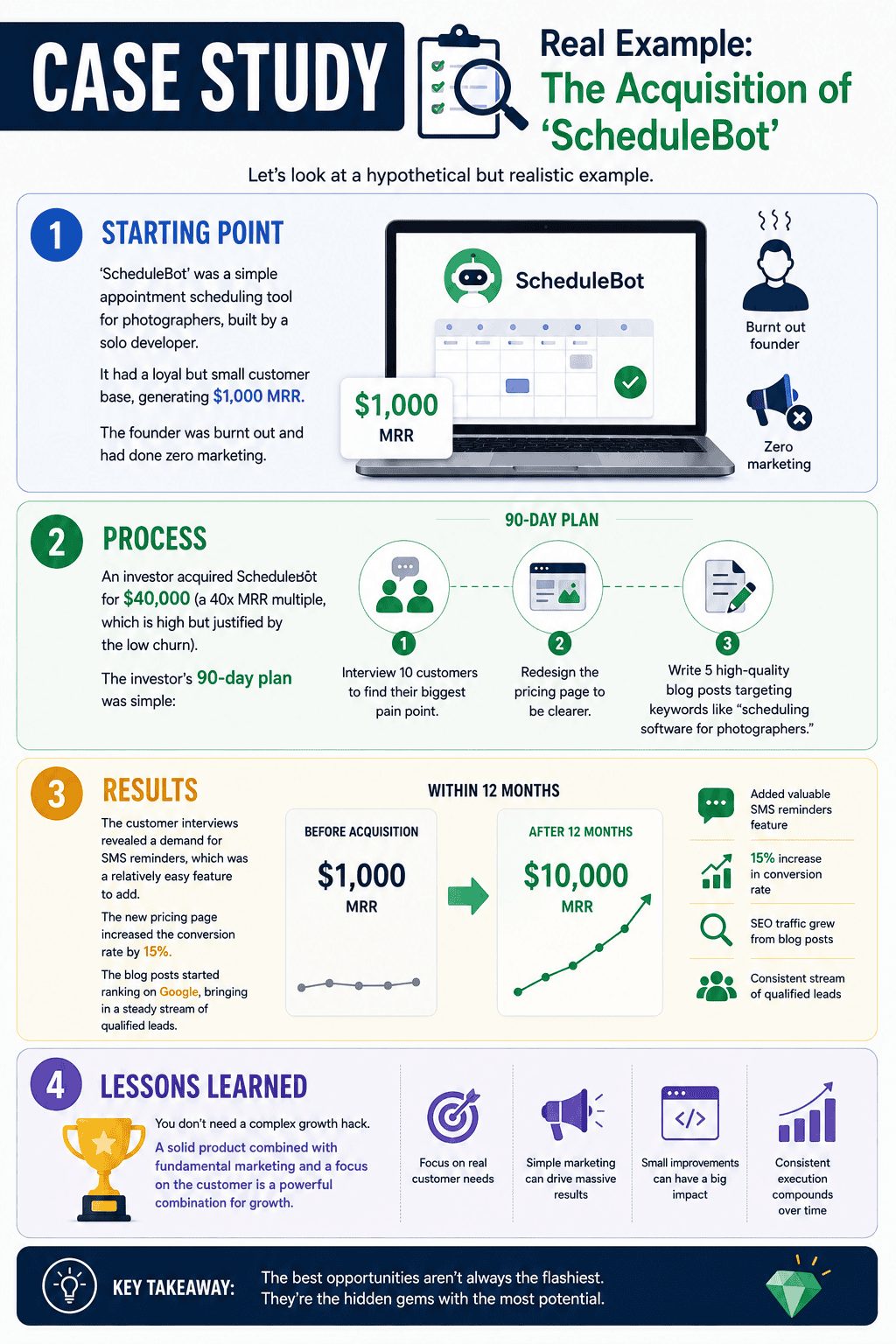
CASE STUDY
Real Example: The Acquisition of ‘ScheduleBot’
Let’s look at a hypothetical but realistic example.
- Starting Point: ‘ScheduleBot’ was a simple appointment scheduling tool for photographers, built by a solo developer. It had a loyal but small customer base, generating $1,000 MRR. The founder was burnt out and had done zero marketing.
- Process: An investor acquired ScheduleBot for $40,000 (a 40x MRR multiple, which is high but justified by the low churn). The investor’s 90-day plan was simple:
- Interview 10 customers to find their biggest pain point.
- Redesign the pricing page to be clearer.
- Write 5 high-quality blog posts targeting keywords like “scheduling software for photographers.”
- Results: The customer interviews revealed a demand for SMS reminders, which was a relatively easy feature to add. The new pricing page increased the conversion rate by 15%. The blog posts started ranking on Google, bringing in a steady stream of qualified leads. Within 12 months, ScheduleBot grew from $1,000 MRR to $10,000 MRR.
- Lessons Learned: You don’t need a complex growth hack. A solid product combined with fundamental marketing and a focus on the customer is a powerful combination for growth.
TROUBLESHOOTING
Common Problems & Solutions
Even with a perfect plan, you’ll face challenges. Here’s how to handle them.
| Problem | Cause | Solution |
|---|---|---|
| Post-Acquisition Growth Stalls | The initial “quick wins” have been implemented, and you’re unsure what to do next. | Go back to basics: talk to your customers. Launch a survey, do interviews, and build a roadmap based directly on their feedback. |
| MRR Dips After Transition | Some customers were loyal to the founder, not the product, and churned after the sale. | Proactively communicate the ownership change to all customers. Introduce yourself, share your vision, and offer excellent support to build new trust. |
| Founder is Unresponsive | The founder is not providing the support agreed upon in the transition plan. | This should be addressed in the APA with a clause tying final payment to the completion of the support period. Using escrow helps enforce this. |
SUCCESS FRAMEWORK
How To Get Results Faster
To accelerate your success, implement the “First 90-Day Growth Sprint.” This framework forces you to focus on high-impact activities immediately after taking over. The key is to build momentum.
□ Action 1: Talk to 10 Customers. Get on a call with your best customers and your most recent cancellations. Ask them what they love, what they hate, and what they wish the product could do.
□ Action 2: Fix 3 Quick-Win Bugs or UI Issues. Show existing customers that the product is under active, positive development. This builds immediate goodwill.
□ Action 3: Launch One New Marketing Channel. Don’t try to do everything. Pick one channel (e.g., content marketing, Google Ads, affiliate outreach) and focus on it. For content, consider using AI writing software to increase your output.
□ Action 4: Optimize the Pricing Page. Test a new headline, layout, or pricing structure. It’s one of the highest-leverage pages on your site.
□ Action 5: Create a 6-Month Content & Product Roadmap. Use what you learned from customer calls to plan your next moves. This turns your reactive bug-fixing into a proactive growth strategy.
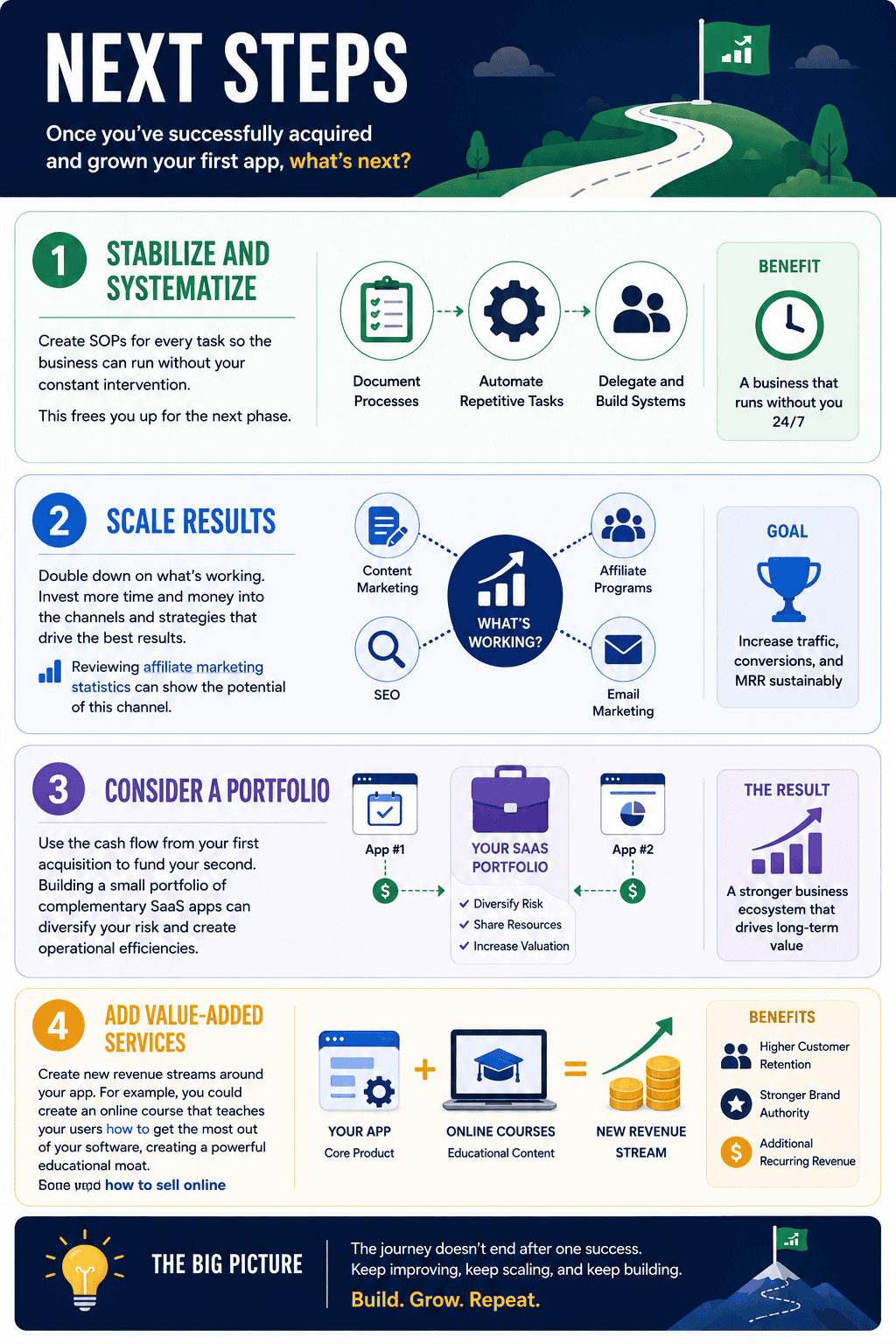
NEXT STEPS
Once you’ve successfully acquired and grown your first app, what’s next?
- Stabilize and Systematize: Create SOPs for every task so the business can run without your constant intervention. This frees you up for the next phase.
- Scale Results: Double down on what’s working. If content marketing is driving growth, hire a writer. If affiliates are working well, build out a formal program. Reviewing affiliate marketing statistics can show the potential of this channel.
- Consider a Portfolio: Use the cash flow from your first acquisition to fund your second. Building a small portfolio of complementary SaaS apps can diversify your risk and create operational efficiencies.
- Add Value-Added Services: You can create new revenue streams around your app. For example, you could learn how to sell online courses that teach your users how to get the most out of your software, creating a powerful educational moat.
FAQ
1. How much should I pay for a small SaaS app?
For small SaaS businesses, a typical valuation is 3-5 times the Seller’s Discretionary Earnings (SDE). Factors like growth rate, customer churn, and market position can push the multiple higher or lower.
2. Where is the best place to find SaaS businesses for sale?
Acquire.com is the leading curated marketplace for SaaS businesses. Flippa is a larger, more general marketplace where you can find smaller micro-SaaS projects. Networking on X (Twitter) and Indie Hackers is also effective.
3. What is SDE?
SDE stands for Seller’s Discretionary Earnings. It’s calculated by taking the net profit and adding back the owner’s salary, benefits, and any personal expenses run through the business. It represents the total financial benefit available to one new owner-operator.
4. Do I need to be a developer to buy a SaaS app?
No, but it helps. If you’re non-technical, you should have a budget to hire developers for maintenance and new features, and you must have a technical advisor help you during due diligence.
5. What is a good MRR for a small SaaS?
There’s no single answer. A “good” MRR depends on your budget and goals. Many first-time buyers target apps in the $500 – $5,000 MRR range, as they are more affordable and have proven product-market fit.
6. What is an Asset Purchase Agreement (APA)?
An APA is a legal contract that finalizes the sale. It details which assets are being transferred (code, domain, customer list, etc.), the price, and the obligations of both the buyer and seller. It is essential for a secure transaction.
7. How can I verify a seller’s revenue claims?
Always request read-only access to their payment processing accounts, like Stripe or PayPal. This allows you to see the raw, unfiltered revenue data directly from the source.
8. What is a good churn rate?
For a small B2B SaaS, a monthly customer churn rate below 5% is generally considered good. A churn rate over 10% can be a red flag that requires deep investigation.
9. What is a Letter of Intent (LOI)?
An LOI is a non-binding document that outlines the basic terms of a potential deal before you spend significant time and money on legal fees and deep due diligence. It signals serious intent from the buyer.
10. How long should the founder support period be?
A standard transition and support period is 30-90 days. This should be enough time for knowledge transfer on technical aspects, customer support, and daily operations.
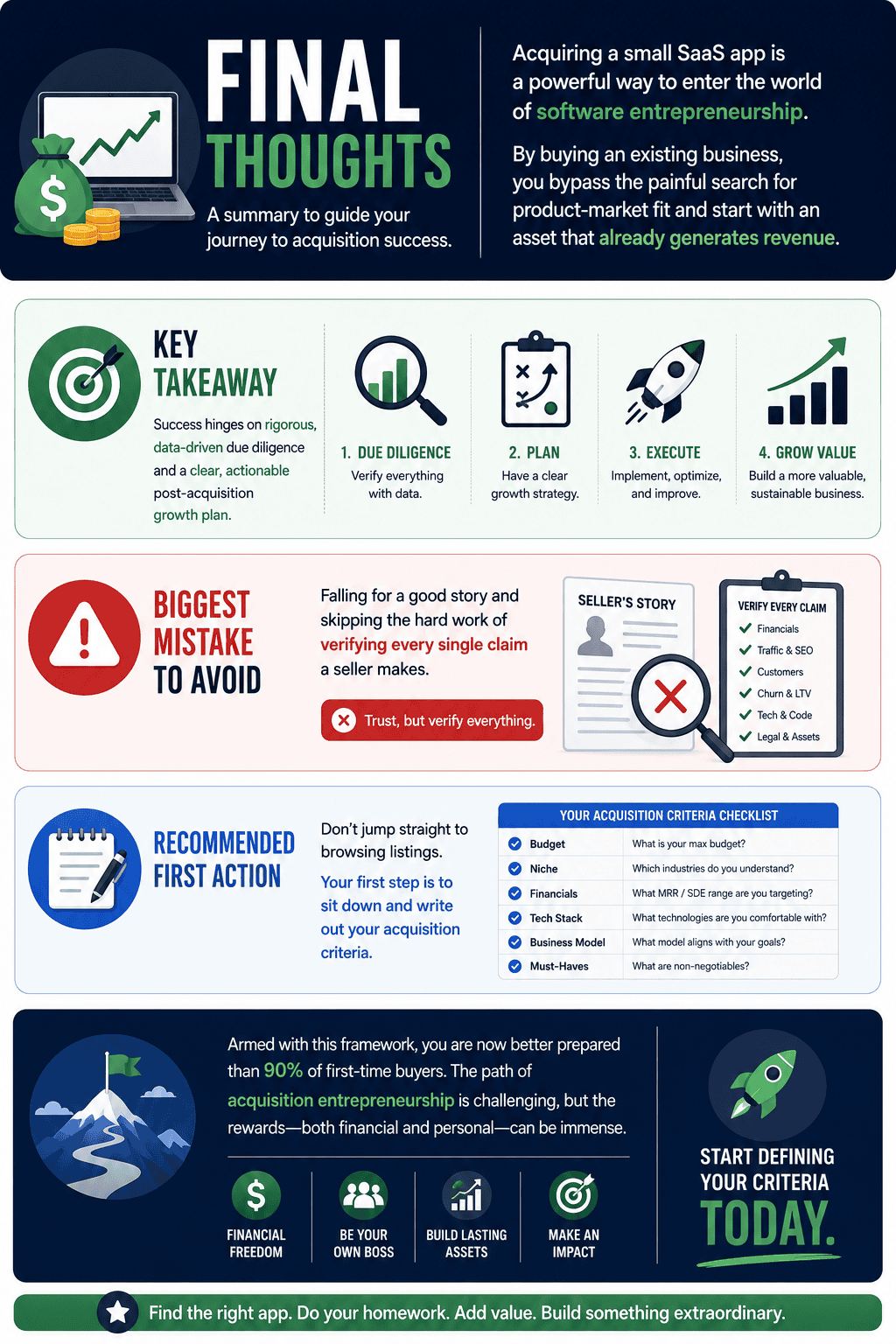
CONCLUSION
Acquiring a small SaaS app is a powerful way to enter the world of software entrepreneurship. By buying an existing business, you bypass the painful search for product-market fit and start with an asset that already generates revenue.
- Key Takeaway: Success hinges on rigorous, data-driven due diligence and a clear, actionable post-acquisition growth plan.
- Biggest Mistake to Avoid: Falling for a good story and skipping the hard work of verifying every single claim a seller makes. Trust, but verify everything.
- Recommended First Action: Don’t jump straight to browsing listings. Your first step is to sit down and write out your acquisition criteria. Know what you’re looking for before you start the hunt.
Armed with this framework, you are now better prepared than 90% of first-time buyers. The path of acquisition entrepreneurship is challenging, but the rewards—both financial and personal—can be immense. Start defining your criteria today.