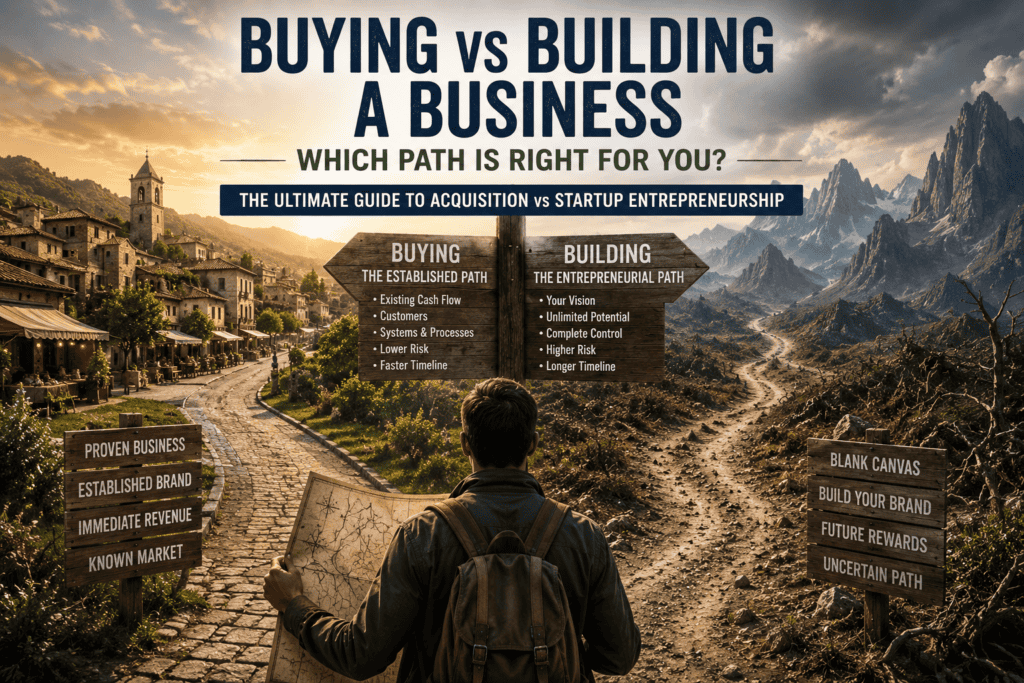




Deciding on your entrepreneurial path is one of the most significant choices you’ll ever make. Do you take the keys to an established business with existing cash flow, or do you build your vision from the ground up? This guide is designed to cut through the noise and provide a clear framework for making that decision between Buying vs Building.
This guide is for aspiring entrepreneurs, professionals considering a career shift, and small business owners weighing their next move. Our goal is to help you confidently choose between buying an existing business or starting one from scratch by understanding the trade-offs in risk, investment, timeline, growth potential, and long-term profitability.
Expect to spend a few weeks on research and self-assessment, with a potential budget ranging from a few hundred dollars for market research tools to significant capital if you pursue an acquisition. The timeline to revenue can be immediate when buying, versus months or years when building.
What You’ll Learn
- How to assess your personal risk tolerance and entrepreneurial style.
- A framework for analyzing market opportunities for both buying and building.
- How to model the financial requirements and potential returns for each path.
- The critical differences in timeline, effort, and growth potential.
- Actionable steps to take once you’ve made your decision.
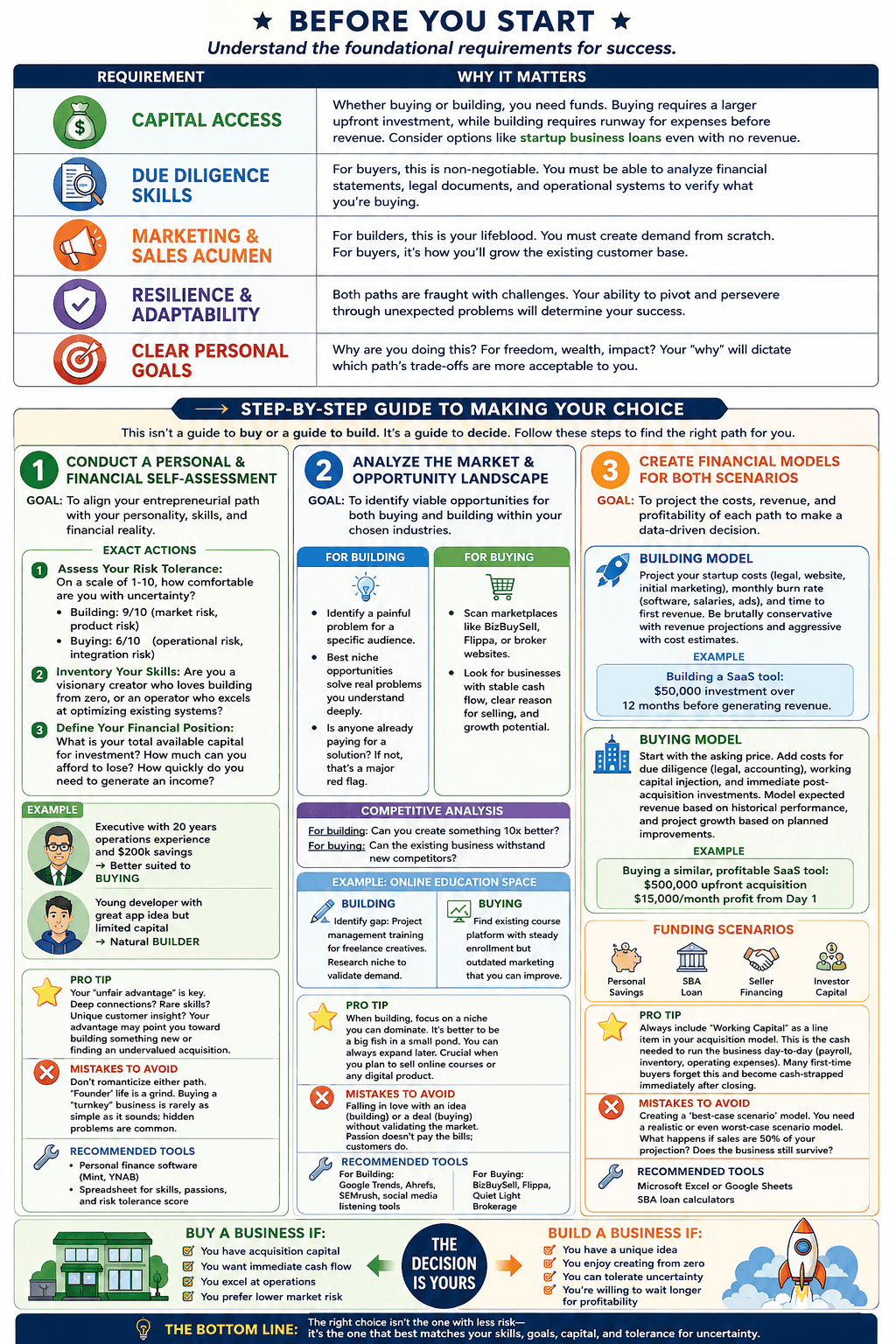
BEFORE YOU START
Before diving in, it’s crucial to understand the foundational requirements. This isn’t just about money; it’s about skills, mindset, and preparation.
| Requirement | Why It Matters |
|---|---|
| Capital Access | Whether buying or building, you need funds. Buying requires a larger upfront investment, while building requires runway for expenses before revenue. Consider options like startup business loans even with no revenue. |
| Due Diligence Skills | For buyers, this is non-negotiable. You must be able to analyze financial statements, legal documents, and operational systems to verify what you’re buying. |
| Marketing & Sales Acumen | For builders, this is your lifeblood. You must create demand from scratch. For buyers, it’s how you’ll grow the existing customer base. |
| Resilience & Adaptability | Both paths are fraught with challenges. Your ability to pivot and persevere through unexpected problems will determine your success. |
| Clear Personal Goals | Why are you doing this? For freedom, wealth, impact? Your ‘why’ will dictate which path’s trade-offs are more acceptable to you. |
STEP-BY-STEP GUIDE TO MAKING YOUR CHOICE
This isn’t a guide to buy or a guide to build. It’s a guide to decide. Follow these steps to find the right path for you.
Step 1: Conduct a Personal & Financial Self-Assessment
Goal: To align your entrepreneurial path with your personality, skills, and financial reality.
Why it matters: Choosing a path that conflicts with your core strengths or risk tolerance is a recipe for burnout and failure. The journey of Buying vs Building is profoundly different.
Exact actions:
- Assess Your Risk Tolerance: On a scale of 1-10, how comfortable are you with uncertainty? Building is a 9/10 (market risk, product risk), while buying is a 6/10 (operational risk, integration risk).
- Inventory Your Skills: Are you a visionary creator who loves building from zero, or an operator who excels at optimizing existing systems? Be honest.
- Define Your Financial Position: What is your total available capital for investment? How much can you afford to lose? How quickly do you need to generate an income?
Example: An executive with 20 years of operational experience and $200k in savings might be better suited to buying a business where they can apply their optimization skills immediately. A young developer with a groundbreaking app idea but limited capital is a natural builder.
Pro Tip
Your ‘unfair advantage’ is key. Do you have deep industry connections? A rare technical skill? A unique insight into a customer problem? Your advantage might point you toward building something new or identifying an undervalued acquisition.
Mistakes to Avoid
Don’t romanticize either path. ‘Founder’ status can seem glamorous, but it’s a grind. Buying a ‘turnkey’ business is rarely as simple as it sounds; hidden problems are common.
Recommended Tools
- Personal finance software (Mint, YNAB) to get a clear picture of your capital.
- A simple spreadsheet for listing your skills, passions, and risk tolerance score.
Step 2: Analyze the Market & Opportunity Landscape
Goal: To identify viable opportunities for both buying and building within your chosen industries.
Why it matters: Your success depends on the market, not just your execution. A great entrepreneur in a dying market will fail.
Exact actions:
- For Building: Identify a painful problem for a specific audience. The best niche site ideas come from solving a problem you understand deeply. Is anyone already paying for a solution? If not, that’s a major red flag.
- For Buying: Scan marketplaces like BizBuySell, Flippa, or broker websites for businesses in your target industry and price range. Look for businesses with stable cash flow, a clear reason for selling, and identifiable growth opportunities.
- Competitive Analysis: For both paths, analyze the competition. For building, can you create something 10x better? For buying, can the existing business withstand new competitors?
Example: You’re interested in the online education space. For building, you might identify a gap for teaching project management to freelance creatives. You’d research this niche to validate demand. For buying, you might find an existing course platform for sale that has steady enrollment but outdated marketing, which you know you can improve.
Pro Tip
When building, focus on a niche you can dominate. It’s better to be a big fish in a small pond. You can always expand later. This is crucial when you plan to sell online courses or any digital product.
Mistakes to Avoid
Falling in love with an idea (building) or a deal (buying) without validating the market. Passion doesn’t pay the bills; customers do.
Recommended Tools
- For Building: Google Trends, Ahrefs, SEMrush, social media listening tools.
- For Buying: BizBuySell, Flippa, Quiet Light Brokerage.
Step 3: Create Financial Models for Both Scenarios
Goal: To project the costs, revenue, and profitability of each path to make a data-driven decision.
Why it matters: This moves your decision from ‘gut feel’ to black-and-white numbers. It’s where you’ll see the true cost and potential return.
Exact actions:
- Building Model: Project your startup costs (legal, website, initial marketing), monthly burn rate (software, salaries, ads), and time to first revenue. Be brutally conservative with revenue projections and aggressive with cost estimates.
- Buying Model: Start with the asking price. Add costs for due diligence (legal, accounting), working capital injection, and immediate post-acquisition investments. Model your expected revenue based on historical performance, and project growth based on your planned improvements.
- Funding Scenarios: How will you fund this? Savings, SBA loan, seller financing? Model the debt service (loan payments) and its impact on your cash flow.
Example: Building a SaaS tool might cost $50k over 12 months before generating revenue. Buying a similar, profitable SaaS tool might cost $500k upfront but generate $15k/month in profit from day one.
Pro Tip
Always include ‘Working Capital’ as a line item in your acquisition model. This is the cash needed to run the business day-to-day (payroll, inventory). Many first-time buyers forget this and become cash-strapped immediately after closing.
Mistakes to Avoid
Creating a ‘best-case scenario’ model. You need a realistic or even worst-case scenario model. What happens if sales are 50% of your projection? Does the business still survive?
Recommended Tools
- Microsoft Excel or Google Sheets are all you need.
- SBA loan calculators.
VISUAL ROADMAP: BUYING VS. BUILDING
| Phase | Goal (Buying Path) | Time Required | Goal (Building Path) | Time Required |
|---|---|---|---|---|
| Phase 1: Foundation | Find & Vet a Business | 2-6 Months | Validate Idea & Niche | 1-3 Months |
| Phase 2: Transaction | Due Diligence & Closing | 2-4 Months | Build MVP & Get First Users | 3-9 Months |
| Phase 3: Operation | Stabilize & Operate | 3-6 Months | Find Product-Market Fit | 6-18 Months |
| Phase 4: Growth | Implement Growth Levers | Ongoing | Scale Marketing & Sales | Ongoing |
TOOLS & RESOURCES
| Tool | Purpose | Best For | Cost |
|---|---|---|---|
| BizBuySell | Marketplace for buying existing businesses. | Buyers | Free to browse |
| Ahrefs / SEMrush | SEO and market research. | Builders | $99+/month |
| Google Sheets | Financial modeling and projections. | Both | Free |
| SBA.gov | Information on government-backed business loans. | Both | Free |
| AI Writing Software | Content creation and marketing for a new brand. | Builders | Varies (e.g., AI writing tools) |
| Flippa | Marketplace for buying online businesses and websites. | Buyers | Free to browse |
COMMON MISTAKES
Mistakes Most Beginners Make
Many aspiring entrepreneurs stumble by making preventable errors. Here’s how to sidestep them.
| Mistake | Consequence | Better Approach |
|---|---|---|
| Underestimating Capital Needs | Running out of money mid-build or post-acquisition, leading to failure. | Create a conservative financial model with a 25-50% buffer for unexpected costs. |
| Ignoring Due Diligence (Buying) | Buying a business with hidden debts, legal issues, or declining sales. | Hire experienced legal and financial professionals to conduct thorough due diligence. Trust but verify everything. |
| Building a Solution Nobody Wants (Building) | Wasting months or years on a product that has no market demand. | Start with the customer problem, not the solution. Validate demand with pre-orders, sign-up pages, or surveys before writing a line of code. |
| Confusing Revenue with Profit | A business can have high revenue but be unprofitable and cash-flow negative. | Focus on Seller’s Discretionary Earnings (SDE) or EBITDA when buying, and unit economics when building. |
EXPERT INSIGHTS
What Most Guides Don’t Tell You
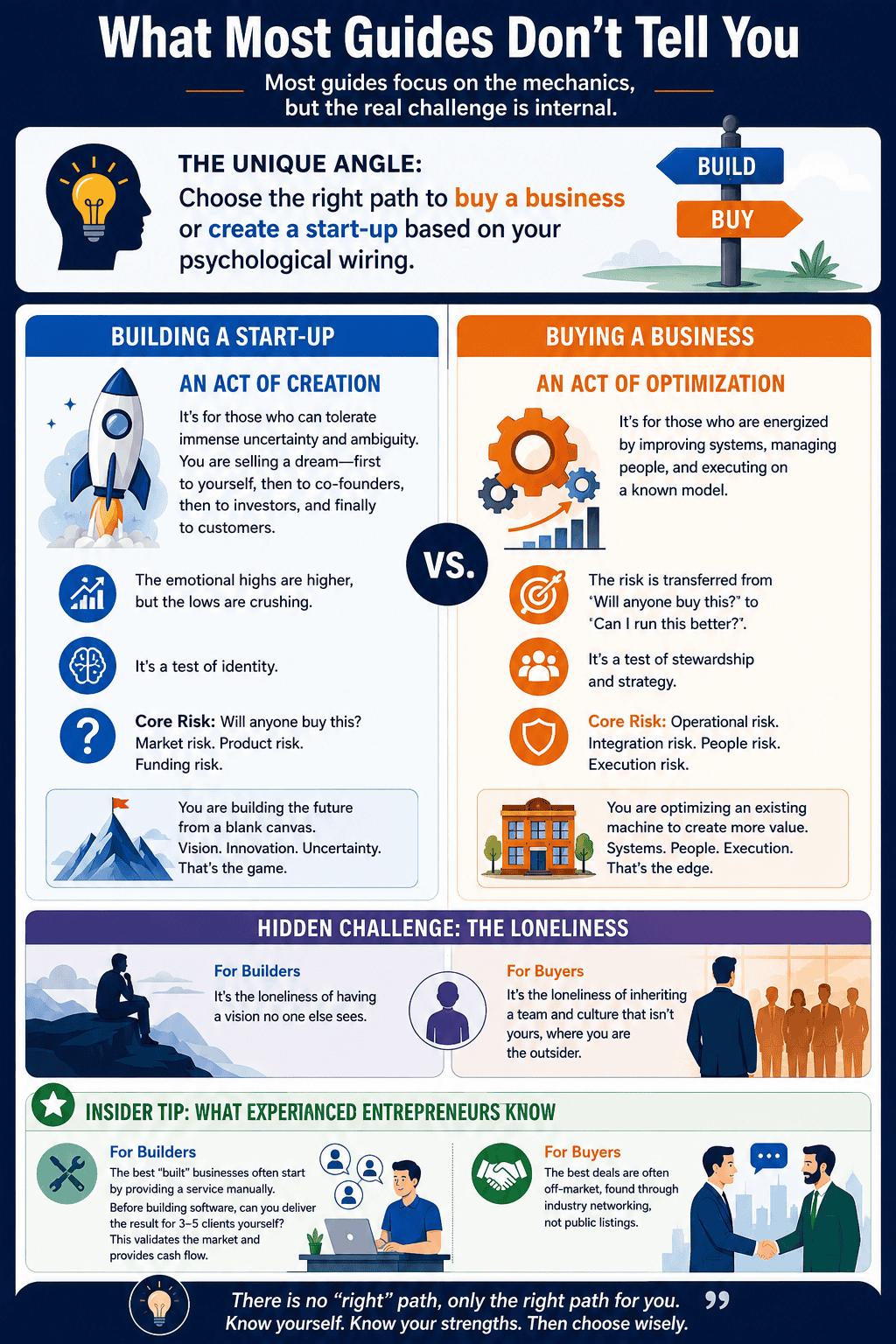
Most guides focus on the mechanics, but the real challenge is internal. The unique angle is to choose the right path to buy a business or create a start-up based on your psychological wiring.
- Building is an act of creation. It’s for those who can tolerate immense uncertainty and ambiguity. You are selling a dream—first to yourself, then to co-founders, then to investors, and finally to customers. The emotional highs are higher, but the lows are crushing. It’s a test of identity.
- Buying is an act of optimization. It’s for those who are energized by improving systems, managing people, and executing on a known model. The risk is transferred from ‘Will anyone buy this?’ to ‘Can I run this better?’. It’s a test of stewardship and strategy.
Hidden Challenge: The loneliness. For builders, it’s the loneliness of having a vision no one else sees. For buyers, it’s the loneliness of inheriting a team and culture that isn’t yours, where you are the outsider.
Insider Tip: The best ‘built’ businesses often start by providing a service manually. Before building software, can you deliver the result for 3-5 clients yourself? This validates the market and provides cash flow. For buyers, the best deals are often off-market, found through industry networking, not public listings.
CASE STUDY
Real Example: The Operator vs. The Creator
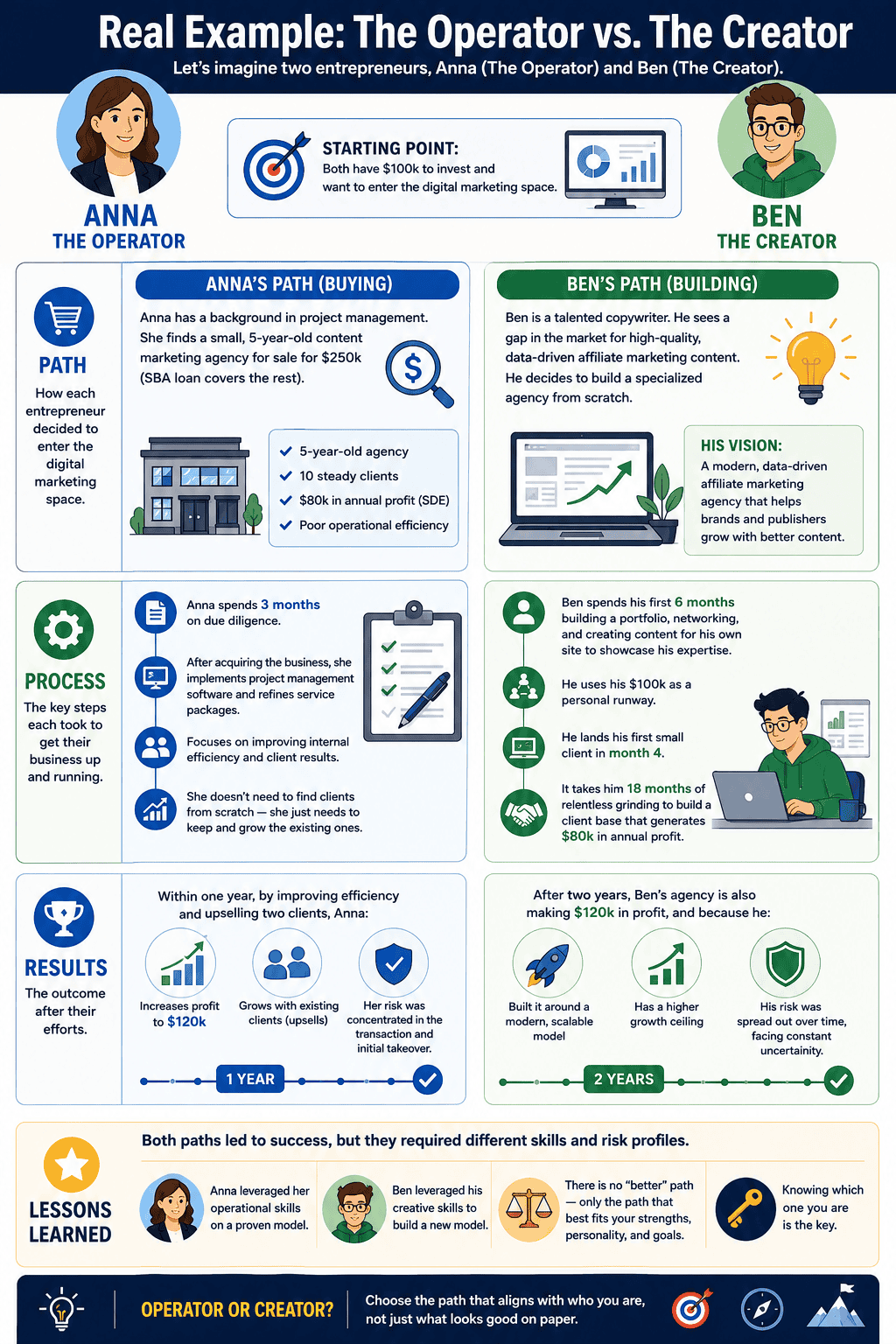
Let’s imagine two entrepreneurs, Anna (The Operator) and Ben (The Creator).
- Starting Point: Both have $100k to invest and want to enter the digital marketing space.
- Anna’s Path (Buying): Anna has a background in project management. She finds a small, 5-year-old content marketing agency for sale for $250k (SBA loan covers the rest). The agency has 10 steady clients and $80k in annual profit (SDE) but has poor operational efficiency.
- Process: Anna spends 3 months on due diligence. After acquiring the business, she implements project management software, refines service packages, and focuses on improving client results. She doesn’t need to find clients from scratch; she just needs to keep and grow the existing ones.
- Results: Within one year, by improving efficiency and upselling two clients, she increases the profit to $120k. Her risk was concentrated in the transaction and initial takeover.
- Ben’s Path (Building): Ben is a talented copywriter. He sees a gap in the market for high-quality, data-driven affiliate marketing content. He decides to build a specialized agency from scratch.
- Process: Ben spends his first 6 months building a portfolio, networking, and creating content for his own site to showcase his expertise. He uses his $100k as a personal runway. He lands his first small client in month 4. It takes him 18 months of relentless grinding to build a client base that generates $80k in annual profit.
- Results: After two years, Ben’s agency is also making $120k in profit, and because he built it around a modern, scalable model, it has a higher growth ceiling. His risk was spread out over time, facing constant uncertainty.
Lessons Learned: Both paths led to success, but they required different skills and risk profiles. Anna leveraged her operational skills on a proven model. Ben leveraged his creative skills to build a new model. Knowing which one you are is the key.
TROUBLESHOOTING
Common Problems & Solutions
| Problem | Cause | Solution |
|---|---|---|
| Analysis Paralysis | Overwhelmed by the number of variables and fear of making the wrong choice. | Time-box your research. Give yourself a deadline (e.g., 30 days) to make a decision. Use the step-by-step framework in this guide to force a conclusion. |
| Can’t Find a Good Business to Buy | The market is competitive, or your criteria are too narrow. | Broaden your industry criteria, consider smaller ‘tuck-in’ acquisitions, or engage a business broker who has access to off-market deals. |
| Struggling to Get First Customers (Building) | Your product is ready, but you have no traction. | Focus 80% of your time on distribution, not the product. Go to the communities where your customers live (online or offline) and solve their problems directly to build trust. |
| Post-Acquisition Culture Clash (Buying) | The existing team is resistant to your changes and new leadership. | Go slow. Spend the first 90 days listening and learning. Don’t change anything unless it’s a critical fire. Build trust with the team before implementing your grand vision. |
Here’s a blog-ready comparison section you can use.
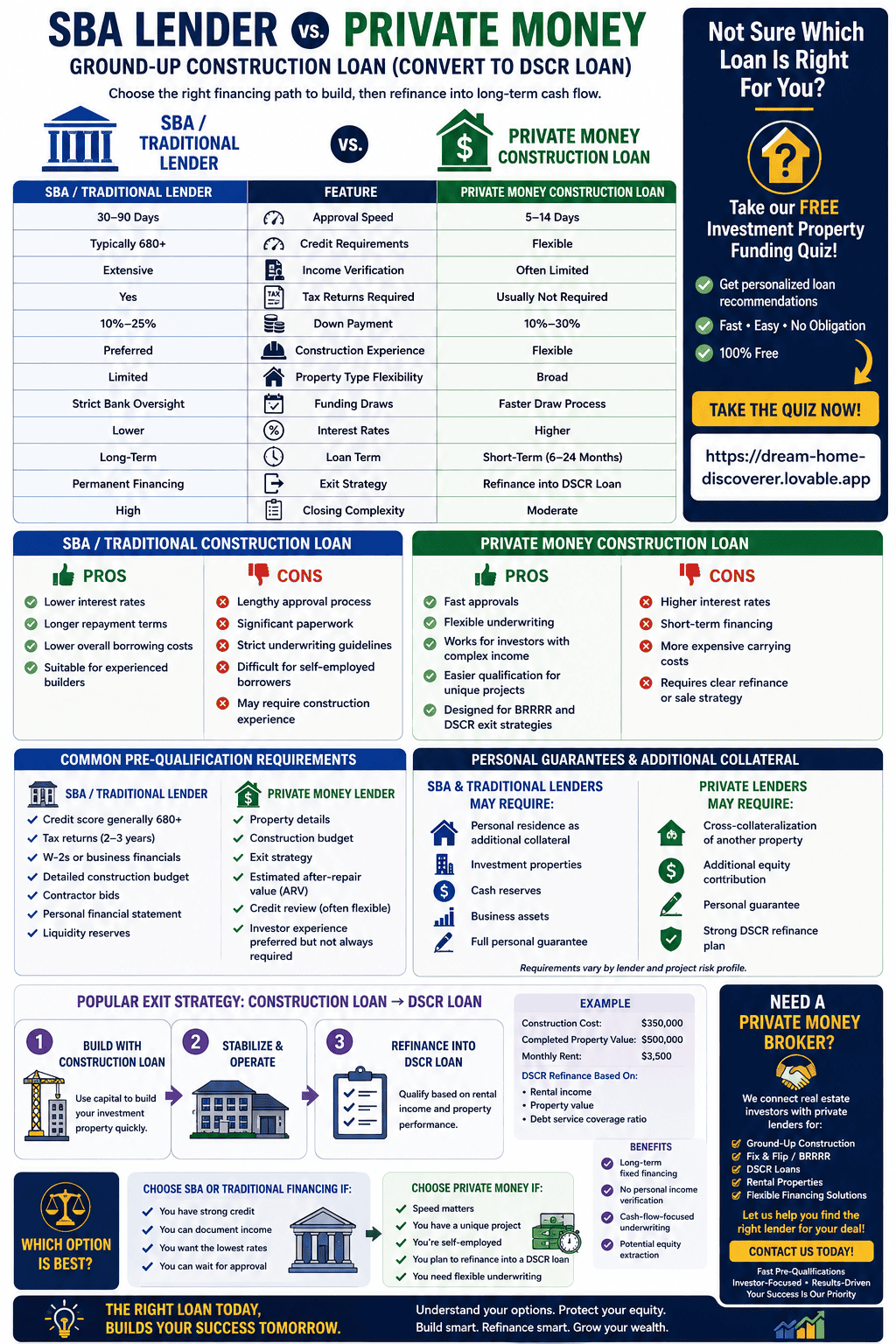
SBA Lender vs. Private Money Ground-Up Construction Loan (DSCR Exit Strategy)
If you’re building a new construction investment property, one of the biggest decisions you’ll make is how to finance the project. Most investors choose between a traditional SBA-backed lender, a bank construction loan, or a private money construction loan that can later be refinanced into a DSCR (Debt Service Coverage Ratio) loan once the property is complete and generating rental income.
Comparison Table
| Feature | SBA / Traditional Construction Loan | Private Money Construction Loan |
|---|---|---|
| Approval Speed | 30–90 Days | 5–14 Days |
| Credit Requirements | Typically 680+ | Flexible |
| Income Verification | Extensive | Often Limited |
| Tax Returns Required | Yes | Usually Not Required |
| Down Payment | 10%–25% | 10%–30% |
| Construction Experience Required | Preferred | Flexible |
| Property Type Flexibility | Limited | Broad |
| Funding Draws | Strict Bank Oversight | Faster Draw Process |
| Interest Rates | Lower | Higher |
| Loan Term | Long-Term | Short-Term (6–24 Months) |
| Exit Strategy | Permanent Financing | Refinance into DSCR Loan |
| Closing Complexity | High | Moderate |
Pros and Cons
SBA / Traditional Construction Loan
Pros
✅ Lower interest rates
✅ Longer repayment terms
✅ Lower overall borrowing costs
✅ Suitable for experienced builders
Cons
❌ Lengthy approval process
❌ Significant paperwork
❌ Strict underwriting guidelines
❌ Difficult for self-employed borrowers
❌ May require construction experience
Private Money Construction Loan
Pros
✅ Fast approvals
✅ Flexible underwriting
✅ Works for investors with complex income
✅ Easier qualification for unique projects
✅ Designed for BRRRR and DSCR exit strategies
Cons
❌ Higher interest rates
❌ Short-term financing
❌ More expensive carrying costs
❌ Requires clear refinance or sale strategy
Common Pre-Qualification Requirements
SBA / Traditional Lender
- Credit score generally 680+
- Tax returns (2–3 years)
- W-2s or business financials
- Detailed construction budget
- Contractor bids
- Personal financial statement
- Liquidity reserves
Private Money Lender
- Property details
- Construction budget
- Exit strategy
- Estimated after-repair value (ARV)
- Credit review (often flexible)
- Investor experience preferred but not always required
Personal Guarantees & Additional Collateral
Many borrowers are surprised to learn that lenders often require more than just the property being built.
SBA & Traditional Lenders May Require:
🏠 Personal residence as additional collateral
🏡 Investment properties
💰 Cash reserves
📈 Business assets
✍️ Full personal guarantee
Private Lenders May Require:
🏠 Cross-collateralization of another property
💰 Additional equity contribution
✍️ Personal guarantee
📊 Strong DSCR refinance plan
Requirements vary by lender and project risk profile.
Popular Exit Strategy: Construction Loan → DSCR Loan
Many real estate investors use private money to build quickly and then refinance into a long-term DSCR loan after construction is complete.
Example
Construction Cost: $350,000
Completed Property Value: $500,000
Monthly Rent: $3,500
DSCR Refinance Based On:
- Rental income
- Property value
- Debt service coverage ratio
Benefits:
✅ Long-term fixed financing
✅ No personal income verification
✅ Cash-flow-focused underwriting
✅ Potential equity extraction
Which Option Is Best?
Choose SBA or Traditional Financing If:
✔ You have strong credit
✔ You can document income
✔ You want the lowest rates
✔ You can wait for approval
Choose Private Money If:
✔ Speed matters
✔ You have a unique project
✔ You’re self-employed
✔ You plan to refinance into a DSCR loan
✔ You need flexible underwriting
Free Investment Property Funding Quiz
🏡 Not sure which loan program fits your situation?
Take our free loan discovery quiz and receive personalized financing recommendations based on your project, credit profile, down payment, and investment goals.
👉 Start Here: https://dream-home-discoverer.lovable.app
Need a Private Money Broker?
Whether you’re building a rental property, developing a short-term rental, financing a fix-and-flip, or planning a DSCR refinance, our private money network can help connect you with lenders that specialize in investor-friendly financing solutions.
Fast Pre-Qualifications • Ground-Up Construction • DSCR Loans • Investor Properties • Flexible Underwriting
Contact us today to explore your options before submitting applications that could impact your financing strategy.
SUCCESS FRAMEWORK
How To Get Results Faster
To make a confident decision quickly, follow this checklist. This framework forces you to move from theory to action.
□ Quantify Your Capital: What is the exact dollar amount you can invest and potentially lose?
□ Score Your Skills: On a scale of 1-10, rate yourself on: 1) Sales & Marketing, 2) Operations & Management, 3) Product Creation & Innovation.
□ Define Your Income Timeline: Do you need positive cash flow in <6 months or can you wait 18+ months?
□ Talk to Two Entrepreneurs: Find one person who bought a business and one who built one. Ask them about the hidden challenges and what they wish they’d known.
□ Model One Buy and One Build Scenario: Create a simple spreadsheet for one realistic acquisition target and one realistic startup idea. Compare the 24-month financial outlook.
NEXT STEPS
Once you’ve completed the framework and chosen your path, the real work begins.
- If You Chose to Buy: Your next step is to formalize your acquisition criteria (industry, size, location, financials) and begin actively sourcing deals. Engage with business brokers, network in your target industry, and prepare your financing.
- If You Chose to Build: Your next step is deep customer discovery. Get out of the building. Talk to at least 20 potential customers about the problem you plan to solve. Do not start building until you have overwhelming evidence that the problem is real, painful, and people are willing to pay for a solution. This might involve setting up a basic website, which you can learn more about in this guide on how to host a website.
- Advanced Strategy: For builders, consider affiliate marketing as an initial revenue stream while you build your core product. It’s a low-cost way to generate traffic and income. The latest affiliate marketing statistics show it’s a booming industry.
The Crossroads of Entrepreneurship: A Tale as Old as Business Itself
Picture this: You’re at the edge of a vast landscape, map in hand, heart pounding with ambition. One path winds toward a sturdy, established village—complete with roads, homes, and a humming marketplace. The other veers into wild, uncharted territory, promising glory but riddled with thorns and dead ends. This is the essence of buying vs building a business. Acquisition entrepreneurship offers the allure of an existing operation; starting from scratch demands forging your own trail.
For small business owners and aspiring entrepreneurs, this choice isn’t abstract. It’s a pivotal decision that shapes your financial future, daily life, and legacy. Will you inherit cash flow, customers, and systems—or craft them anew amid uncertainty? This guide dissects both paths with precision, drawing on established realities of business valuation, funding landscapes, and operational timelines. No hype, just clarity to help you choose wisely.
Over the next sections, we’ll compare the two routes head-to-head, weigh pros and cons, explore funding mechanisms like SBA loans and seller financing, timeline differences, real-world scenarios, ideal business types, and a practical decision framework. By the end, you’ll have the tools to navigate your own founder’s crossroads.
Head-to-Head: Key Differences in Buying vs Building a Business
At its core, buying vs building a business boils down to inheritance versus invention. When you buy an existing business, you step into a machine already running: revenue streams flowing, suppliers locked in, employees trained. Metrics like Seller’s Discretionary Earnings (SDE)—a key valuation tool for small businesses under $1 million in revenue—provide a clear snapshot of true profitability after owner adjustments.
Building from scratch, conversely, starts with a blank canvas. You define product-market fit from the ground up, iterating through customer feedback loops until traction emerges. Success here hinges on vision and persistence, but failure rates hover around 90% for new ventures in their first few years, per longstanding entrepreneurial data.
Revenue Ramp-Up
Acquisitions deliver immediate cash flow. A well-run business might generate SDE of $200,000 annually from day one, allowing you to service debt while drawing a salary. Startups? Expect months or years to breakeven, burning capital on development and marketing.
Risk Profile
Buyers mitigate risk by scrutinizing financials—EBITDA multiples (earnings before interest, taxes, depreciation, amortization) guide pricing for larger deals. Builders face existential threats: no product-market fit means no business.
Capital Intensity
Acquisitions demand upfront capital but leverage proven assets. Startups spread costs over time but require relentless funding pursuits.
This comparison reveals no one-size-fits-all; your skills, resources, and risk appetite dictate the winner.
Pros and Cons of Acquisition Entrepreneurship
Acquisition entrepreneurship appeals to those valuing stability over spectacle. Here’s the balanced ledger.
Advantages
- Instant Revenue and Customers: No cold starts. Walk into a business with established small business systems—bookkeeping, inventory, CRM—handling operations seamlessly.
- Reduced Risk: Historical data reveals trajectories. Due diligence uncovers hidden issues before closing.
- Proven Model: Product-market fit is validated; tweak rather than invent.
- Faster Path to Profit: SDE provides owner benefit immediately, often 2-4x multiples in pricing.
- Seller Transition: Knowledge transfer minimizes learning curves.
Disadvantages
- High Entry Cost: $500K-$2M common for solid SDE producers.
- Inherited Problems: Lazy employees, outdated tech, or legal entanglements lurk.
- Less Innovation: Evolutionary growth, not revolutionary.
- Search Friction: Finding the right deal takes 6-18 months.
- Debt Burden: Financing amplifies leverage risks.
Buying a business trades the thrill of creation for the security of continuity—a pragmatic choice in an unpredictable economy.
Pros and Cons of Building a Startup from Scratch
The startup path captivates dreamers who thrive on disruption. Yet it demands grit amid chaos.
Advantages
- Full Creative Control: Shape every aspect to your vision, unhindered by legacy.
- Unlimited Upside: Unicorns emerge from garages; scalability without ceilings.
- Lower Initial Cost: Bootstrap with $10K-50K in many sectors.
- Equity Retention: No dilution from sellers or early investors.
- Personal Branding: Build a story that resonates globally.
Disadvantages
- Uncertain Product-Market Fit: 80-90% fail to achieve it, per venture capital analyses.
- Long Time to Revenue: 12-36 months typical for traction.
- High Failure Rate: Capital exhaustion before validation.
- Opportunity Cost: Years invested with no paycheck.
- Intense Competition: Crowded markets demand differentiation.
Startups reward the bold but punish the unprepared. Mastery of lean methodologies and customer discovery separates survivors from statistics.
Funding the Dream: Startup Funding vs Acquisition Financing
Money fuels both paths, but sources differ sharply. Understanding startup funding versus acquisition options like seller financing is crucial.
Funding an Acquisition
Buyers leverage the business’s own cash flow for repayment. Key avenues:
- SBA Loans: 7(a) program guarantees up to $5 million, with terms to 10 years for working capital, 25 for real estate. Rates hover at prime + 2.25-2.75%; 10-20% down required. Ideal for small business systems with steady SDE.
- Seller Financing: 20-50% of price, 3-7 year terms at 6-10% interest. Motivates sellers, eases bank approvals.
- Bank Loans/ROBS: Traditional term loans or Rollovers for Business Startups using 401(k)s tax-free.
Total funding: 70-90% debt-financed, preserving equity.
Funding a Startup
Startups chase growth capital amid pre-revenue voids.
- Bootstrapping: Self-fund via savings, revenue reinvestment. Slow but controlled—80% of small businesses start this way.
- Venture Capital/Angels: Equity for 10-30% stakes post-traction. High scrutiny on product-market fit; dilution inevitable.
- Crowdfunding/Grants: Kickstarter for products, SBIR for tech innovations.
Acquisitions finance predictably; startups speculatively. Choose based on collateral: assets for buying, vision for building.
Timelines: From Search to Scale in Acquisition vs Startup Launch
Time is the entrepreneur’s scarcest resource. Buying vs building a business diverges dramatically here.
Acquisition Timeline: 6-24 Months
- Search (3-12 months): Broker networks, marketplaces like BizBuySell sift listings.
- Due Diligence (1-3 months): Financial audits, legal reviews, customer calls.
- Financing/Closing (1-3 months): SBA approvals average 45-90 days.
- Transition (1-6 months): Seller handover, system immersion.
Revenue from month 1 post-close.
Startup Timeline: 12-48 Months to Scale
- Ideation/Validation (3-6 months): MVP build, customer interviews.
- Launch (3-12 months): Marketing, iteration for product-market fit.
- Scale (6-24 months): Hire, fundraise, expand.
Breakeven lags; patience is paramount. Acquisitions accelerate; startups cultivate.
Three Illustrative Scenarios: Paths in Action
Abstract concepts crystallize through stories. Consider these representative scenarios drawn from common entrepreneurial trajectories.
Scenario 1: The Steady Acquisition of a Local Service Business
A mid-career professional, flush with $150K savings, targets a HVAC firm generating $300K SDE. After 8 months searching, due diligence confirms clean books. SBA loan covers 80%, seller finances 10%. Post-close, revenue funds debt service; optimizations boost SDE 20% in year one. Low drama, reliable wealth-building.
Scenario 2: Bootstrapping a Niche E-Commerce Startup
A young couple invests $30K in custom apparel site. Six months validate product-market fit via Etsy tests. Launch yields $10K/month by year-end, reinvested for growth. Year two hits $500K revenue sans debt. Freedom reigns, but weekends vanish into fulfillment.
Scenario 3: VC-Fueled SaaS Venture
Tech-savvy founder prototypes workflow tool. $500K angel round funds team; 18 months to $50K MRR. VC Series A scales to millions, but equity slices to 20%. Explosive potential meets boardroom pressures.
Each illuminates trade-offs: security, independence, velocity.
Best Businesses to Buy vs Best to Build
Not all businesses suit every path. Match type to strategy.
Prime for Acquisition: Stable, Cash-Flow Positive Operations
- Service businesses (plumbing, landscaping): Recurring revenue, low tech needs.
- Laundromats, car washes: Passive, asset-backed.
- Franchises: Proven systems, brand support.
- Manufacturing/distribution: EBITDA-rich for larger deals.
- E-commerce with inventory: Turnkey fulfillment.
Prime for Building: Innovative, Scalable Ventures
- SaaS/software: High margins, recurring subs post-fit.
- Consumer apps: Viral potential.
- Niche DTC brands: Direct customer relationships.
- Biotech/green tech: Grant-heavy innovation.
- Content platforms: Network effects.
Buy boring for banks; build disruptive for venture allure.
The Founder’s Crossroads Framework: Your Step-by-Step Decision Tool
Decision paralysis ends here. This framework—rooted in risk, resources, and reality—guides methodically.
Step 1: Assess Your Resources
- Capital: >$200K? Lean acquisition. <$50K? Bootstrap build.
- Time: Need income now? Buy.
Step 2: Gauge Risk Tolerance
High: Build. Low: Acquire. Quadrant map:
- Conservative/Capitalized: Buy established.
- Aggressive/Capital-Light: Bootstrap niche.
- Visionary/Connected: VC startup.
- Balanced: Seller-financed buyout.
Step 3: Match Skills to Model
Operator? Acquire. Innovator? Build.
Step 4: Validate Path
Test: Shadow a business owner or run a micro-startup. Iterate.
Apply rigorously; revisit quarterly.
Key Takeaways
- Buying offers speed and stability; building, control and scale.
- Leverage SDE/EBITDA for smart pricing.
- SBA/seller finance accelerates acquisitions; bootstrap/VC powers startups.
- Use the Founder’s Crossroads Framework to decide.
- Match business type to path: stable for buy, innovative for build.
FAQ
1. Is it cheaper to build a business than to buy one?
Initially, yes. Startup costs are lower than an acquisition price. However, building often requires funding your own salary for 1-2 years, which can make the total cost higher over time if you fail to generate revenue quickly.
2. Which path is less risky, buying or building?
Buying is generally less risky because you are acquiring an asset with proven cash flow and a customer base. The market risk is largely eliminated. Building involves market risk, product risk, and execution risk, making it inherently riskier.
3. How much money do I need to buy a business?
Typically, you need 10-30% of the purchase price in cash for a down payment on an SBA loan. So, for a $500,000 business, you would need $50,000 – $150,000 in liquid capital.
4. What is the main reason startups fail?
According to most studies, the #1 reason is ‘no market need.’ They build a product that nobody wants to buy.
5. What is the main reason acquisitions fail?
Poor integration is a primary cause. This includes culture clashes, failure to retain key employees, and fumbling the handoff from the previous owner.
6. Can I get a loan to build a business from scratch?
It’s more difficult than getting an acquisition loan, but yes. You’ll need a very strong business plan, and often some form of personal collateral. There are specific startup business loans that don’t require revenue.
7. What is a better indicator of a healthy business to buy: revenue or profit?
Profit (specifically SDE or EBITDA). Revenue is a vanity metric; profit is sanity. A business with $1M in revenue and $50k in profit is far less attractive than one with $500k in revenue and $200k in profit.
8. How long does it take to find a business to buy?
The process of searching, vetting, doing due diligence, and closing typically takes 6-12 months.
9. Should I quit my job to build a business?
If possible, no. Try to validate your idea and get your first paying customers on the side. This de-risks the venture significantly before you take the full plunge.
10. Is seller financing a good option when buying a business?
Yes, it’s excellent. If a seller is willing to finance a portion of the deal, it shows they have confidence in the future of the business. It also reduces the amount of capital you need upfront.
Frequently Asked Questions
What is SDE vs EBITDA in business valuation?
SDE adds owner perks to net profit for small biz; EBITDA standardizes for larger, institutional deals.
How do SBA loans work for acquisitions?
Government-backed, low down payments, long terms—perfect for qualified buyers.
Is acquisition entrepreneurship right for first-timers?
Yes, if due diligence-savvy; many thrive faster than founders.
How long to achieve product-market fit?
3-18 months average; persistence key.
CONCLUSION
You stand at a fork in the road. One path, buying, offers immediate cash flow and a proven concept, demanding your skills as an operator and steward. The other, building, offers a blank canvas for your vision, demanding your skills as a creator and evangelist. Neither is inherently better—the right choice is the one that aligns with your capital, your skills, and your soul.
The biggest mistake is not choosing the ‘wrong’ path, but choosing without self-awareness. By following this guide, you’ve moved beyond a simple pro/con list to a deep, data-driven personal analysis.
Your recommended first action is to complete the 5-point checklist in the ‘Success Framework’ section. It will take you less than a day and will bring more clarity than weeks of passive reading. Choose your path with eyes wide open, and begin your entrepreneurial journey with confidence.
Choose Your Path with Eyes Wide Open
The fork awaits. Whether pursuing acquisition entrepreneurship or grinding toward product-market fit, align with your wiring. No path guarantees success—execution does. Step forward informed, resilient, and unyielding. Your business legacy begins now.
SEO Title: Buying vs Building a Business: Ultimate Guide to Acquisition vs Startup (2024)
Meta Description: Compare buying vs building a business: pros/cons, funding (SBA loans, VC), timelines, scenarios. Acquisition entrepreneurship or startup? Founder’s framework inside.
Buying vs Building a Business: Which Path Is Right for You? explores one of the most important decisions in entrepreneurship: whether to pursue acquisition entrepreneurship by buying a business or embrace startup entrepreneurship by building a company from scratch. The article compares the advantages, challenges, and financial realities of business acquisition versus launching a new venture, helping aspiring entrepreneurs, startup founders, and small business owners determine which path best aligns with their goals.
Readers will learn how buying an existing business can provide immediate cash flow, established customers, proven business operations, and faster access to profitability, while also understanding the importance of business valuation, due diligence, seller financing, and SBA loans. On the other hand, the guide examines the opportunities and risks associated with starting a business from scratch, including startup costs, startup funding, market validation, and long-term growth potential.
Through practical examples, financial insights, and interactive calculators, the article helps readers compare startup vs acquisition strategies, evaluate business ownership opportunities, estimate funding requirements, assess return on investment, and understand the impact of entrepreneurial risk. Whether you’re a first-time entrepreneur, an experienced business investor, or someone pursuing financial independence through small business acquisition, this guide provides a clear framework for choosing between buying a company and launching a startup to maximize long-term success, business profitability, and wealth-building potential.