






Are you a budding entrepreneur looking for the perfect niche site idea that will keep your business ahead of the curve? If so, you’ve come to the right place! This ultimate guide to 13 best niche site ideas for 2026 is here to help you find success in this rapidly changing digital landscape.
From ecommerce stores to content-rich websites, these unique and innovative ideas are guaranteed to provide you with the opportunity to make money on the internet. Whether it’s through affiliate marketing or offering services, each of these top picks offers endless possibilities for creativity and growth. Plus, they’ll give you an edge over competitors who don’t have access to such cutting-edge technology.
So if you’re ready to take your business into the future, look no further than our comprehensive list of 13 best niche site ideas for 2026. With every suggestion backed by research and industry insights, we guarantee that one (or more!) of them will be just what you need to put yourself at the top of your game.
Definition Of A Niche Site
A niche site is a website that focuses on targeting specific, narrow markets. It’s a specialized type of online presence designed to focus in and capitalize on the interests of an audience with very particular needs or wants. When defining what a niche site is, it’s important to note that the purpose isn’t just about optimizing content for search engines; rather, it’s more focused on creating content that appeals directly to visitors who are already interested in certain topics—this includes providing advice, product reviews, new ideas, tutorials and other helpful information they may be seeking out.
When considering this definition of a niche site, there are several components worth noting. Firstly, as opposed to generalist websites which provide broad coverage across many topics or industries, these sites hone in on one area specifically. Secondly, while the goal is to increase revenue through increased web traffic and sales conversions from targeted audiences, these sites also strive to offer quality material by focusing solely on relevant content within their chosen subject matter. Finally, when building such sites it pays dividends to conduct extensive research into target demographics and related trends so you can create content tailored for them accordingly.
Therefore, if you’re looking for success in your online endeavours beyond simply gaining organic rankings from SEO efforts alone then seriously consider investing time into researching identifying your ideal niche market and build up your own specialized website around its needs today!
Identifying Your Niche Market
Now that you understand the definition of a niche site, it’s time to take action and start identifying your target audience. This is where market segmentation comes into play—or more specifically, niche-marketing techniques which focus on splitting up potential customers into small segments for greater marketing effectiveness. Through careful research and analysis, one can identify their ideal customer base and tailor messaging accordingly in order to gain an edge over competitors.
When creating a niche strategy, here are some key components to consider:
• Analyzing Niche Demographics: Understanding who makes up your prospective buyers is critical for success; by researching age groups, income brackets, occupations and lifestyle habits associated with them as well as industry trends and consumer behaviours you can build a better picture of what they need from your website.
• Conduct Market Research: In addition to demographics, understanding how many people use your product or service and why will help narrow down even further who you should be targeting within this sector. Surveys and interviews are great ways to collect data about what consumers want so make sure these activities form part of your overall plan when developing content strategies.
• Identifying Your Target Audience: Once you have all the above information at hand then it’s important to look at the bigger picture – this means assessing how different types of users interact with each other in order to create targeted messages tailored towards specific niches rather than casting a wide net across multiple audiences simultaneously. By doing so you’ll ensure maximum engagement from those most likely interested in your offerings!
Armed with all this knowledge about your perfect customer profile, it’s now time to move onto finding the right domain name for your new venture…
Finding The Right Domain Name
Now it’s time to find the perfect domain name for your niche site. Your chosen website address should be memorable and easy-to-type, as well as being indicative of what visitors can expect to find there. To make this process easier, you should begin by conducting some research into which names are available or already taken; luckily with a wide variety of domain name generators out there today, finding one that suits your needs has never been simpler!
When looking for a suitable domain name, take note of any words or phrases associated with your industry—this will help narrow down the options considerably. Additionally, consider whether adding numbers or special characters could work in your favour too – after all, these features can often make the difference between an average URL and one that stands out from the crowd. It’s also important to think about any potential legal issues when selecting a particular word or phrase so ensure you check first before committing yourself!
Once you have narrowed down your list of possible choices then it is simply a case of making sure they’re available and selecting the best option for your situation. Bear in mind that if someone else has already registered a similar domain then this could potentially cause confusion amongst users – therefore try to pick something unique enough to avoid any misunderstandings further down the line.
With careful research and consideration of multiple factors such as brand recognition, availability and clarity – picking just the right domain name doesn’t have to be a daunting task but rather an exciting opportunity for discovery!
Creating Content For Your Niche Site
Creating content for your niche site can be a daunting task, especially if you’re starting from scratch. But with the right strategies and techniques, it doesn’t have to be an insurmountable challenge! With that in mind, let’s explore some of the best ways to go about creating content for your niche website.
When producing content for your site, one of the most important things to remember is quality over quantity – make sure what you write is informative, entertaining and engaging. You should also strive to create unique pieces of content that will stand out from the crowd; hyperbole can come in handy here as it helps add flair and excitement to your writing. Additionally, don’t forget to optimize each piece for search engine visibility by using relevant keywords throughout– this way more people are likely to find it on Google or other search engines which could ultimately lead them back to your website!
Finally, there are various marketing techniques available that you can use once your content has been created. These range from email campaigns and social media promotion through to sponsored posts and paid advertising. It’s worth experimenting with different methods until you find something that works well for your particular audience – after all, not everyone responds in the same way so take time testing out different tactics until you get the desired result!
Monetizing Your Niche Site
Having laid the groundwork for creating great content, it’s time to turn our attention to monetizing your niche site. With a bit of knowledge and strategy, there are plenty of ways you can make money from your website. Let’s have a look at some of the most effective strategies for monetizing your niche site.
The first option is through advertising – this could involve displaying banner ads or text links on various pages throughout your website, as well as making use of affiliate programs that provide commissions when visitors click through from your site and purchase products or services related to the topic matter. Additionally, you may also want to consider selling digital goods such as eBooks or online courses directly on your website in order to generate revenue more quickly and easily than relying solely on advertisements alone.
Another way to make money with a niche site is by offering consulting services based around any expertise you may have within the particular field; these could be anything from one-off advice sessions all the way up to ongoing coaching plans depending upon how much work you wish to put in! Finally, if you find yourself with excess inventory from dropshipping stores or other ventures then why not list them for sale in exchange for niche-site profits? The possibilities here are endless so don’t limit yourself– get creative and explore different options until something sticks!
With an array of potential opportunities available, finding ways to monetize your niche site doesn’t need to be difficult. But before diving into any endeavor, ensure you do some research beforehand so that you understand exactly what needs doing and how best to go about achieving success with each method chosen. Now let’s move onto discussing another important factor: promoting your niche site.
Promoting Your Niche Site
Now that you’ve established your niche site and determined how to monetize it, the next step is promoting your website. Promoting a niche site requires a combination of marketing techniques in order for it to become visible on search engines and other platforms. This includes using various forms of advertising such as pay-per-click campaigns, social media posts, email outreach, content syndication, guest blogging opportunities – all with the aim of boosting visibility for your website and driving more traffic back to it.
In addition to these strategies, there are also some key considerations when it comes to niche site promotion in 2026. Firstly, look into ways to optimize your existing content by making sure titles and descriptions contain relevant keywords so that they appear higher up in search engine rankings; secondly, ensure any ads or sponsored links adhere strictly to guidelines set out by the respective platform owners; thirdly, consider investing time into building relationships with influencers within the same field who can help spread awareness about what you’re doing– this could be through shoutouts or even offering collaborations! Finally, make use of SEO best practices like creating meta tags/descriptions for each page which will improve organic visibility from search engine crawlers.
With an effective promotion strategy in place, you’ll be able to increase your chances of success exponentially. But before moving onto launching your project officially, let’s take a moment here to explore some of the key considerations required for taking full advantage of growth opportunities in 2026.
Key Considerations For 2026
As we approach 2026, there are already some clear trends emerging in the world of niche marketing. Keyword research is becoming more important than ever – and not just for SEO purposes but also to help ensure that your content speaks directly to a target audience. Additionally, it’s essential to stay on top of the latest SEO trends as search engines continue to evolve their algorithms. This includes optimizing titles, descriptions and other meta tags so that they appear higher up in rankings; making use of featured snippets; leveraging rich media such as videos or infographics; and ultimately creating content that provides value for readers rather than just pushing sales messages.
At the same time though, these strategies must be combined with an effective overall marketing strategy which takes into account all aspects of promotion from social media presence through to influencer outreach campaigns. Content should ideally focus on answering questions related to key topics within your chosen field while still being optimized correctly– this means focusing on quality over quantity when producing written pieces coupled with visuals such as images or video clips where relevant (and possible). It’s also worth bearing in mind that competition can often be fierce in certain niches so you’ll need to think carefully about how best to differentiate yourself from others if you want success!
Finally, keep track of any changes happening within your industry and adjust/tweak your tactics accordingly – understanding what works differentiates successful niche websites from those destined for obscurity! Of course, no two businesses will have exactly the same goals but by using the principles outlined above you’ll be well-placed to build an online presence that stands out from the crowd in 2026.
What You’ll Learn
- How to find profitable, low-competition niche site ideas.
- The realistic earning potential and timelines for a niche site.
- The exact step-by-step process to build and grow your site from scratch.
- The best ways to monetize your website traffic.
- Common beginner mistakes and how to avoid them.
- A 30-day action plan to get you started immediately.
Realistic Earning Potential
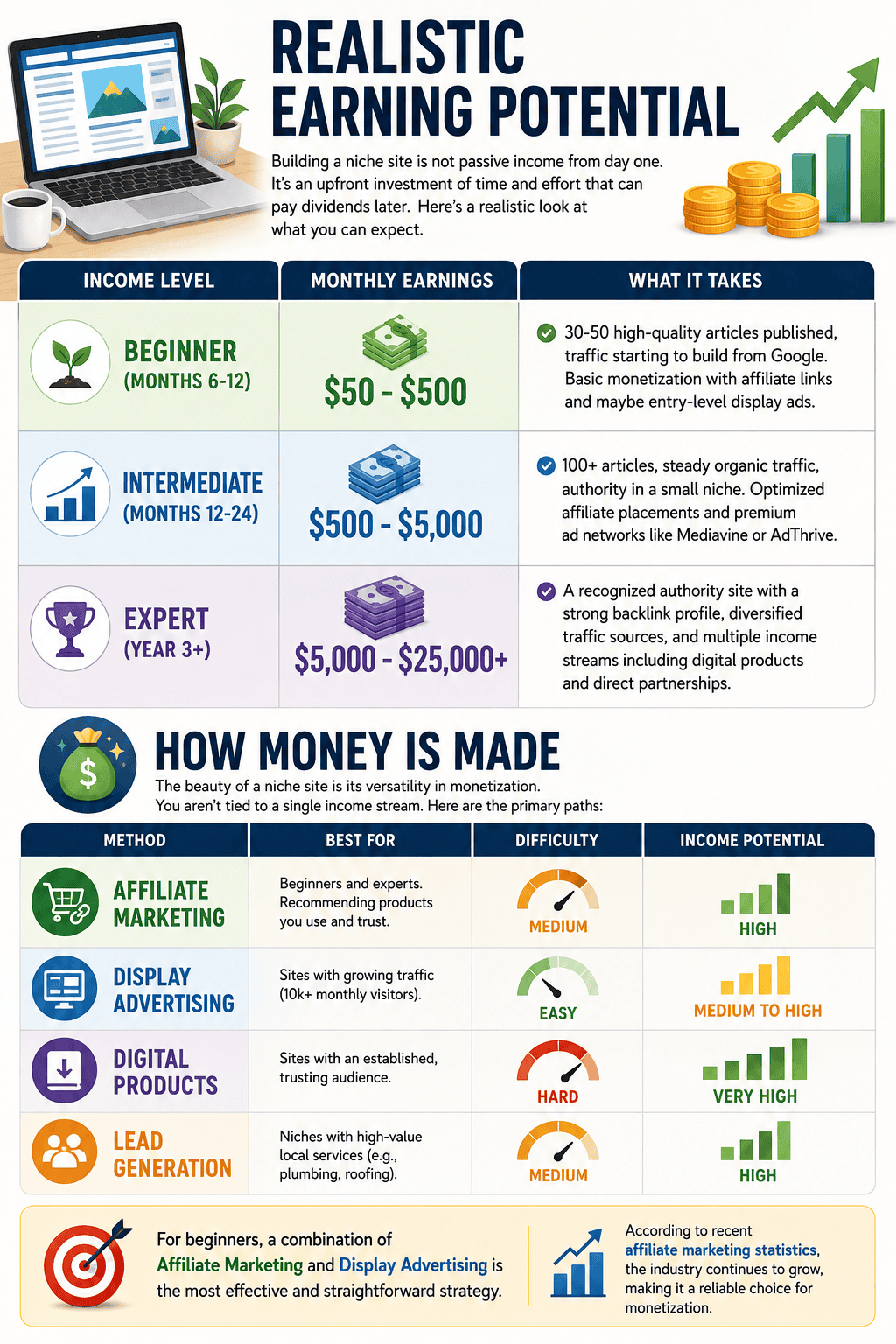
Building a niche site is not passive income from day one. It’s an upfront investment of time and effort that can pay dividends later. Here’s a realistic look at what you can expect.
| Income Level | Monthly Earnings | What It Takes |
|---|---|---|
| Beginner (Months 6-12) | $50 – $500 | 30-50 high-quality articles published, traffic starting to build from Google. Basic monetization with affiliate links and maybe entry-level display ads. |
| Intermediate (Months 12-24) | $500 – $5,000 | 100+ articles, steady organic traffic, authority in a small niche. Optimized affiliate placements and premium ad networks like Mediavine or AdThrive. |
| Expert (Year 3+) | $5,000 – $25,000+ | A recognized authority site with a strong backlink profile, diversified traffic sources, and multiple income streams including digital products and direct partnerships. |
How Money Is Made
The beauty of a niche site is its versatility in monetization. You aren’t tied to a single income stream. Here are the primary paths:
| Method | Best For | Difficulty | Income Potential |
|---|---|---|---|
| Affiliate Marketing | Beginners and experts. Recommending products you use and trust. | Medium | High |
| Display Advertising | Sites with growing traffic (10k+ monthly visitors). | Easy | Medium to High |
| Digital Products | Sites with an established, trusting audience. | Hard | Very High |
| Lead Generation | Niches with high-value local services (e.g., plumbing, roofing). | Medium | High |
For beginners, a combination of Affiliate Marketing and Display Advertising is the most effective and straightforward strategy. According to recent affiliate marketing statistics, the industry continues to grow, making it a reliable choice for monetization.
Step-by-Step Guide to Building Your Niche Site
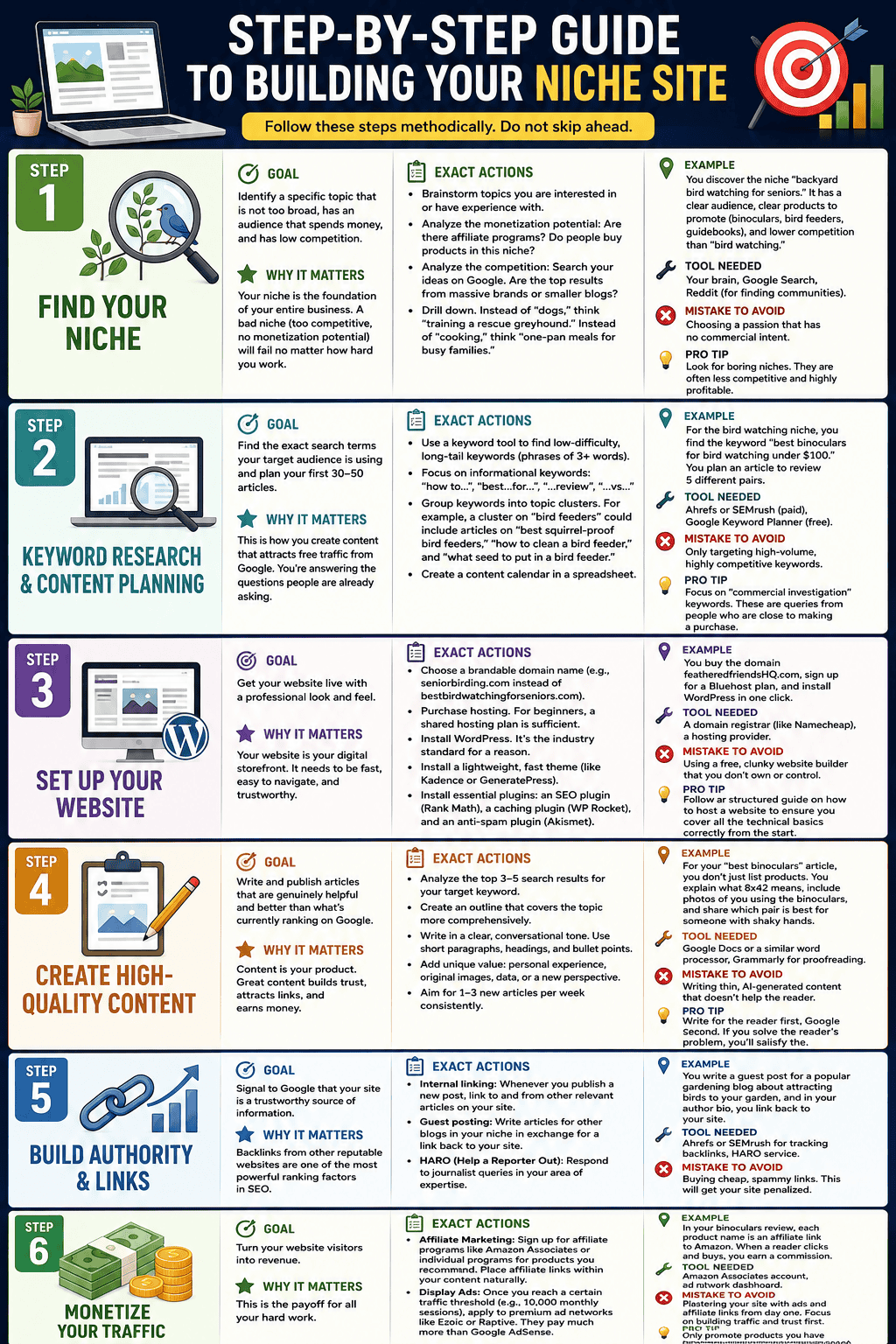
Follow these steps methodically. Do not skip ahead.
Step 1: Find Your Niche
- Goal: Identify a specific topic that is not too broad, has an audience that spends money, and has low competition.
- Why it matters: Your niche is the foundation of your entire business. A bad niche (too competitive, no monetization potential) will fail no matter how hard you work.
- Exact actions:
- Brainstorm topics you are interested in or have experience with.
- Analyze the monetization potential: Are there affiliate programs? Do people buy products in this niche?
- Analyze the competition: Search your ideas on Google. Are the top results from massive brands or smaller blogs?
- Drill down. Instead of “dogs,” think “training a rescue greyhound.” Instead of “cooking,” think “one-pan meals for busy families.”
- Example: You discover the niche “backyard bird watching for seniors.” It has a clear audience, clear products to promote (binoculars, bird feeders, guidebooks), and lower competition than “bird watching.”
- Tool needed: Your brain, Google Search, Reddit (for finding communities).
- Mistake to avoid: Choosing a passion that has no commercial intent.
- Pro tip: Look for boring niches. They are often less competitive and highly profitable.
Step 2: Keyword Research & Content Planning
- Goal: Find the exact search terms your target audience is using and plan your first 30-50 articles.
- Why it matters: This is how you create content that attracts free traffic from Google. You’re answering the questions people are already asking.
- Exact actions:
- Use a keyword tool to find low-difficulty, long-tail keywords (phrases of 3+ words).
- Focus on informational keywords: “how to…”, “best…for…”, “…review”, “…vs…”
- Group keywords into topic clusters. For example, a cluster on “bird feeders” could include articles on “best squirrel-proof bird feeders,” “how to clean a bird feeder,” and “what seed to put in a bird feeder.”
- Create a content calendar in a spreadsheet.
- Example: For the bird watching niche, you find the keyword “best binoculars for bird watching under $100.” You plan an article to review 5 different pairs.
- Tool needed: Ahrefs or SEMrush (paid), Google Keyword Planner (free).
- Mistake to avoid: Only targeting high-volume, highly competitive keywords.
- Pro tip: Focus on “commercial investigation” keywords. These are queries from people who are close to making a purchase.
Step 3: Set Up Your Website
- Goal: Get your website live with a professional look and feel.
- Why it matters: Your website is your digital storefront. It needs to be fast, easy to navigate, and trustworthy.
- Exact actions:
- Choose a brandable domain name (e.g.,
seniorbirding.cominstead ofbestbirdwatchingforseniors.com). - Purchase hosting. For beginners, a shared hosting plan is sufficient.
- Install WordPress. It’s the industry standard for a reason.
- Install a lightweight, fast theme (like Kadence or GeneratePress).
- Install essential plugins: an SEO plugin (Rank Math), a caching plugin (WP Rocket), and an anti-spam plugin (Akismet).
- Choose a brandable domain name (e.g.,
- Example: You buy the domain
featheredfriendsHQ.com, sign up for a Bluehost plan, and install WordPress in one click. - Tool needed: A domain registrar (like Namecheap), a hosting provider.
- Mistake to avoid: Using a free, clunky website builder that you don’t own or control.
- Pro tip: Follow a structured guide on how to host a website to ensure you cover all the technical basics correctly from the start.
Step 4: Create High-Quality Content
- Goal: Write and publish articles that are genuinely helpful and better than what’s currently ranking on Google.
- Why it matters: Content is your product. Great content builds trust, attracts links, and earns money.
- Exact actions:
- Analyze the top 3-5 search results for your target keyword.
- Create an outline that covers the topic more comprehensively.
- Write in a clear, conversational tone. Use short paragraphs, headings, and bullet points.
- Add unique value: personal experience, original images, data, or a new perspective.
- Aim for 1-3 new articles per week consistently.
- Example: For your “best binoculars” article, you don’t just list products. You explain what
8x42means, include photos of you using the binoculars, and share which pair is best for someone with shaky hands. - Tool needed: Google Docs or a similar word processor, Grammarly for proofreading.
- Mistake to avoid: Writing thin, AI-generated content that doesn’t help the reader.
- Pro tip: Write for the reader first, Google second. If you solve the reader’s problem, you’ll satisfy the search engine.
Step 5: Build Authority & Links
- Goal: Signal to Google that your site is a trustworthy source of information.
- Why it matters: Backlinks from other reputable websites are one of the most powerful ranking factors in SEO.
- Exact actions:
- Internal linking: Whenever you publish a new post, link to and from other relevant articles on your site.
- Guest posting: Write articles for other blogs in your niche in exchange for a link back to your site.
- HARO (Help a Reporter Out): Respond to journalist queries in your area of expertise.
- Example: You write a guest post for a popular gardening blog about attracting birds to your garden, and in your author bio, you link back to your site.
- Tool needed: Ahrefs or SEMrush for tracking backlinks, HARO service.
- Mistake to avoid: Buying cheap, spammy links. This will get your site penalized.
- Pro tip: The best links are earned, not built. Create content so good that people naturally want to link to it.
Step 6: Monetize Your Traffic
- Goal: Turn your website visitors into revenue.
- Why it matters: This is the payoff for all your hard work.
- Exact actions:
- Affiliate Marketing: Sign up for affiliate programs like Amazon Associates or individual programs for products you recommend. Place affiliate links within your content naturally.
- Display Ads: Once you reach a certain traffic threshold (e.g., 10,000 monthly sessions), apply to premium ad networks like Ezoic or Raptive. They pay much more than Google AdSense.
- Example: In your binoculars review, each product name is an affiliate link to Amazon. When a reader clicks and buys, you earn a commission.
- Tool needed: Amazon Associates account, ad network dashboard.
- Mistake to avoid: Plastering your site with ads and affiliate links from day one. Focus on building traffic and trust first.
- Pro tip: Only promote products you have used or thoroughly researched. Your audience’s trust is your most valuable asset.
Tools & Resources
Investing in the right tools can save you time and accelerate your growth. Here are the essentials:
| Tool | Purpose | Best For | Cost |
|---|---|---|---|
| Ahrefs / SEMrush | Keyword Research, Competitor Analysis, Link Building | All stages of growth | $99+/month (Expensive but powerful) |
| Namecheap | Domain Registration | Buying your website address | ~$12/year |
| SiteGround / Bluehost | Website Hosting | Beginners | $3 – $15/month |
| GeneratePress / Kadence | WordPress Theme | Fast-loading, professional design | Free, with Pro versions ~$59/year |
| SurferSEO / Frase | Content Optimization | Writing SEO-friendly articles | $49+/month |
| Google Analytics | Traffic Analysis | Understanding your audience | Free |
Content / Offer Strategy
Your content strategy should be laser-focused on solving your audience’s problems at different stages of their journey.
| Strategy | Why It Works | Example |
|---|---|---|
| “Best X for Y” Posts | Captures buyers at the end of their research phase. Highly monetizable with affiliate links. | “Best Lightweight Hiking Boots for Women” |
| “How-To” Guides | Builds trust and authority by solving a specific problem. Attracts links and ranks well. | “How to Waterproof Your Hiking Boots” |
| Product Reviews | Provides in-depth information on a single product, helping users make a buying decision. | “Merrell Moab 3 Hiking Boot Review: 100 Miles Later” |
| Informational Articles | Answers broad questions in your niche, establishing you as an expert and capturing top-of-funnel traffic. | “What is a Day Hike? A Beginner’s Guide” |
Common Mistakes
Many beginners quit because they make one of these avoidable mistakes.
| Mistake | Why It Hurts | Better Approach |
|---|---|---|
| Choosing a Bad Niche | You’re doomed from the start. Too much competition or no one spending money means no path to profit. | Spend at least a week on niche research. Validate that other, smaller sites are making money in the niche. |
| Inconsistency | Niche sites are built on momentum. Publishing 10 articles in one week and then none for 2 months kills your growth. | Create a realistic publishing schedule (e.g., 1-2 articles per week) and stick to it for a year. |
| Giving Up Too Soon | It can take 6-8 months to see any meaningful traffic from Google. Most people quit in month 3 or 4. | Understand this is a long-term project. Commit to at least 12 months before evaluating success. |
| Ignoring Technical SEO | A slow site or poor structure can prevent your great content from ever being seen. | Use a fast theme, a caching plugin, and follow the setup steps in the website hosting guide. |
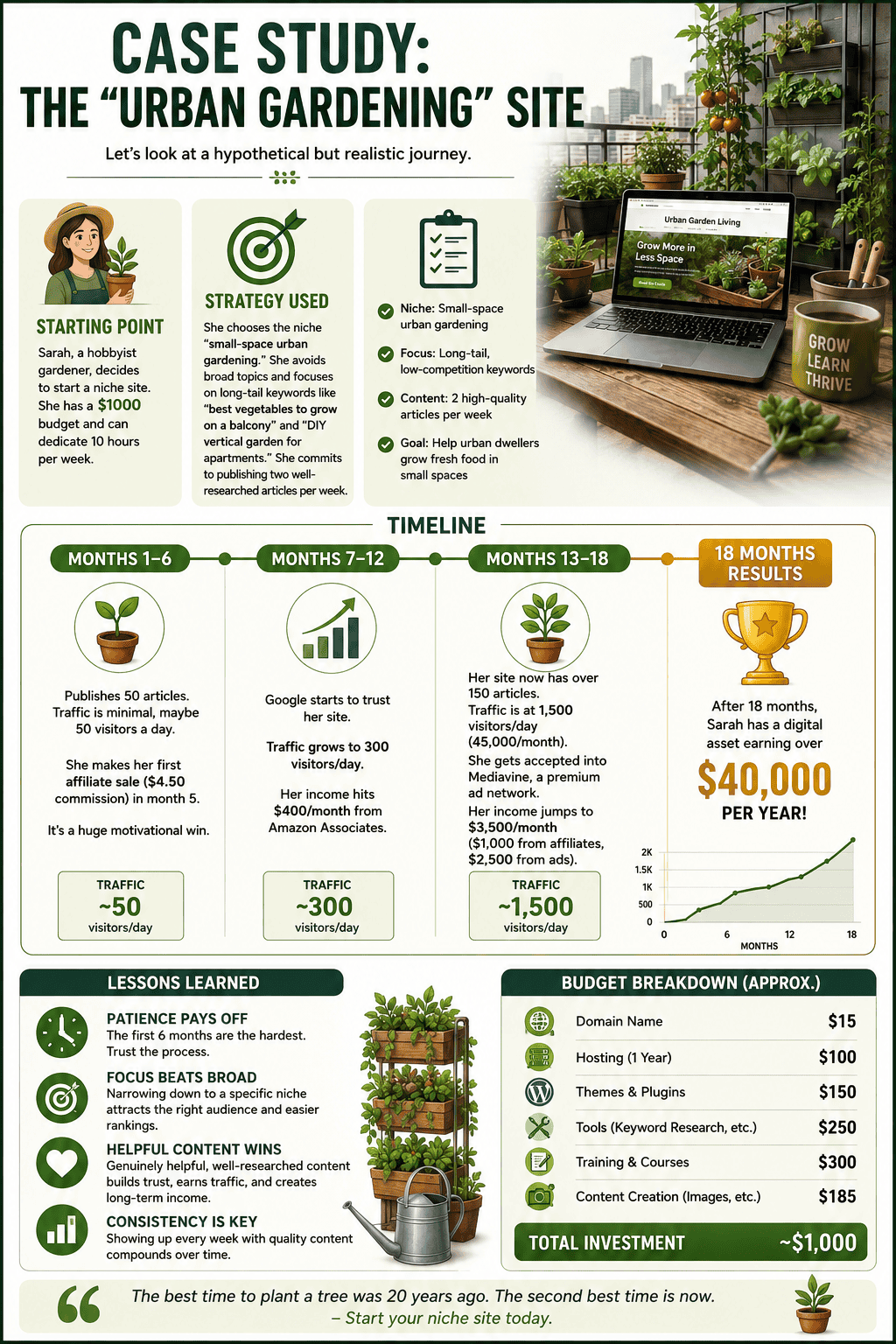
Case Study: The “Urban Gardening” Site
Let’s look at a hypothetical but realistic journey.
- Starting Point: Sarah, a hobbyist gardener, decides to start a niche site. She has a $1000 budget and can dedicate 10 hours per week.
- Strategy Used: She chooses the niche “small-space urban gardening.” She avoids broad topics and focuses on long-tail keywords like “best vegetables to grow on a balcony” and “DIY vertical garden for apartments.” She commits to publishing two well-researched articles per week.
- Timeline:
- Months 1-6: Publishes 50 articles. Traffic is minimal, maybe 50 visitors a day. She makes her first affiliate sale ($4.50 commission) in month 5. It’s a huge motivational win.
- Months 7-12: Google starts to trust her site. Traffic grows to 300 visitors/day. Her income hits $400/month from Amazon Associates.
- Months 13-18: Her site now has over 150 articles. Traffic is at 1,500 visitors/day (45,000/month). She gets accepted into Mediavine, a premium ad network. Her income jumps to $3,500/month ($1,000 from affiliates, $2,500 from ads).
- Results: After 18 months, Sarah has a digital asset earning over $40,000/year.
- Lessons Learned: Patience and consistency were everything. Focusing on genuinely helpful content for a specific audience worked better than any shortcut.
Challenges & Solutions
It won’t always be smooth sailing. Here’s how to navigate the inevitable bumps.
| Challenge | Cause | Solution |
|---|---|---|
| The “Google Sandbox” | Google’s tendency to not trust new sites for the first 6-9 months. | This is normal. Don’t panic. Continue publishing high-quality content consistently. Your time will come. |
| Content Creation Burnout | The relentless need to write and publish can be exhausting. | Batch your tasks. Dedicate one day to keyword research, another to outlining, and others to writing. If budget allows, consider outsourcing writing for less critical articles. |
| Algorithm Updates | A sudden drop in traffic after a Google update. | Diversify your traffic by starting an email list. Don’t rely 100% on Google. Review your content to ensure it still meets search intent and provides the best answer. |
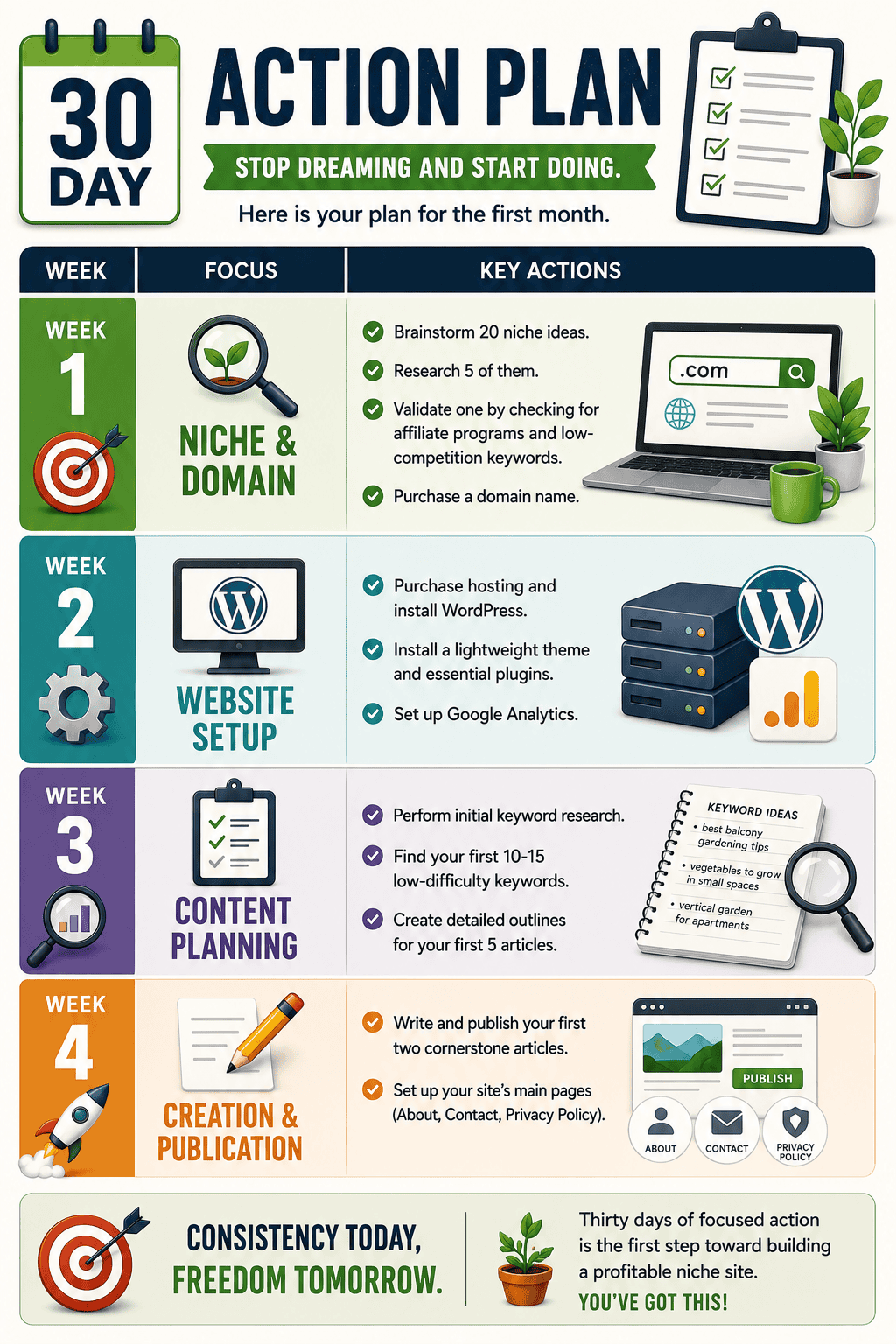
30-Day Action Plan
Stop dreaming and start doing. Here is your plan for the first month.
| Week | Focus | Key Actions |
|---|---|---|
| Week 1 | Niche & Domain | Brainstorm 20 niche ideas. Research 5 of them. Validate one by checking for affiliate programs and low-competition keywords. Purchase a domain name. |
| Week 2 | Website Setup | Purchase hosting and install WordPress. Install a lightweight theme and essential plugins. Set up Google Analytics. |
| Week 3 | Content Planning | Perform initial keyword research. Find your first 10-15 low-difficulty keywords. Create detailed outlines for your first 5 articles. |
| Week 4 | Creation & Publication | Write and publish your first two cornerstone articles. Set up your site’s main pages (About, Contact, Privacy Policy). |
Expert Insights
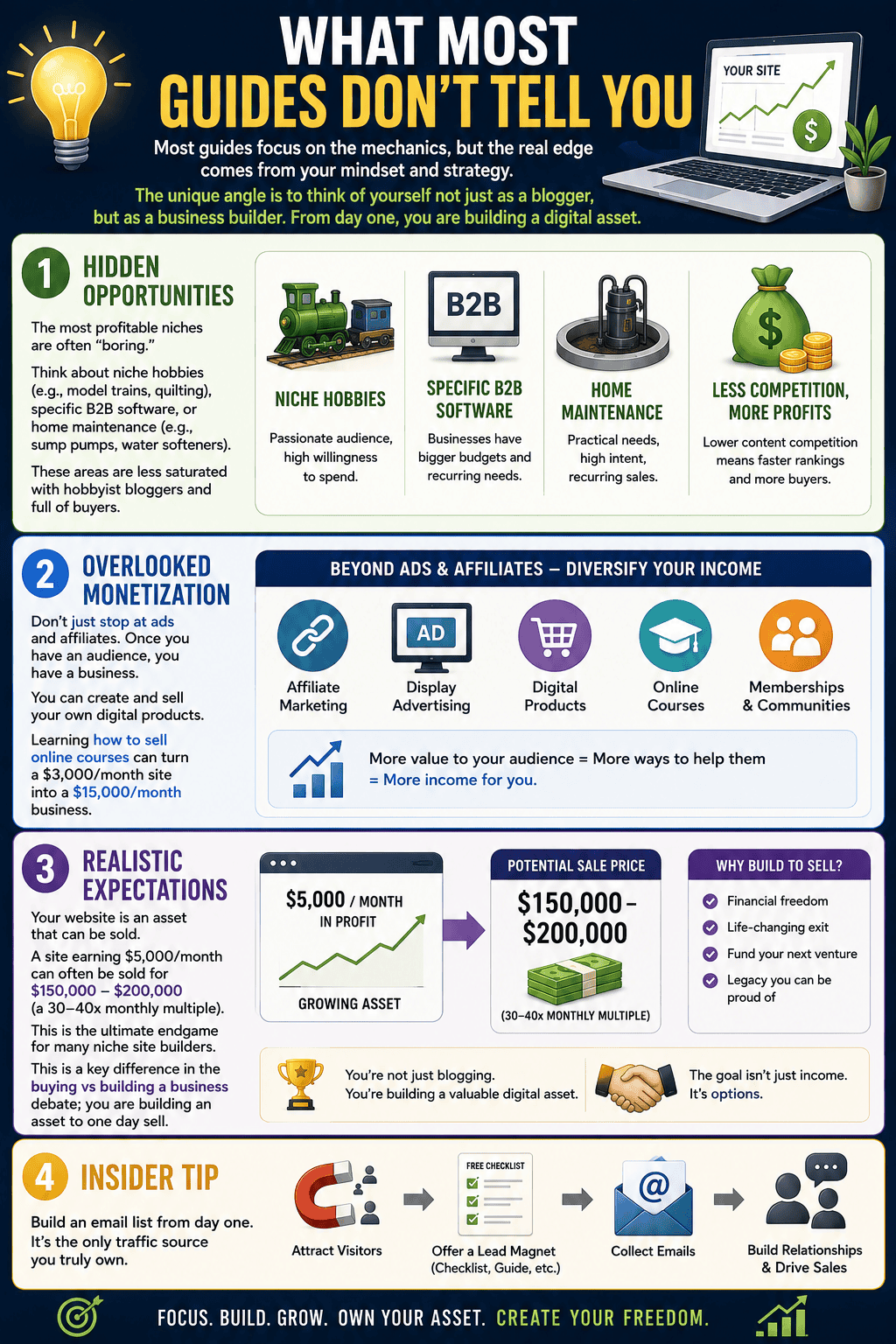
What Most Guides Don’t Tell You
Most guides focus on the mechanics, but the real edge comes from your mindset and strategy. The unique angle is to think of yourself not just as a blogger, but as a business builder. From day one, you are building a digital asset.
- Hidden Opportunities: The most profitable niches are often “boring.” Think about niche hobbies (e.g., model trains, quilting), specific B2B software, or home maintenance (e.g., sump pumps, water softeners). These areas are less saturated with hobbyist bloggers and full of buyers.
- Overlooked Monetization: Don’t just stop at ads and affiliates. Once you have an audience, you have a business. You can create and sell your own digital products. Learning how to sell online courses can turn a $3,000/month site into a $15,000/month business.
- Realistic Expectations: Your website is an asset that can be sold. A site earning $5,000/month can often be sold for $150,000 – $200,000 (a 30-40x monthly multiple). This is the ultimate endgame for many niche site builders. This is a key difference in the buying vs building a business debate; you are building an asset to one day sell.
- Insider Tip: Build an email list from day one. It’s the only traffic source you truly own. Offer a simple checklist or cheat sheet in exchange for an email address.
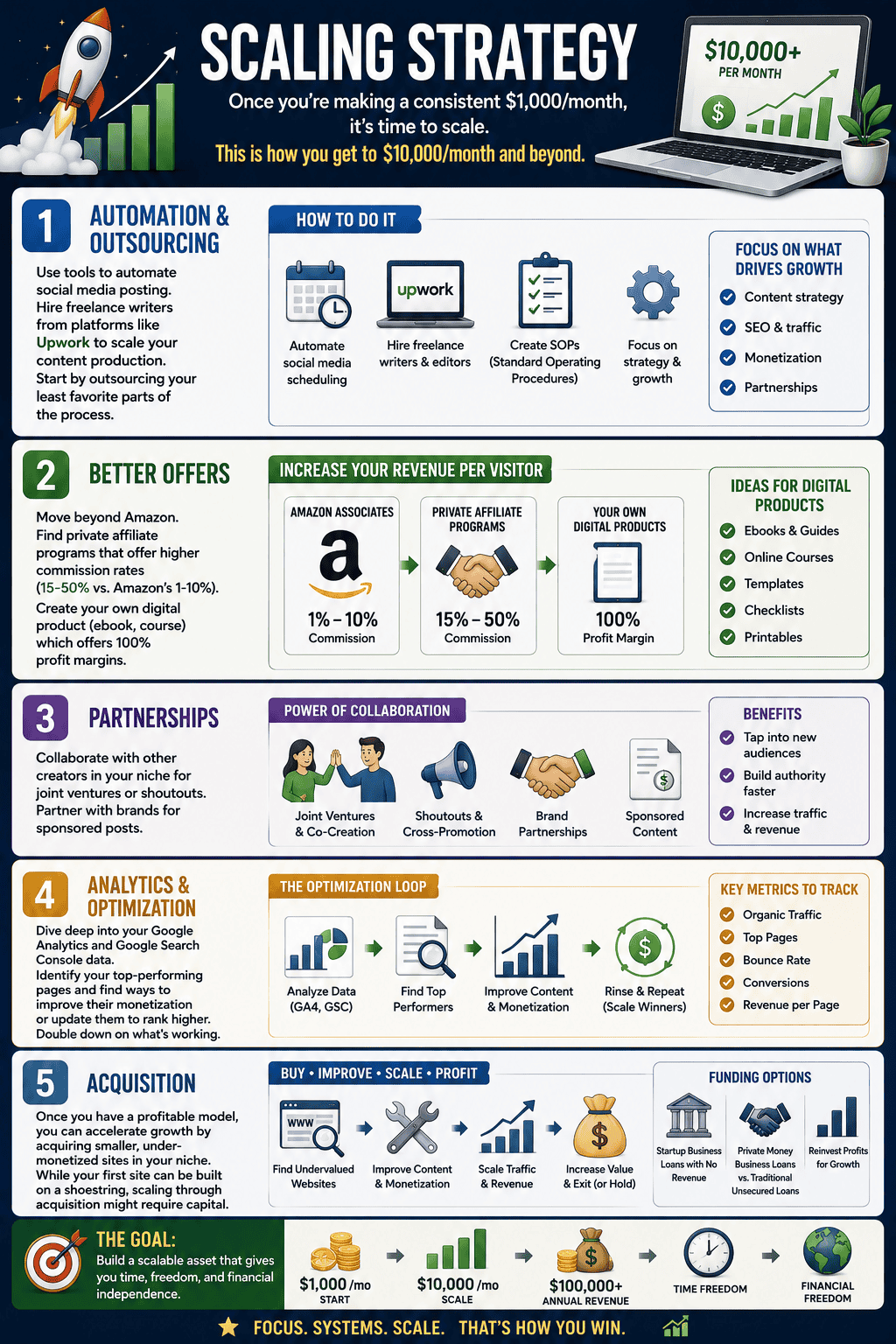
Scaling Strategy
Once you’re making a consistent $1,000/month, it’s time to scale. This is how you get to $10,000/month and beyond.
- Automation & Outsourcing: Use tools to automate social media posting. Hire freelance writers from platforms like Upwork to scale your content production. Start by outsourcing your least favorite parts of the process.
- Better Offers: Move beyond Amazon. Find private affiliate programs that offer higher commission rates (15-50% vs. Amazon’s 1-10%). Create your own digital product (ebook, course) which offers 100% profit margins.
- Partnerships: Collaborate with other creators in your niche for joint ventures or shoutouts. Partner with brands for sponsored posts.
- Analytics & Optimization: Dive deep into your Google Analytics and Google Search Console data. Identify your top-performing pages and find ways to improve their monetization or update them to rank higher. Double down on what’s working.
- Acquisition: Once you have a profitable model, you can accelerate growth by acquiring smaller, under-monetized sites in your niche. While your first site can be built on a shoestring, scaling through acquisition might require capital. Exploring options like startup business loans with no revenue or understanding the difference between private money business loans vs. traditional unsecured loans can be part of a long-term expansion plan.
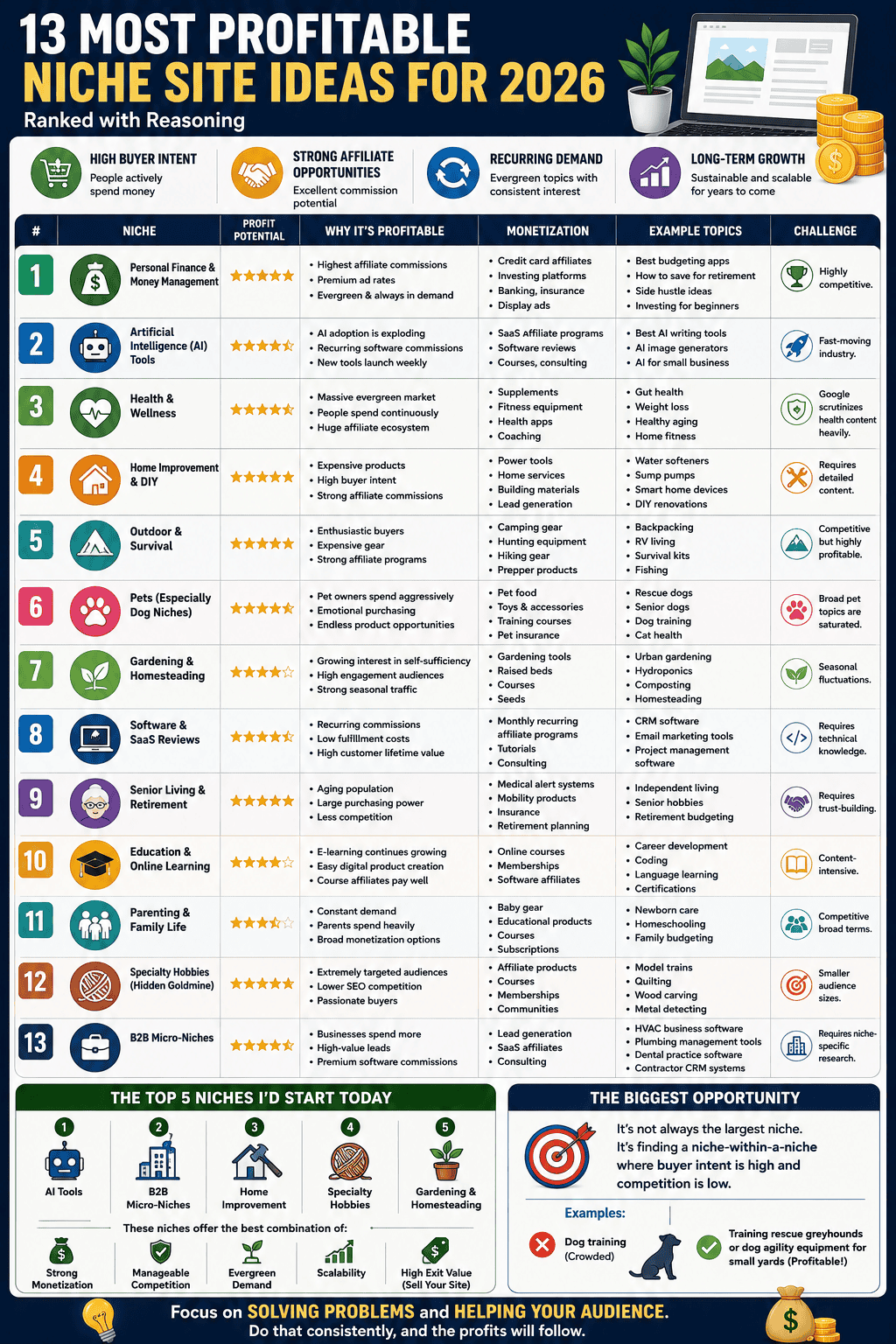
13 Most Profitable Niche Site Ideas (Table Chart)
| Rank | Niche | Profit Potential | Why It’s Profitable | Best Monetization Methods | Competition Level |
|---|---|---|---|---|---|
| 1 | Personal Finance & Money Management | ⭐⭐⭐⭐⭐ | High affiliate payouts, premium ad rates, evergreen demand | Credit cards, investing apps, insurance, ads | High |
| 2 | AI Tools | ⭐⭐⭐⭐⭐ | Explosive growth, recurring SaaS commissions | Software affiliates, courses, consulting | Medium-High |
| 3 | Health & Wellness | ⭐⭐⭐⭐⭐ | Massive market, recurring purchases | Supplements, fitness gear, coaching | High |
| 4 | Home Improvement & DIY | ⭐⭐⭐⭐⭐ | Expensive products, strong buyer intent | Tools, home services, lead generation | Medium |
| 5 | Outdoor & Survival | ⭐⭐⭐⭐⭐ | High-ticket gear, passionate audience | Camping gear, hunting, fishing products | Medium |
| 6 | Pets (Dog Niches) | ⭐⭐⭐⭐⭐ | Emotional buyers, endless product demand | Pet food, training courses, insurance | Medium |
| 7 | Gardening & Homesteading | ⭐⭐⭐⭐ | Growing self-sufficiency trend | Gardening tools, seeds, courses | Medium-Low |
| 8 | Software & SaaS Reviews | ⭐⭐⭐⭐⭐ | Recurring commissions, high LTV customers | SaaS affiliates, tutorials, consulting | Medium |
| 9 | Senior Living & Retirement | ⭐⭐⭐⭐⭐ | Aging population with spending power | Mobility products, insurance, planning | Medium-Low |
| 10 | Education & Online Learning | ⭐⭐⭐⭐ | Growing e-learning market | Courses, memberships, software | Medium |
| 11 | Parenting & Family Life | ⭐⭐⭐⭐ | Constant demand and spending | Baby gear, educational products | Medium-High |
| 12 | Specialty Hobbies | ⭐⭐⭐⭐⭐ | Passionate audiences, low SEO competition | Affiliates, memberships, courses | Low |
| 13 | B2B Micro-Niches | ⭐⭐⭐⭐⭐ | High-value leads and software commissions | Lead generation, SaaS, consulting | Low-Medium |
Profitability Comparison
Best Opportunities for New Site Builders
| Category | Best Choice |
|---|---|
| Easiest to Rank | Specialty Hobbies |
| Highest Affiliate Earnings | Personal Finance |
| Fastest Growing Market | AI Tools |
| Best Long-Term Asset | B2B Micro-Niches |
| Best Balance of Competition & Profit | Gardening & Homesteading |
| Best Exit/Sale Value | SaaS Reviews |
| Most Underrated Opportunity | Senior Living & Retirement |
Sweet Spot Strategy: Target a niche within a niche such as urban gardening for seniors, rescue greyhound training, HVAC software reviews, or model train accessories. These often have lower competition and higher conversion rates than broad markets.
Profitability of Top Niche Site Ideas
Relative profit potential based on monetization opportunities, buyer intent, and long-term growth.
| niche | score |
|---|---|
| Personal Finance | 5 |
| AI Tools | 5 |
| Health & Wellness | 5 |
| Home Improvement | 5 |
| Outdoor & Survival | 5 |
| Pets | 5 |
| Gardening | 4 |
| SaaS Reviews | 5 |
| Senior Living | 5 |
| Education | 4 |
| Parenting | 4 |
| Specialty Hobbies | 5 |
| B2B Micro-Niches | 5 |
FAQ
1. What is a niche website?
A niche website is a website that focuses on a small, specific, and well-defined topic within a larger market. For example, instead of a broad “fitness” site, a niche site might focus on “kettlebell workouts for men over 40.”
2. Are niche sites still profitable?
Yes, absolutely. While the internet is more competitive than ever, the principles of serving a specific audience with high-quality, helpful content remain a highly profitable business model.
3. How much does it cost to start a niche site?
You can start for under $100 for the first year, which covers a domain name and basic shared hosting. A more realistic budget of $500-$1000 allows for premium tools and potentially some outsourced content.
4. How do I find a profitable niche?
Look for niches where people have problems they are willing to spend money to solve. Check for the presence of affiliate programs, online courses, and products. Use tools and forums to see what questions people are asking.
5. How long does it take to make money with a niche site?
Be prepared to see little to no income for the first 6-9 months. Significant, life-changing income typically takes 18-24 months of consistent effort.
6. Do I need to be an expert in the niche?
No, but you need to be willing to become one. You can document your learning journey. Your job is to become the most helpful resource, which requires deep research, not necessarily a pre-existing Ph.D.
7. Can I use AI to write my content?
AI can be a useful tool for brainstorming, outlining, and overcoming writer’s block. However, relying solely on AI to generate full articles often results in generic, soulless content that doesn’t rank well or build trust. Use it as an assistant, not a replacement for human expertise and experience.
8. What’s more important: content or links?
In the beginning, content is 100% more important. Great content will naturally attract links over time and will start to rank on its own for long-tail keywords. You can’t build links to a site with no value.
9. How many articles do I need?
There is no magic number. Focus on quality and consistency. Aim to build a library of 50-100 high-quality, interconnected articles over your first year to establish topical authority.
10. What is a good niche site example?
Websites like Wirecutter (now owned by the NYT, but started as a niche site), OutdoorGearLab, and NerdWallet are massive examples. Smaller, successful examples exist in almost every hobby and industry, often run by solo entrepreneurs.
Frequently Asked Questions
What Is The Best Platform To Use For Creating A Niche Site?
Building a niche site can be overwhelming with all the different platform options available. It’s important to choose the right one for your project, as it will ultimately determine how successful the website is going to be. There are several popular platforms such as WordPress, Blogger, Squarespace, Wix and Jekyll that offer various features and benefits depending on what you’re looking for in a website builder.
WordPress is an incredibly popular choice amongst web developers due to its flexibility and easy-to-use interface. It provides users with access to thousands of plugins and themes so they can customize their sites however they want. Plus, there are many tutorials online for those just starting out with WordPress which makes it even easier to get up and running quickly.
Blogger has been around since 1999 and though it may not have all the bells and whistles of some other platforms, it’s still used by millions today because of its simplicity. With Blogger you won’t need any coding knowledge or design experience; you simply create content using pre-made templates provided by Google. You also don’t have to worry about hosting your own websites or dealing with databases like you would if you were using WordPress or another CMS (content management system).
Squarespace is another great option when creating a niche site due to its modern designs, intuitive user interface and drag & drop page editor tool which allow anyone – regardless of technical skill level – build beautiful websites without having any coding skills whatsoever. Additionally, Squarespace offers fully integrated ecommerce solutions including payment processing and product catalogues allowing users to start selling products online within minutes! Furthermore, unlike most other website builders where customers need to pay extra for more advanced features, Squarespace comes with unlimited bandwidth meaning no matter how much traffic your website receives you won’t ever need upgrade your plan – something that could end up saving a lot of money in the long run! When deciding what platform best suits your needs consider these three options carefully before making a final decision.
What Are The Long-Term Benefits Of Having A Niche Site?
Building a niche site has become an increasingly popular way to generate income, build brand recognition and drive targeted traffic. With the right platform and search engine optimization (SEO) strategy, having a niche site can kickstart passive revenue streams that diversify your income portfolio. But what are the long-term benefits of investing in a niche site?
The first major benefit is increased revenue potential. Niche sites tend to be highly focused on specific topics or industries, which means they often attract passionate audiences who seek out valuable content related to their interests. This makes it easier for you to monetize your website with affiliate marketing programs, ad networks, sponsored posts and other digital products like ebooks or courses. Additionally, because most of these visitors already have an interest in the subject matter of your website, there’s less competition from other websites vying for attention within this smaller yet more engaged audience pool.
Another ongoing advantage of running a niche site is its ability to serve as a powerful tool for improving search engine visibility over time. Since each page on your website will likely target multiple keywords related to one topic or industry, it’ll be much easier for search engines like Google to recognize the relevancy of each piece of content you create and rank them accordingly based on quality signals such as backlinks or user engagement metrics. Higher rankings mean higher organic traffic volume — leading to more opportunities for conversions and sales down the road even without additional paid media investments.
Finally, building up a successful niche website also allows you to develop relationships with influential people within that particular community; whether they’re entrepreneurs offering advice through guest blogging or industry experts looking for partnership opportunities around product launches. These connections not only provide invaluable networking opportunities but also give you access to fresh perspectives about emerging trends in that field so you can stay ahead of the curve when it comes to innovating new strategies for growth.
How Do I Choose The Right Keywords For My Niche Site?
Choosing the right keywords for your niche site is essential to its success. It’s not just a matter of finding words that are related to your topic, but also selecting and optimizing those words so they have the best chance at being seen by potential customers or readers. Keyword research is an important part of choosing which niche you should focus on and making sure you get it right can be incredibly rewarding in the long run.
When it comes to keyword selection, there are two main approaches: using targeted keywords or general phrases. Targeted keywords are specific terms used to find information about a certain product or service, while general phrases cover broader topics without focusing too much on one particular thing. For example, if you’re trying to rank for ‘coffee makers’, you’ll want to use both ‘coffee maker’ as well as more generic terms like ‘espresso machines’. This way, your content will show up for a variety of search queries rather than just one narrow subject area.
Once you’ve identified the relevant keywords for your niche site, it’s time to start optimizing them for better ranking results. Using SEO techniques such as meta tags, heading tags and other on-page optimization strategies can help ensure that your content appears higher in search engine rankings when people enter these keywords into their query box. Additionally, building quality backlinks from reputable websites will further improve your chances of achieving high rankings with Google and other major search engines. All this effort put into keyword optimization will allow your website to reach new heights in organic search traffic!
By carefully researching and selecting the right set of targeted keywords – then optimizing them through SEO tactics – any aspiring entrepreneur has the opportunity to make their mark online. With some hard work and dedication, anyone can create a successful niche site that stands out among all others!
What Are The Most Effective Ways To Drive Traffic To My Niche Site?
When it comes to driving traffic to a niche site, there are several strategies that can be used. Blogging, keyword research, content marketing, social media and paid ads are all effective ways of creating visibility for your website. However, using the right approach is essential in order to maximize the effectiveness of each one.
The first step should always be blog creation; it’s an excellent way to increase organic search engine rankings and build authority within your chosen field. To ensure success with blogging, research relevant keywords before writing any posts and consider using them throughout the text as well as titles and headings. Additionally, focus on developing engaging and valuable content that will attract readers back for more.
Once you have established yourself through blogging and optimized your pages for SEO purposes, content marketing is another great option for boosting traffic levels further. Here again, quality is king – create high-value pieces tailored around topics related to your business which offer real value or insight to viewers. Also promote this content via social networks such as Twitter or Facebook where appropriate – this will help raise awareness of the brand while also sending visitors directly back to the website itself. Finally don’t forget about paid advertising methods too; investing in Google Ads or other forms of digital promotion can yield fast results if done correctly.
By taking these steps into consideration when looking at how best to drive traffic towards a niche site you will be able to make sure every visitor who finds their way onto your page has been directed there intentionally rather than by chance! With careful strategizing in advance you can get the most out of each method offered allowing you to gain maximum benefit from promoting your products or services online.
How Much Time Do I Need To Invest In My Niche Site To Be Successful?
When it comes to achieving niche site success, one of the most important factors is time investment. How much effort you put into your niche website plays a key role in determining how successful it will be. This means that anyone looking to make their mark with a new niche site must ask themselves: how much time do I need to invest in my niche site to be successful?
The answer depends on several factors, including the complexity and scope of your project and how quickly you are able to learn relevant skills. In general, however, investing at least 20 hours per week for two or three months is an adequate starting point for any aspiring online entrepreneur. During this time period, it’s essential to focus on developing knowledge related to SEO, content creation and marketing strategy while also putting in some extra hours during weeks when possible. It’s also worth noting that there may be additional costs associated with setting up a website; depending on what kind of features you require from your hosting provider.
Ultimately, the amount of time and effort needed to build a successful niche website varies greatly from person-to-person. Some entrepreneurs have found success after only minimal investments in terms of both money and time whereas others have taken years before finally seeing results. So whether you’re just getting started or already deep in your niche efforts, remember that staying consistent can go a long way towards helping you reach the level of success that you desire.
Final Thoughts
In conclusion, niche sites can be an incredible investment of your time and energy. With the right platform, careful keyword selection, effective traffic generation strategies, and consistent effort over time, you can build a successful niche site that will bring in long-term benefits.
But how do you know which ideas are best for your niche site? The 13 ideas outlined in this ultimate guide for 2026 provide excellent starting points for any aspiring entrepreneur. Whether you’re looking to create a blog about parenting tips or start an online store selling rare books – there is something here for everyone!
So why not give it a try? After all, what have you got to lose? All it takes is some creativity and hard work – who knows where it could take you!
Welcome to your no-nonsense guide to building a profitable niche website. Forget the get-rich-quick schemes. We’re diving into a proven business model that can generate a real, sustainable income. Building a niche site is about creating a valuable resource on a specific topic, attracting an audience, and monetizing that attention. It’s a marathon, not a sprint, but the finish line can be life-changing.
This guide is for aspiring entrepreneurs, side-hustle seekers, and anyone willing to put in the work to build a digital asset. If you’re a beginner with a modest budget and a lot of determination, you’re in the right place.
Realistically, with a startup budget of around $1000 and a consistent effort over 12 to 24 months, building an asset that generates $60,000 – $300,000 per year is an achievable goal. It requires learning, patience, and execution.
Conclusion
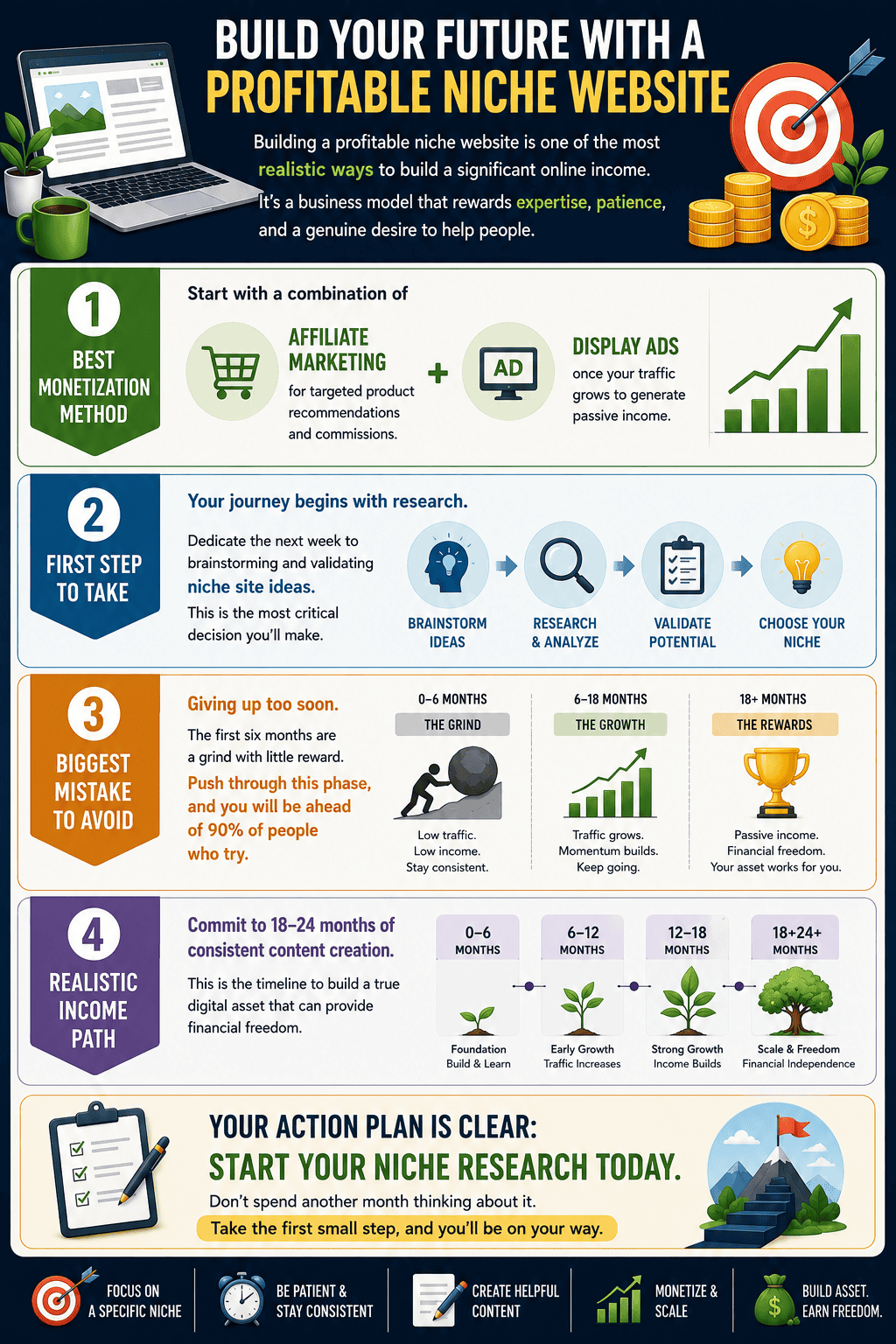
Building a profitable niche website is one of the most realistic ways to build a significant online income. It’s a business model that rewards expertise, patience, and a genuine desire to help people.
- Best Monetization Method: Start with a combination of Affiliate Marketing for targeted product recommendations and Display Ads once your traffic grows.
- First Step to Take: Your journey begins with research. Dedicate the next week to brainstorming and validating niche site ideas. This is the most critical decision you’ll make.
- Biggest Mistake to Avoid: Giving up too soon. The first six months are a grind with little reward. Push through this phase, and you will be ahead of 90% of people who try.
- Realistic Income Path: Commit to 18-24 months of consistent content creation. This is the timeline to build a true digital asset that can provide financial freedom.
Your action plan is clear: start your niche research today. Don’t spend another month thinking about it. Take the first small step, and you’ll be on your way.
Here’s an SEO-friendly summary for a blog post titled “13 Best Niche Site Ideas Ultimate Guide for 2026” that naturally incorporates many of your target keywords:
13 Best Niche Site Ideas Ultimate Guide for 2026 – Summary
If you’re looking for the best niche site ideas and wondering how to start a blog that can generate long-term revenue, this guide covers the best niche ideas for entrepreneurs who want to make money online. There’s a lot of opportunity in niche publishing, and there are a lot of profitable markets that can help you build authority, grow traffic, and bring in passive income.
Before creating a niche site, it’s important to understand what is a niche site and why your niche website topic matters. Choosing the right niche website topic can determine whether your site gains traction or gets lost in a ton of competition. Many of the most successful niche sites focus on a specific audience and often target a niche-within-a-niche. If you’re wondering what is a niche-within-a-niche, it’s simply a highly targeted segment of a broader market with less competition and greater earning potential.
This niche site ideas – summary explores profitable opportunities ranging from health and fitness to technology, personal finance, pets, outdoor recreation, and social media. Whether you want to build a niche site around a hobby, create a niche site all about a specialized topic, or launch a niche site that solves a specific problem, there are a lot of opportunities available in 2026.
One of the biggest advantages of building a niche site is the ability to make money with multiple revenue streams. Affiliate marketing remains one of the easiest ways to make money blogging, and there are often substantial affiliate commissions to be had. A successful niche site can also generate advertising revenue, sell digital products, and even help you scale your influence and make money through consulting or coaching services.
If you have decided to start a niche website, one of the first things you need to do is conduct keyword research. Finding a niche with low keyword competition can give your site a better chance of ranking quickly and gaining a little bit of traction in search engines. The goal is to create a niche site you can grow into a valuable online asset that can bring in passive income for years to come.
Many creators use niche websites alongside social platforms to expand their reach. Learning how to make money on Instagram, YouTube, or other platforms can complement your content strategy and help increase your influence and make additional income streams. When you treat your blog like a business, you’ll be better positioned to grow traffic, build authority, and make money online consistently.
This guide also highlights how to start an online business through content creation. For beginners, a niche site is an easy way to start building an audience without investing a lot of money upfront. While some niches have a lot of potential, others may require more effort because there’s a lot of competition. The key is choosing a niche you enjoy and are willing to spend time developing.
As with a site like this, some of the links in this article may be affiliate links. You can read our affiliate disclosure in our privacy policy. Some of the links may generate a commission at no cost to you. If you decide to purchase a paid plan or product through one of these links, we may earn a commission at no cost to you if you make a qualifying purchase.
Please note that this site is not intended to provide financial advice and all content is for entertainment only. Any examples of earnings or success are not guarantees. As always, conduct your own research before making financial decisions.
Whether you’re interested in making money in this niche, exploring money in this niche, or simply looking for inspiration, these 13 best niche site ideas provide an excellent starting point for entrepreneurs who want to create a niche site, grow an audience, and build a profitable online business in 2026.
,