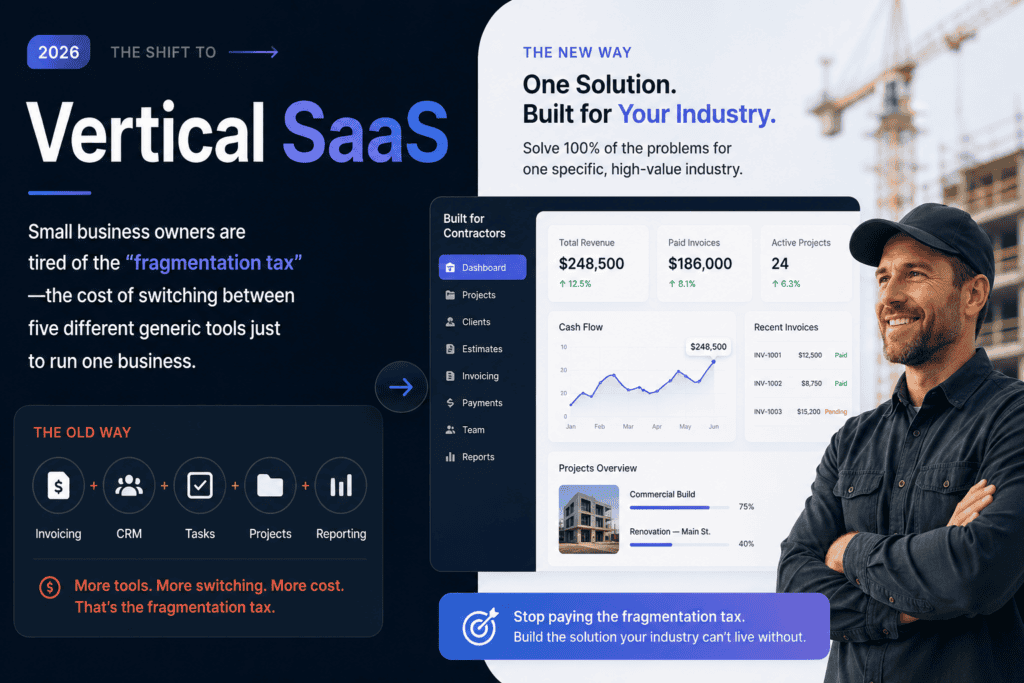





In 2026, the software market is undergoing a radical shift. Small business owners are tired of “fragmentation tax”—the cost of switching between five different generic tools just to run one business. This is where the opportunity for vertical SaaS lies. Instead of trying to serve everyone, you solve 100% of the problems for one specific, high-value industry.
At Medex PMC LLC, we work with real estate investors and business owners who scale their operations through strategic funding. We see firsthand that the most successful founders aren’t those who build the most features, but those who build the right workflows. This guide is for the ambitious founder looking to build a lean, high-margin SaaS business this year.
What You’ll Learn
- How to find an industry niche that has real demand—and validate it before you spend months building a product.
- Why focusing on a specific industry with a vertical SaaS solution is often a smarter, safer, and more profitable strategy than trying to serve everyone with a horizontal SaaS product.
- How adding payments, invoicing, funding, and other financial workflows can make your software indispensable and dramatically increase customer retention.
- A practical 30-day roadmap for going from idea to a working MVP that you can put in front of real customers.
Realistic Earning Potential
| Income Level | Monthly Earnings | What It Takes |
|---|---|---|
| Beginner | $500 – $2,000 | Building your first niche automation tool |
| Scaling | $5,000 – $15,000 | Securing 50+ monthly recurring subscribers |
| Authority | $30,000+ | Full-stack platform serving a specific industry |
Success in SaaS is a marathon of retention. While traffic matters, high-ticket recurring revenue from a loyal, niche customer base is the goal.
How Money Is Made
| Method | Best For | Difficulty | Income Potential |
|---|---|---|---|
| Subscription Fees | Steady Monthly Recurring Revenue | Moderate | High |
| Embedded Payments | Processing fees via Stripe/Atlas | High | Very High |
| Financing Integrations | Referral fees from funding partners | Moderate | High |
Medex PMC recommends focusing on business finance integration. If your SaaS helps construction companies, embedding a financing bridge for their projects—connected to specialized firms like Medex PMC—creates a powerful, recurring revenue stream.
Step-by-Step Guide
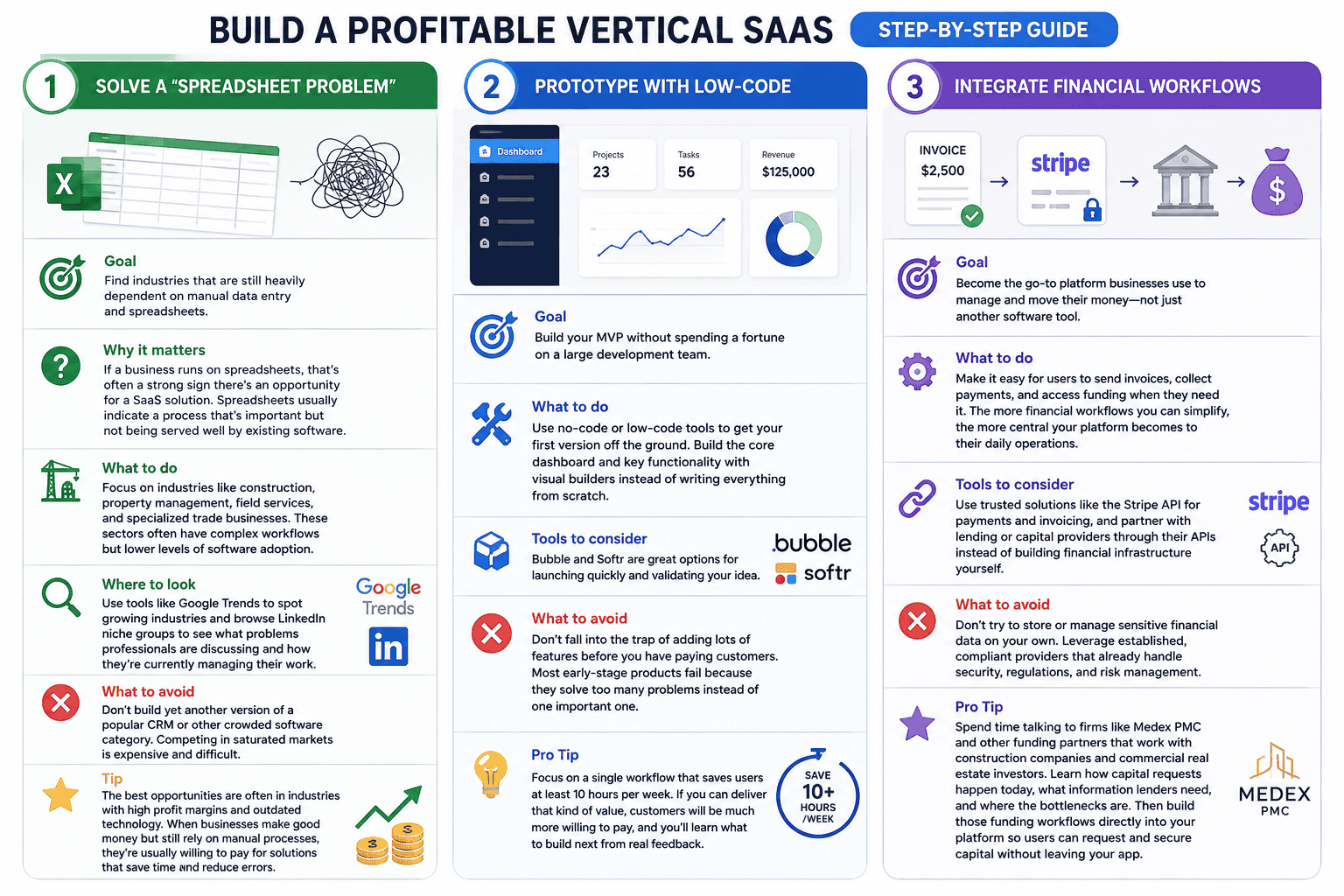
Step 1: Solve a ‘Spreadsheet Problem’
Goal: Find industries that are still heavily dependent on manual data entry and spreadsheets.
Why it matters: If a business runs on spreadsheets, that’s often a strong sign there’s an opportunity for a SaaS solution. Spreadsheets usually indicate a process that’s important but not being served well by existing software.
What to do: Focus on industries like construction, property management, field services, and specialized trade businesses. These sectors often have complex workflows but lower levels of software adoption.
Where to look: Use tools like Google Trends to spot growing industries and browse LinkedIn niche groups to see what problems professionals are discussing and how they’re currently managing their work.
What to avoid: Don’t build yet another version of a popular CRM or other crowded software category. Competing in saturated markets is expensive and difficult.
Tip: The best opportunities are often in industries with high profit margins and outdated technology. When businesses make good money but still rely on manual processes, they’re usually willing to pay for solutions that save time and reduce errors.
Step 2: Prototype with Low-Code
Goal: Build your MVP without spending a fortune on a large development team.
What to do: Use no-code or low-code tools to get your first version off the ground. Build the core dashboard and key functionality with visual builders instead of writing everything from scratch.
Tools to consider: Bubble and Softr are great options for launching quickly and validating your idea.
What to avoid: Don’t fall into the trap of adding lots of features before you have paying customers. Most early-stage products fail because they solve too many problems instead of one important one.
Pro Tip: Focus on a single workflow that saves users at least 10 hours per week. If you can deliver that kind of value, customers will be much more willing to pay, and you’ll learn what to build next from real feedback.
Step 3: Integrate Financial Workflows
Goal: Become the go-to platform businesses use to manage and move their money—not just another software tool.
What to do: Make it easy for users to send invoices, collect payments, and access funding when they need it. The more financial workflows you can simplify, the more central your platform becomes to their daily operations.
Tools to consider: Use trusted solutions like the Stripe API for payments and invoicing, and partner with lending or capital providers through their APIs instead of building financial infrastructure yourself.
What to avoid: Don’t try to store or manage sensitive financial data on your own. Leverage established, compliant providers that already handle security, regulations, and risk management.
Pro Tip: Spend time talking to firms like Medex PMC and other funding partners that work with construction companies and commercial real estate investors. Learn how capital requests happen today, what information lenders need, and where the bottlenecks are. Then build those funding workflows directly into your platform so users can request and secure capital without leaving your app.
Tools & Resources
| Tool | Purpose | Best For | Cost |
|---|---|---|---|
| Bubble | No-Code Development | Building full web apps | Custom |
| Airtable | Database Management | Handling complex user data | Tiered |
| Stripe | Payment Processing | Embedded monetization | Transactional |
| Make | Workflow Automation | Connecting disparate apps | Tiered |
Content / Offer Strategy
| Strategy | Why It Works | Example |
|---|---|---|
| Educational Webinars | Demonstrates expertise | “How to automate your construction draws” |
| Workflow Blueprints | High perceived value | PDF guide on business scaling |
| Funding Strategy Reviews | Aligns with user goals | “The 2026 Guide to Capital for SMBs” |
Common Mistakes
| Mistake | Why It Hurts | Better Approach |
|---|---|---|
| Chasing Features | Bloats software, confuses users | Stay lean, solve one thing perfectly |
| Ignoring Retention | High churn kills SaaS growth | Build community and strong onboarding |
| Funding Neglect | Customers quit when they run out of cash | Integrate funding options early |
Case Study: Construction Task Manager
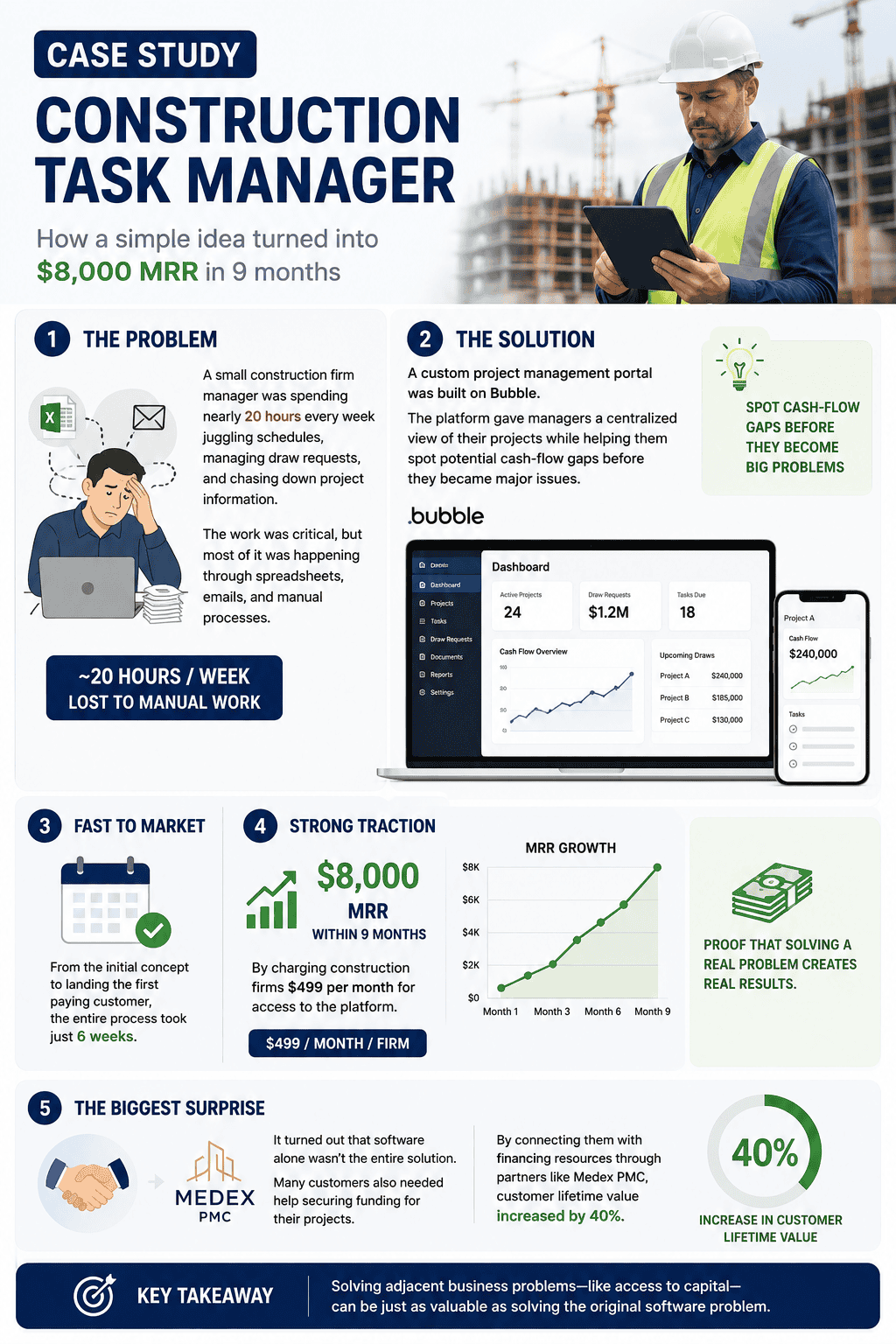
The idea started with a simple observation: a small construction firm manager was spending nearly 20 hours every week juggling schedules, managing draw requests, and chasing down project information. The work was critical, but most of it was happening through spreadsheets, emails, and manual processes.
To solve the problem, a custom project management portal was built on Bubble. The platform gave managers a centralized view of their projects while helping them spot potential cash-flow gaps before they became major issues.
From the initial concept to landing the first paying customer, the entire process took just six weeks.
Within nine months, the business grew to $8,000 in monthly recurring revenue by charging construction firms $499 per month for access to the platform.
One of the biggest surprises came after launch. It turned out that software alone wasn’t the entire solution. Many customers also needed help securing funding for their projects. By connecting them with financing resources through partners like Medex PMC, customer lifetime value increased by 40%, proving that solving adjacent business problems can be just as valuable as solving the original software problem.
Challenges & Solutions
| Challenge | Cause | Solution |
|---|---|---|
| Customer Acquisition | Trust issues for new tools | Focus on direct sales to niche groups |
| Feature Creep | Trying to serve everyone | Strict adherence to the core niche |
| Churn | Poor user experience | Invest in heavy onboarding and education |
30-Day Action Plan Vertical SaaS Businesses
| Week | Focus | Key Actions |
|---|---|---|
| 1 | Research | Identify 3 industries over-reliant on Excel |
| 2 | Outreach | Interview 10 potential users in the niche |
| 3 | Prototype | Build the landing page and core workflow MVP |
| 4 | Launch | Secure your first two beta testers |
Expert Insights: What Most Guides Don’t Tell You
The real secret in 2026 isn’t just software; it’s ecosystem integration. If your SaaS helps an investor manage their portfolio, don’t just stop at tracking. Connect your users to the capital they need to grow. By acting as the bridge to specialized funding networks—such as the relationships Medex PMC maintains—your software transitions from a “cost” into a “wealth-building partner.” This shifts your positioning from a commodity to an essential part of the business stack.
Vertical SaaS Businesses Scaling Strategy
Automation: Make onboarding as hands-off as possible by using personalized video walkthroughs. New users should quickly understand how your platform works without needing a live demo every time.
Outsourcing: As support requests start coming in, don’t spend all your time answering routine questions. Use trained virtual assistants to handle common customer support tickets so your team can stay focused on growth and product development.
Partnerships: Look for strategic partnerships with funding providers and capital firms. Giving your users access to financing and funding resources can make your platform significantly more valuable and create an additional competitive advantage.
Analytics: One of the most important metrics to track is “time-to-first-value”—how long it takes a new user to experience a meaningful benefit from your product. The faster users get value, the more likely they are to stick around, become customers, and recommend your platform to others.
FAQ
- What is vertical SaaS? A platform designed for a specific industry or niche.
- Do I need to know how to code? No, using tools like Bubble is sufficient for 2026.
- How much should I charge? Charge based on the value/ROI, not your costs.
- How do I get first customers? Direct outreach via LinkedIn is the standard for B2B.
- Is it too late to start? No, the shift to vertical tools is just beginning.
- What is embedded finance? Integrating payment and lending directly into your UI.
- How do I validate a niche? If people are buying spreadsheets to solve it, it’s a gap.
- What happens if software breaks? Maintain a robust backend database, don’t over-rely on Zapier.
- Can I outsource the dev? Yes, but define the “logic” yourself first.
- What is the biggest overhead? Customer acquisition and cloud hosting costs.
- Should I have a free tier? Avoid it; freemium usually yields bad customers.
Conclusion
The biggest opportunities in SaaS over the next decade won’t come from building another generic CRM, project management tool, or marketing platform. They’ll come from deeply understanding one industry and creating software that solves its most painful problems better than anyone else.
That’s the power of vertical SaaS.
Instead of competing against thousands of software companies for every type of customer, you focus on a specific niche, learn its workflows inside and out, and become the operating system that runs that business. The result is often higher customer retention, stronger pricing power, and a product that becomes increasingly difficult to replace. Industry-focused software also creates opportunities to expand into payments, financing, insurance, and other financial services that can dramatically increase revenue per customer. (Forbes)
The key is to start simple. Find an industry that still relies on spreadsheets and manual processes. Talk to the people doing the work. Build a solution that saves them time, eliminates frustration, or helps them make more money. Then continue expanding your platform around the workflows that matter most.
The future belongs to founders who stop trying to serve everyone and start solving everything for someone.
If you’re looking for your next SaaS opportunity, don’t ask, “What software should I build?” Instead ask, “Which industry is still operating like it’s 2010?” The answer could be your next million-dollar business.
Vertical SaaS Businesses: Why the Biggest Software Opportunities in 2026 Are Hiding in Plain Sight
A construction manager spends nearly 20 hours every week updating spreadsheets, chasing draw requests, coordinating subcontractors, and searching through email chains for project information.
That’s more than 1,000 hours every year spent on administrative work instead of growing the business.
Most SaaS founders look at this problem and think:
“There should be an app for that.”
The smartest founders see something else:
A business opportunity.
While thousands of entrepreneurs are busy building the next AI-powered CRM or trying to compete with Salesforce, HubSpot, and Monday.com, an entirely different market is quietly generating billion-dollar companies.
It’s called vertical SaaS.
Instead of building software for everyone, vertical SaaS companies focus on one specific industry and solve nearly every operational problem that industry faces.
The result?
- Higher customer retention
- Less competition
- Better pricing power
- More opportunities for recurring revenue
Companies like Procore (construction), Toast (restaurants), ServiceTitan (home services), and Mindbody (fitness businesses) didn’t become industry leaders by serving everyone. They became dominant because they deeply understood a single market and built software around the way those businesses actually operate.
In 2026, this opportunity is bigger than ever.
Small business owners are suffering from what many call the “fragmentation tax”—the hidden cost of switching between five different tools just to run one business.
One platform for invoicing.
Another for project management.
Another for customer relationships.
Another for reporting.
Another for payments.
Every tool solves part of the problem.
None solve the entire workflow.
That’s where vertical SaaS wins.
The founders creating the most valuable software companies today aren’t asking:
“What software should I build?”
They’re asking:
“Which industry is still operating like it’s 2010?”
The answer to that question may be your next million-dollar business.
Why Most SaaS Founders Fail
Most SaaS founders don’t fail because they can’t build software.
They fail because they build software nobody urgently needs.
A common pattern looks like this:
A founder notices a feature missing from an existing product, spends six months building a “better” version, launches it, gets a few signups, and then watches growth stall.
The problem isn’t the product.
The problem is the market.
When you’re building horizontal SaaS, you’re competing against companies with massive budgets, established brands, and years of market dominance.
Even if your software is technically better, convincing customers to switch is incredibly difficult.
Think about replacing:
- Salesforce
- HubSpot
- Monday.com
- Asana
- QuickBooks
You’re not just competing against software.
You’re competing against habits.
That’s why so many founders spend months building products nobody adopts.
Why Vertical SaaS Wins
Vertical SaaS focuses on solving the complete workflow for a specific industry rather than solving a single problem for everyone.
Instead of building a generic project management tool for every business on earth, you build the operating system for construction companies.
Instead of creating another CRM, you build the platform property managers use to run their entire portfolio.
Horizontal SaaS vs Vertical SaaS
| Horizontal SaaS | Vertical SaaS |
|---|---|
| Serves everyone | Serves one industry |
| Massive competition | Limited competition |
| Generic workflows | Industry-specific workflows |
| Lower switching costs | Higher switching costs |
| Price-sensitive customers | Value-based pricing |
| Harder to retain users | Higher retention rates |
When your software becomes deeply integrated into daily operations, replacing it becomes painful.
That’s exactly what you want.
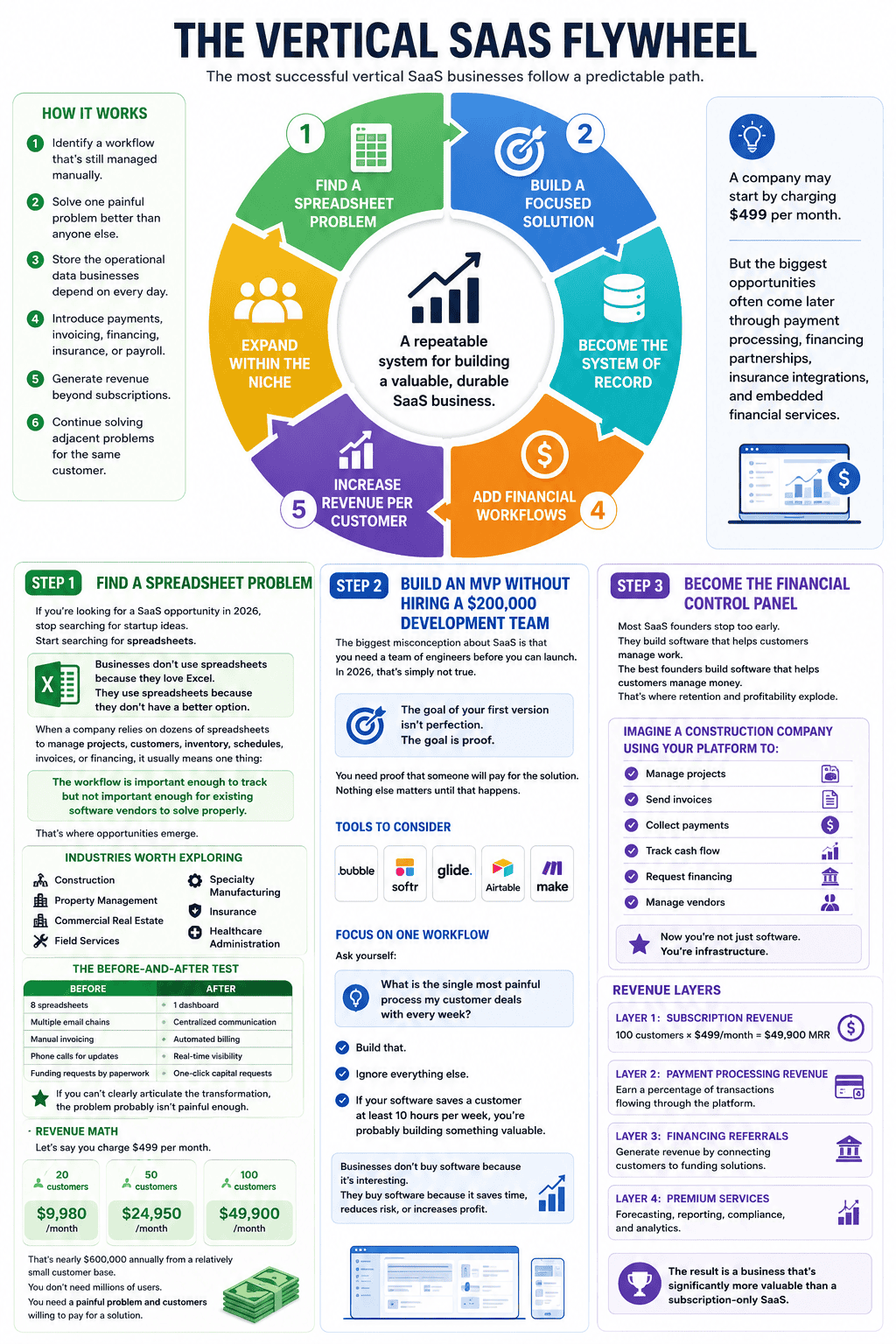
The Vertical SaaS Flywheel
The most successful vertical SaaS businesses follow a predictable path.
1. Find a Spreadsheet Problem
Identify a workflow that’s still managed manually.
2. Build a Focused Solution
Solve one painful problem better than anyone else.
3. Become the System of Record
Store the operational data businesses depend on every day.
4. Add Financial Workflows
Introduce payments, invoicing, financing, insurance, or payroll.
5. Increase Revenue Per Customer
Generate revenue beyond subscriptions.
6. Expand Within the Niche
Continue solving adjacent problems for the same customer.
A company may start by charging $499 per month.
But the biggest opportunities often come later through payment processing, financing partnerships, insurance integrations, and embedded financial services.
Step 1: Find a Spreadsheet Problem
If you’re looking for a SaaS opportunity in 2026, stop searching for startup ideas.
Start searching for spreadsheets.
Businesses don’t use spreadsheets because they love Excel.
They use spreadsheets because they don’t have a better option.
When a company relies on dozens of spreadsheets to manage projects, customers, inventory, schedules, invoices, or financing, it usually means one thing:
The workflow is important enough to track but not important enough for existing software vendors to solve properly.
That’s where opportunities emerge.
Industries Worth Exploring
- Construction
- Property Management
- Commercial Real Estate
- Field Services
- Specialty Manufacturing
- Insurance
- Healthcare Administration
The Before-and-After Test
| Before | After |
|---|---|
| 8 spreadsheets | 1 dashboard |
| Multiple email chains | Centralized communication |
| Manual invoicing | Automated billing |
| Phone calls for updates | Real-time visibility |
| Funding requests by paperwork | One-click capital requests |
If you can’t clearly articulate the transformation, the problem probably isn’t painful enough.
Revenue Math
Let’s say you charge $499 per month.
20 customers = $9,980/month
50 customers = $24,950/month
100 customers = $49,900/month
That’s nearly $600,000 annually from a relatively small customer base.
You don’t need millions of users.
You need a painful problem and customers willing to pay for a solution.
Step 2: Build an MVP Without Hiring a $200,000 Development Team
The biggest misconception about SaaS is that you need a team of engineers before you can launch.
In 2026, that’s simply not true.
The goal of your first version isn’t perfection.
The goal is proof.
You need proof that someone will pay for the solution.
Nothing else matters until that happens.
Tools to Consider
- Bubble
- Softr
- Glide
- Airtable
- Make
Focus on One Workflow
Ask yourself:
What is the single most painful process my customer deals with every week?
Build that.
Ignore everything else.
If your software saves a customer at least 10 hours per week, you’re probably building something valuable.
Businesses don’t buy software because it’s interesting.
They buy software because it saves time, reduces risk, or increases profit.
Step 3: Become the Financial Control Panel
Most SaaS founders stop too early.
They build software that helps customers manage work.
The best founders build software that helps customers manage money.
That’s where retention and profitability explode.
Imagine a construction company using your platform to:
- Manage projects
- Send invoices
- Collect payments
- Track cash flow
- Request financing
- Manage vendors
Now you’re not just software.
You’re infrastructure.
Revenue Layers
Layer 1: Subscription Revenue
100 customers × $499/month = $49,900 MRR
Layer 2: Payment Processing Revenue
Earn a percentage of transactions flowing through the platform.
Layer 3: Financing Referrals
Generate revenue by connecting customers to funding solutions.
Layer 4: Premium Services
Forecasting, reporting, compliance, and analytics.
The result is a business that’s significantly more valuable than a subscription-only SaaS.
Case Study: Construction Task Manager
The idea started with a simple observation.
A construction firm manager was spending nearly 20 hours every week juggling project schedules, draw requests, subcontractor coordination, and cash-flow tracking.
The work was critical.
The process was a mess.
Using Bubble, a simple project management portal was built that centralized project information and highlighted potential cash-flow gaps before they became major issues.
Results:
- 6 weeks from idea to first paying customer
- $499 monthly subscription pricing
- $8,000 monthly recurring revenue within 9 months
The biggest surprise came after launch.
Customers didn’t just need better project management.
They needed better access to capital.
That insight opened the door to financing integrations and funding partnerships, dramatically increasing customer value and retention.
The lesson?
The most valuable opportunities often appear after your first customers start using the product.